Quick Summary
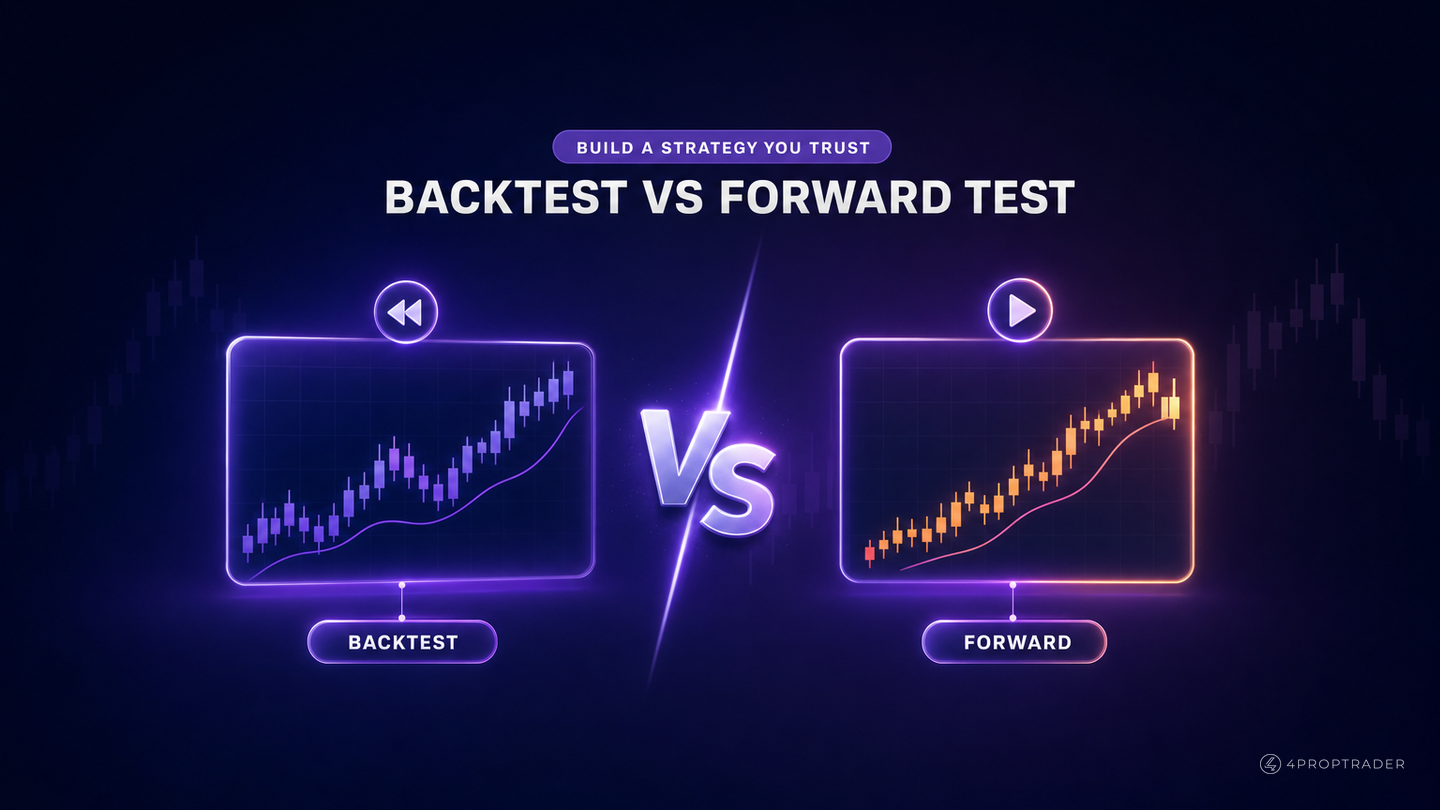
Backtesting and forward testing are the two primary methods traders use to validate a trading strategy before risking real money in the live market. Backtesting applies a strategy to historical data to evaluate how it would have performed in the past. Forward testing — also known as paper trading — applies the same strategy to current market conditions in real time, without financial risk. Both methods serve a distinct purpose, and using both together gives a trader the most complete picture of a strategy's viability and effectiveness.
This article explains what each method involves, the key differences between them, how to use both properly, and why every serious trader should complete this process before they transition to live trading or attempt a prop firm challenge.
Introduction
Most traders are eager to trade. They identify a setup, build a system, and want to get into the live market as quickly as possible. What separates consistently profitable traders from those who blow up early is the discipline to test before they trade — and to test properly.
Backtesting and forward testing are not optional extras for advanced traders. They are the foundational steps in creating a strategy that works under real conditions. A trading strategy that has never been validated against historical data or tested in a live market environment is not a strategy — it is an idea. And ideas alone are not enough when real money is on the line.
The question of backtesting vs forward testing is not really a competition. Both methods answer different questions and reveal different things about a trading system. Understanding what each one does — and how to use both together — is one of the most valuable skills a trader can develop before they ever execute trades on a live account.
What Is Backtesting?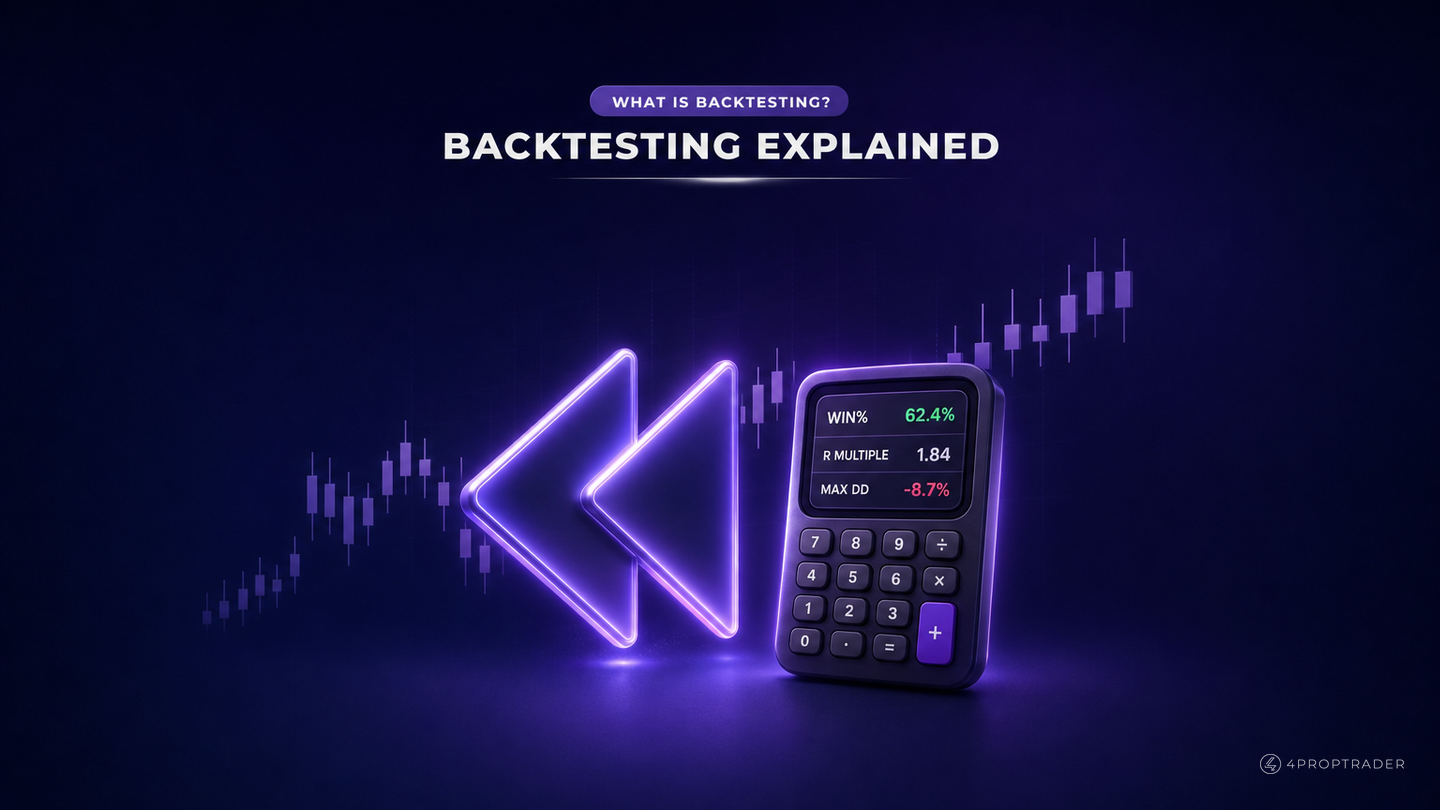
Backtesting is the process of applying a set of trading rules to historical market data to evaluate how a strategy would have performed in the past. The goal is to simulate how a strategy would have generated trades, executed entries and exits, and produced returns across a historical data set — before any real capital is committed to the live market.
When a trader runs a back test, they are essentially asking: "If I had been using this strategy over the past months or years, what would the results have looked like?" The backtesting results provide a statistical picture of the strategy's historical performance — including win rate, average risk and return, maximum drawdown, and consistency across various market conditions.
Backtesting can be done manually — by scrolling through historical charts bar by bar and logging each trade as if it were live — or through dedicated backtesting software that automates the process using coded rules. Platforms such as TradingView offer built-in tools for backtesting strategies directly on historical charts, making it accessible even for traders without programming experience. More advanced backtesting software allows traders to test across multiple instruments, timeframes, and market conditions simultaneously.
What Backtesting Reveals
A properly conducted back test evaluates how a strategy performs across a meaningful sample of historical data. Done correctly, backtesting results should tell a trader:
- The historical win rate of the strategy across the data set
- The average risk and return per trade and overall profitability
- The maximum drawdown experienced during the backtested period
- How the strategy performed across different market conditions — trending, ranging, high volatility, and low volatility
- Whether the entry and exit rules are clear and objective enough to apply consistently
The data for backtesting must be high-quality and representative of the conditions in which the strategy is intended to trade. Using a short or cherry-picked data set produces backtesting results that are misleading — the strategy may appear profitable on the sample but fail in live execution. A robust back test covers multiple market cycles and various market conditions to give a realistic picture of what the strategy can be expected to deliver.
The 5 Steps to Backtest Properly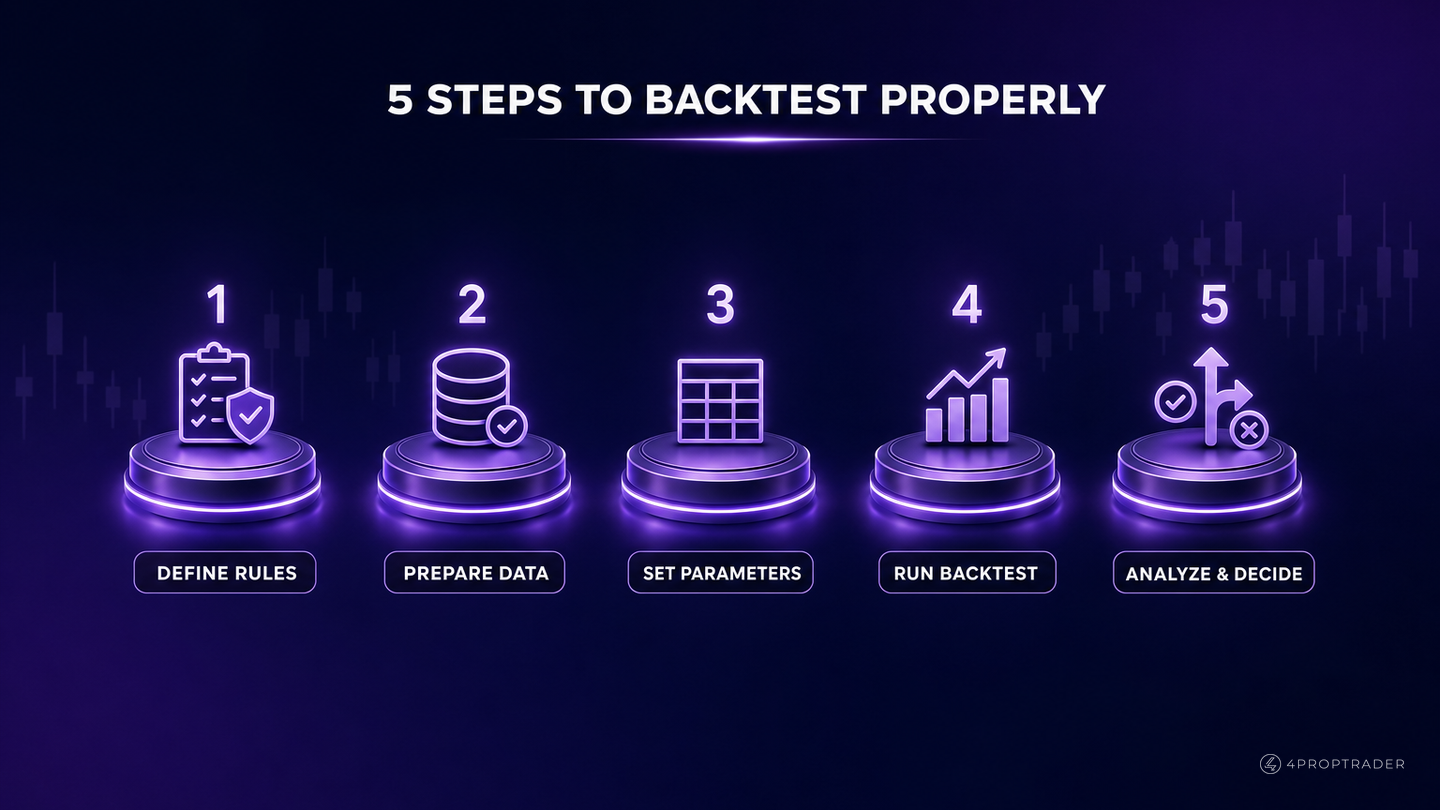
Backtesting without a structured process produces unreliable backtests. Following a disciplined process ensures the results are meaningful and actionable:
Step 1 — Define Rules:
Write down every rule of the trading system in full before you begin. Entry and exit points, stop-loss placement, position size, and trade management rules must all be explicitly defined. Any ambiguity in the rules will produce inconsistent backtests.
Step 2 — Prepare Data:
Gather quality historical market data for the instruments and timeframes you intend to trade. Use historical data that covers a meaningful period — ideally multiple years and different market cycles. The quality of your data for backtesting directly determines the quality of your results.
Step 3 — Set Parameters:
Define the parameters of your backtest — timeframe, instruments, date range, and any filters. Set these before running the test, not after seeing the results. Adjusting parameters after the fact to improve results is a form of curve-fitting that produces a strategy overly optimized for past data rather than future conditions.
Step 4 — Run Backtest:
Execute the backtest using your chosen backtesting software or platform — such as TradingView — or manually bar by bar. Log every simulated trade with the same discipline you would apply in actual trading. Record all entries, exits, size, and outcomes.
Step 5 — Analyze and Decide:
Review your backtest results objectively. Evaluate the strategy's profitability, drawdown, consistency, and performance across various market conditions. Identify areas for improvement. Decide whether the strategy is ready to forward test — or needs refinement before moving forward.
The Limitations of Backtesting
Backtesting is a powerful validation tool, but it has well-documented limitations that every trader must understand before relying on backtesting results alone.
- Hindsight bias: When testing on historical data, it can be tempting to unconsciously use knowledge of what happened next to influence entries and exits — skewing the backtested performance upward.
- Overfitting: A strategy that has been overly optimized for past data may perform exceptionally well on historical data but fail in current market conditions where the variables it was optimised for no longer apply.
- Execution assumptions: Backtests typically assume perfect execution — fills at the exact price, no slippage, and consistent liquidity. In live trading, real-time execution rarely matches these assumptions, particularly in fast-moving or illiquid conditions.
- No behavioural data: Backtesting reveals the mathematical edge of a strategy. It cannot reveal how a trader will behave under live market pressure — whether they will follow the rules, manage their size correctly, or deviate from the plan when real money is on the line.
This last point is critical. The difference between backtesting and forward testing is not just methodological — it is the difference between testing math and testing behaviour. Both matter. Neither alone is sufficient.
What Is Forward Testing?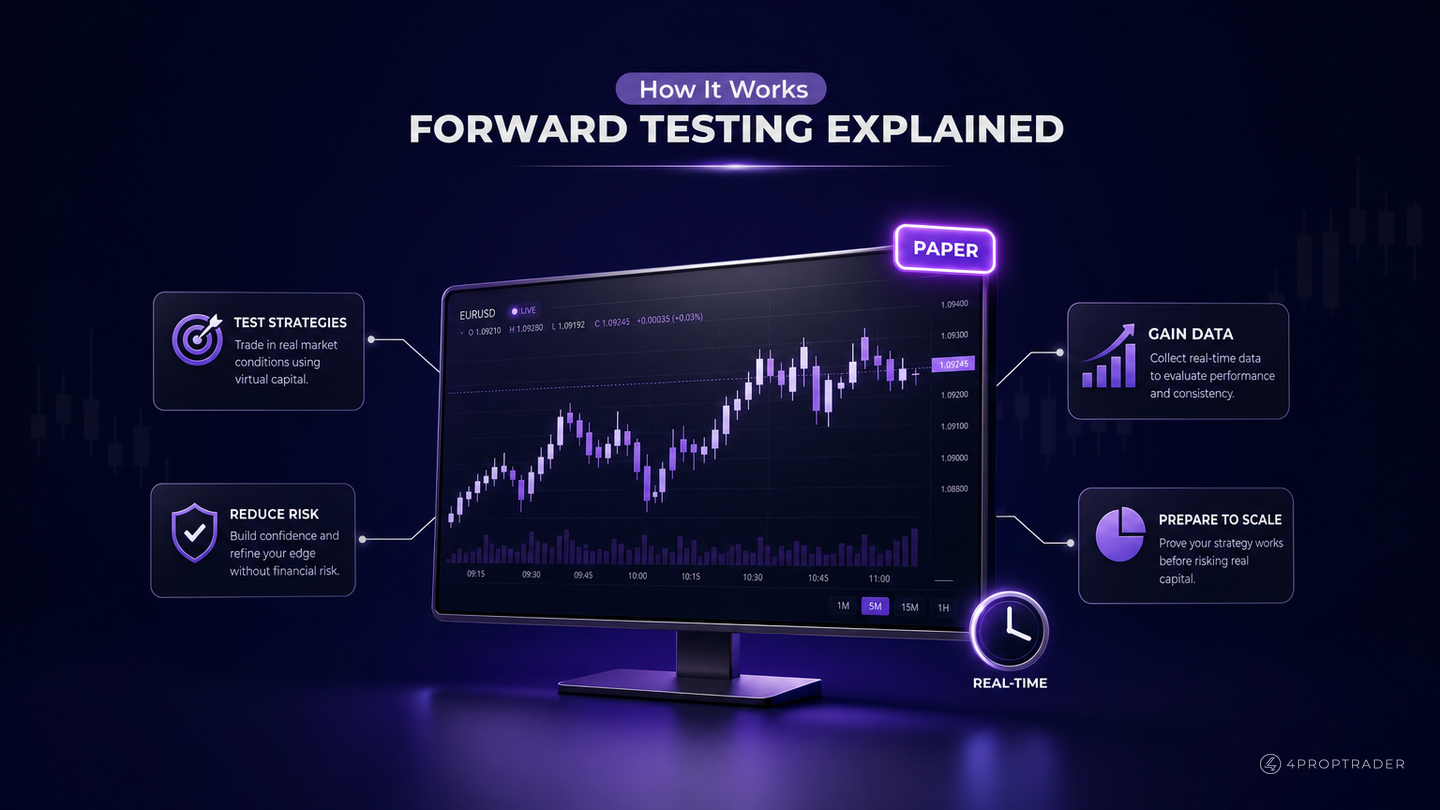
Forward testing — also referred to as paper trading or simulating real trading — is the process of applying a trading strategy to the live market in real time, without risking real capital. Instead of using historical market data, forward testing uses real-time market data and current market conditions to generate trades, which are recorded and evaluated as if they were live.
A forward test can be conducted through a demo account provided by a broker or trading platform, which allows traders to simulate trades using virtual funds in a live market environment. Most brokers and platforms — including forex brokers and futures platforms — offer demo account access with real-time market feeds, making it possible to forward test a strategy under conditions that closely replicate live execution without financial risk.
Forward testing results are particularly valuable because they capture the trader's actual decision-making process in real time. Unlike a back test, where every trade is already known to have concluded, a forward test requires the trader to execute trades as if real money were at stake — experiencing the psychological reality of live market conditions without the financial consequences.
What Forward Testing Reveals
Where backtesting reveals historical mathematical performance, forward testing reveals something different and equally important: how the strategy actually behaves when applied to the current market by a real trader in real time.
Forward testing results should tell a trader:
- Whether the strategy's entry and exit rules are executable in real-time market conditions, not just on historical charts
- How the trader actually behaves when following the system under live market pressure
- Whether the strategy's performance holds up in current market conditions that may differ from the historical data set
- How live execution factors — including spreads, broker fills, and real-time liquidity — affect the strategy's practical results
- Whether the trader's trading plan, risk management rules, and position size discipline hold up under realistic conditions
Paper trading through a demo account also allows traders to refine their strategy without financial risk — identifying areas for improvement in execution, entry, and exit timing, and trade management before committing real capital to a live account.
Backtesting vs Forward Testing: The Differences That Matter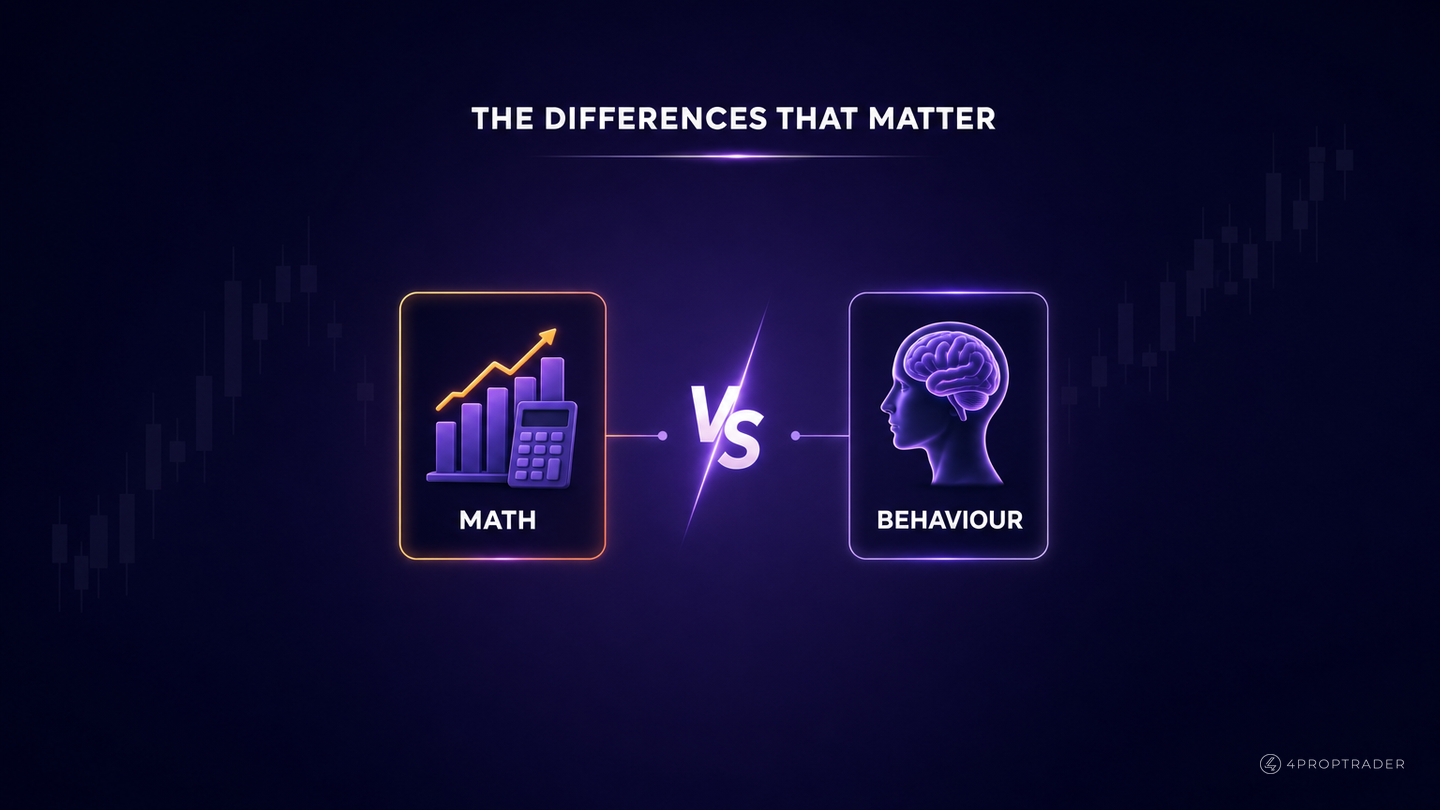
The core difference between backtesting and forward testing is what each method tests. As illustrated clearly by the Math vs Behaviour framework, backtesting tests the mathematical logic of a trading system against historical data, while forward testing tests the trader's ability to execute that system in a live market environment.
|
|
|
|
|
|
|
|
|
|
|
|
|
|
|
|
|
|
|
|
|
|
|
|
Neither backtesting nor forward testing alone is sufficient to validate a trading strategy fully. A strategy with strong backtesting results but poor forward testing results typically indicates one of two things: the strategy was overly optimized for past data and does not hold up in current market conditions, or the trader is struggling to execute the rules consistently under real market pressure. Both are problems that must be identified and addressed before transition to live trading.
A strategy with weak backtesting results should not reach the forward testing stage at all. The back test is the filter — it eliminates strategies that have no historical edge before time, and focus is invested in forward testing them in the live market.
How to Use Backtesting and Forward Testing Together
The most effective approach to strategy validation combines backtesting and forward testing in sequence. This is the process that professional traders and funded traders use to create a strategy they can trust — one backed by both historical evidence and real-time validation.
The recommended sequence is:
- Step 1: Create a strategy with clearly defined entry and exit points, size rules, and risk management parameters
- Step 2: Run backtests on quality historical market data across various market conditions — aiming for a meaningful sample size of at least 100 trades where possible
- Step 3: Evaluate the backtesting results objectively. If the results show acceptable profitability, consistent drawdown, and performance across different market conditions, proceed to forward testing
- Step 4: Open a demo account with your broker or trading platform and begin forward testing the strategy under live market conditions. Log every trade in a trading journal with the same discipline as live trading
- Step 5: Evaluate the forward testing results against the backtesting results. Are they consistent? If the forward test results match the backtests within a reasonable range, the strategy is ready to be considered for live execution
- Step 6: If there are significant gaps between the backtesting and forward testing results, use the trading journal to identify the source. Refine your strategy if needed and repeat the forward testing phase before committing real capital
Using backtesting and forward testing together eliminates the two most common causes of strategy failure: deploying a system with no historical edge, and deploying a system the trader cannot actually execute consistently in a live market environment. Reviewing both sets of data — backtesting and forward testing results — gives a trader the most complete picture of what the strategy is capable of and where it still needs work.
Paper Trading and Demo Accounts: Forward Testing in Practice
Paper trading through a demo account is the most accessible form of forward testing available to retail traders. Most brokers — including forex brokers and futures platforms — offer demo accounts with live market feeds that allow traders to simulate trades in real-time market conditions without risking real money.
A demo account provides access to a real-time market environment including live spreads, actual price feeds, and realistic execution conditions. By using real-time data rather than historical snapshots, forward testing exposes the strategy to the same dynamic conditions — including liquidity, slippage, and current market conditions — that a live trading account would encounter. This makes it a far more reliable test of live execution than backtesting on historical data alone.
The key discipline when paper trading is to treat the demo account as if it were a live account. This means:
- Trading the same size you would use in a real trading account
- Following your trading plan and risk management rules without exception
- Logging every trade in your trading journal — entry and exit, size, rationale, and result
- Not restarting or resetting the demo account when results are poor — that is not how a live account works
The discipline with which you paper trade determines how useful the forward testing results are. A trader who deviates from their rules on a demo account, or who takes shortcuts that they would not take with real money on the line, will not generate forward testing results that accurately predict their live trading performance.
Backtesting, Forward Testing, and the Prop Firm Challenge
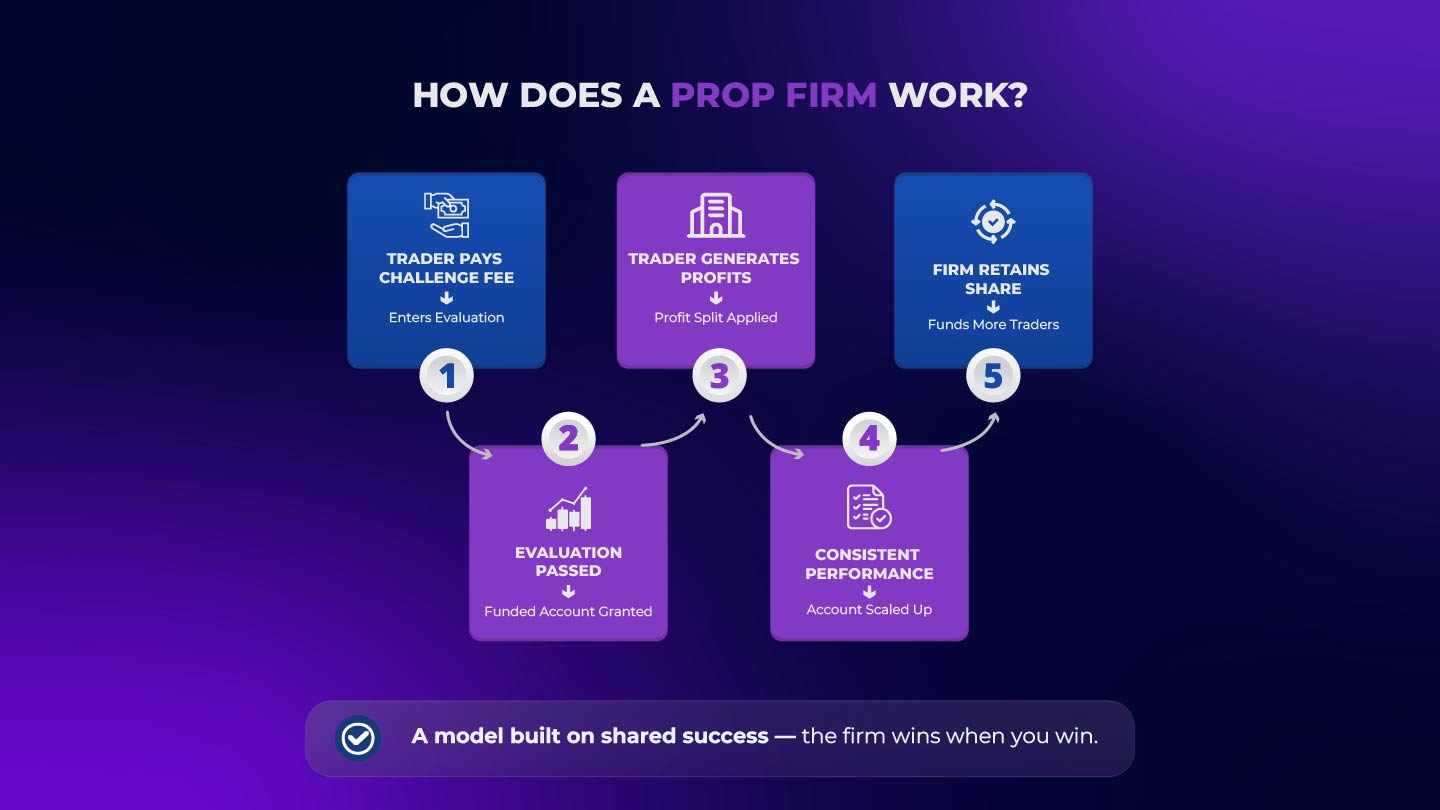
For traders preparing for a 4PropTrader evaluation challenge, the backtesting and forward testing process is not just recommended — it is the foundation of a credible challenge preparation. A prop firm challenge is essentially the most consequential forward test a trader can undertake: real-time market conditions, real rules, and a funded account on the line.
Traders who enter a prop firm challenge without first completing a proper backtesting and forward testing cycle are, in effect, using the evaluation itself as their forward test — with real consequences for failure. This is one of the most common reasons traders fail prop firm evaluations: they have an idea for a strategy but have not validated it rigorously against historical data or tested it without risking real money first.
The recommended approach is to complete the full backtesting and forward testing cycle before attempting a challenge:
- Run backtests on your strategy across historical market data covering multiple market conditions
- Forward test the strategy on a demo account or in a live market environment without financial risk for a meaningful period, at least several weeks of trading in current market conditions
- Compare the backtesting and forward testing results. If both validate the strategy's viability and effectiveness, you are ready to consider the prop firm evaluation as the next step
Entering a challenge with a strategy that has been through both phases of testing gives you a genuine edge: you know the strategy works on historical data, you know you can execute it in a live market environment, and you have the trading journal evidence to demonstrate consistency. That is the foundation of a trader who is ready to trade with real capital on behalf of a prop firm.
Frequently Asked Questions
What is the difference between backtesting and forward testing?
Backtesting applies a trading strategy to historical market data to evaluate past performance. Forward testing applies the same strategy to current market conditions in real time — typically through a demo account or paper trading — without financial risk. Backtesting tests mathematical edge; forward testing tests real-time execution and trader behaviour.
Can I use TradingView for backtesting?
Yes. TradingView offers built-in backtesting tools that allow traders to test strategies directly on historical charts using Pine Script or manual bar-by-bar review. It is one of the most widely used platforms for retail traders' backtesting, particularly for forex, indices, and equity strategies.
How long should I forward test before going live?
There is no fixed rule, but a meaningful forward test should cover enough trades to produce statistically relevant forward testing results — typically a minimum of 30 to 50 trades across different market conditions. For most traders, this means several weeks to a couple of months of paper trading before considering transition to a live account.
Is paper trading the same as forward testing?
Yes. Paper trading is the most common form of forward testing for retail traders. It involves using a demo account to simulate trades in real-time market conditions without risking real money. The terms are used interchangeably, and both describe the process of trading a strategy in the live market without actual financial risk.
What should I do if my forward testing results are worse than my backtesting results?
A gap between backtesting and forward testing results is common and informative. First, review your trading journal to identify where execution diverged from the backtested rules. Common causes include emotional decisions in live conditions, slippage and liquidity differences, and strategy rules that were too subjective to apply consistently in real time. Use the findings to refine your strategy before attempting to transition to a live account or prop firm challenge.
Do I need both backtesting and forward testing?
Yes. Backtesting alone cannot tell you whether you can execute the strategy consistently in a live market. Forward testing alone — without the historical validation of a backtest — risks wasting time on a strategy with no genuine edge. Combining backtesting and forward testing gives you the most complete picture of both the strategy's mathematical viability and your ability to trade it in practice.
Final Thoughts
Backtesting vs forward testing is not a debate about which method is superior. Both are essential, and they serve fundamentally different purposes. Backtesting validates the mathematical logic of a trading strategy against historical data. Forward testing validates the trader's ability to execute that strategy in the live market — without the comfort of knowing how every candle closes.
Together, backtesting and forward testing form the most rigorous validation process available to a retail or funded trader. They are the difference between entering the market with a tested edge and entering with nothing more than confidence — and in trading, confidence without evidence is one of the most expensive assumptions a trader can make.
Run the backtests. Paper trade the strategy. Review both sets of results. Refine your strategy where necessary. Only then consider committing real capital — whether to a personal live account or to a prop firm evaluation challenge. The traders who take this process seriously are the ones who build trading strategies they can actually trust when real money is on the line.
Ready to put a fully tested strategy into practice in a funded environment? Explore the trading challenges available at 4PropTrader, with transparent rules, clear risk parameters, and a structured pathway to funded trading.