Quick Summary
The best time to trade futures is during periods of high liquidity and trading volume — when major exchange sessions overlap, around key data releases, and during the opening and closing windows of the regular trading hours. Futures contracts trade nearly 24 hours a day on the CME Globex platform, but not all times of day offer the same conditions. Understanding when volume and volatility peak is essential for identifying the setups most likely to produce clean, high-quality price movement.
This article breaks down the best times to trade across 4PropTrader's approved futures instruments on the CME, CBOT, NYMEX, and COMEX exchanges — with all times referenced in Central European Time (CET). Whether you are a day trader working around the New York open or a swing trader assessing different sessions across global markets, this guide explains the trading hours that matter most.
Introduction
Futures trade nearly around the clock on the CME Globex electronic trading platform. Most futures contracts are available to trade nearly 24 hours a day — specifically 23 hours a day with a one-hour maintenance break — from Sunday evening through to Friday afternoon. This near-continuous access is one of the defining advantages of futures trading compared to equity markets, which operate on fixed regular trading hours.
However, the fact that futures trade almost around the clock does not mean that every hour presents an equal opportunity. The futures market experiences dramatic variation in trading volume, volatility, and price action depending on the time of day. Certain times of day are characterised by low participation, wide spreads, and choppy price movement. Other windows bring concentrated institutional activity, strong directional trends, and the kind of volume and price movement that makes setups genuinely tradeable.
Identifying the best time to trade futures is not about chasing volatility for its own sake — it is about aligning your trading activity with the times of day when market structure supports your trading strategy. This guide walks through the major global trading sessions, the session overlaps, and the optimal trading hours for each of 4PropTrader's approved instrument groups. Trading involves substantial risk, and choosing the right time to trade is one of the factors within a trader's control.
Why Trading Hours Matter in the Futures Market
Liquidity in the futures market is not evenly distributed across the trading day. Trading volume and volatility are driven by the active participation of institutional traders, commercial hedgers, and large-scale market participants — and their activity clusters around specific windows tied to the open and close of major global markets and scheduled economic data releases.
Trading outside these windows — during low-volume, off-peak hours — carries specific risks for day traders and active futures traders:
- Wider spreads, which increase the cost of every futures trade
- Choppy, low-conviction price action that does not respect technical levels
- Reduced liquidity, which increases slippage risk on stop-losses and market orders
- Poor follow-through on breakouts, as fewer participants are present to sustain directional price movement
During high-volume trading hours, by contrast, spreads tighten, price action becomes more directional, and futures contracts on the CME and other exchanges behave more predictably around key levels. This is why understanding the best time to trade futures is a foundational element of any serious trading strategy — not an afterthought.
The Three Major Global Trading Sessions
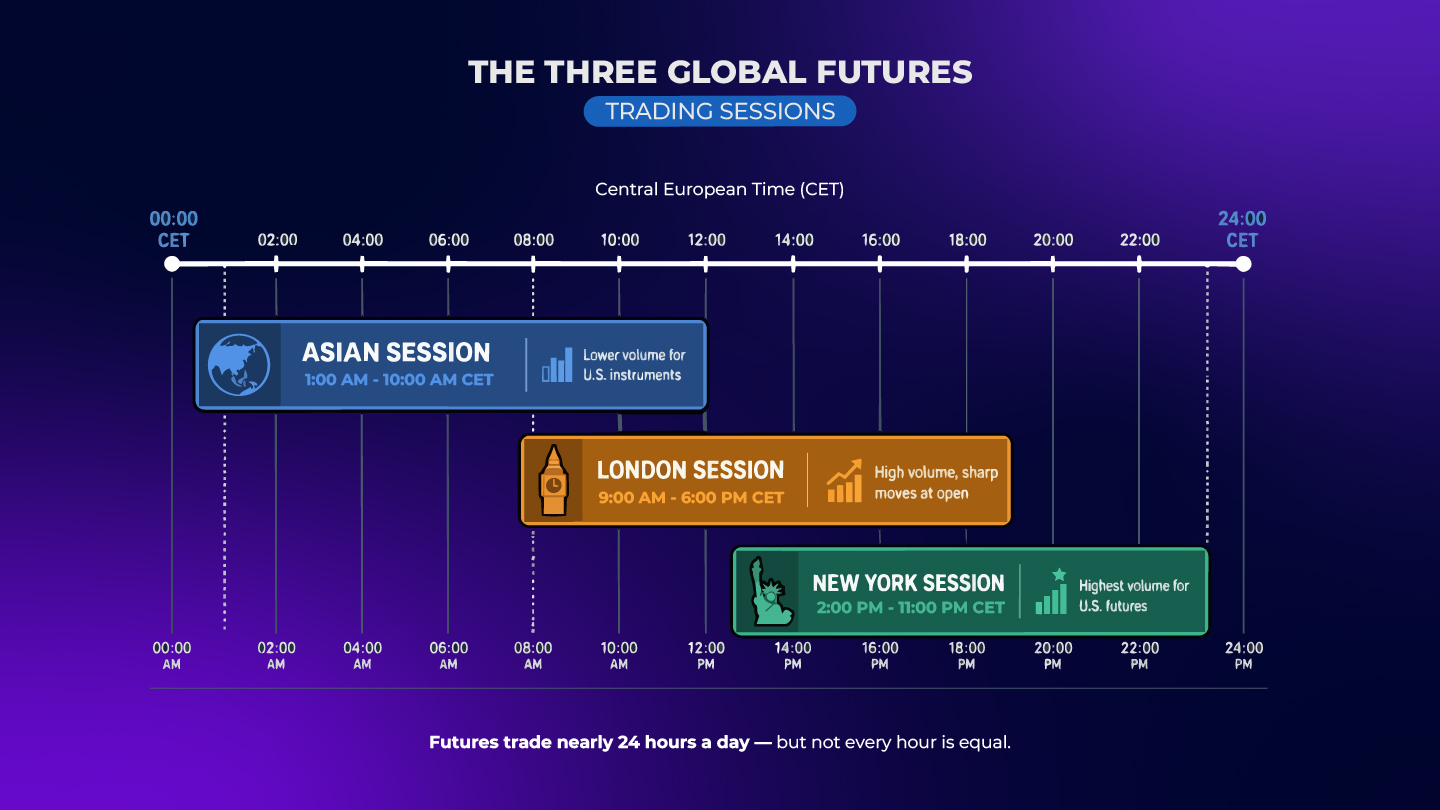
The futures market is shaped by three major global trading sessions, each corresponding to a different financial centre. These sessions define the rhythm of trading activity across the day and are the starting point for understanding optimal trading hours. All times below are in CET.
The Asian Session
The Asian session runs from approximately 1:00 AM to 10:00 AM CET, anchored by Tokyo and extending through Hong Kong and Singapore. For traders focused on U.S.-listed futures products — such as equity index futures on the CME or energy futures on NYMEX — the Asian session generally sees lower trading volume and narrower ranges.
The Asian session is more relevant for futures and forex pairs with direct Asian market exposure, and for COMEX metals futures (MGC, GC, SI, MHG, HG, PL, PA), which can see activity during this window tied to Asian physical demand. For most day traders using 4PropTrader's approved instruments, however, the Asian session is not the primary focus — it is more commonly used for analysis and preparation than for active trade execution.
The London Session
The London session opens at approximately 9:00 AM CET and runs to around 6:00 PM CET, coinciding with European market hours. London remains one of the most significant financial centres globally, and the London session, which opens at 9:00 AM CET, consistently introduces a surge in trading activity across multiple asset classes.
For European traders and traders based in CET time zones, the London session opening is one of the most important trading hours of the day. COMEX metals futures — including Gold (GC, MGC) and Silver (SI) — and CBOT agricultural and rate futures (ZC, ZW, ZS, ZR, ZO, YM, MYM) see notable activity during London hours as European institutional participants establish positions.
The New York Session
The New York session runs from approximately 2:00 PM to 11:00 PM CET and is the most significant trading session for the majority of 4PropTrader's approved futures products. This session drives the highest trading volume and volatility across equity index futures, energy futures, interest rate futures, and metals futures traded on the CME, CBOT, NYMEX, and COMEX exchanges.
The market opening of the New York Stock Exchange at 3:30 PM CET is particularly significant. This is when equity futures — including the E-mini S&P 500 futures (ES, MES), Nasdaq futures (NQ, MNQ), and Dow Jones futures (YM, MYM) — experience their highest trading volume and most concentrated price action of the entire trading day.
The London-New York Overlap: The Most Active Window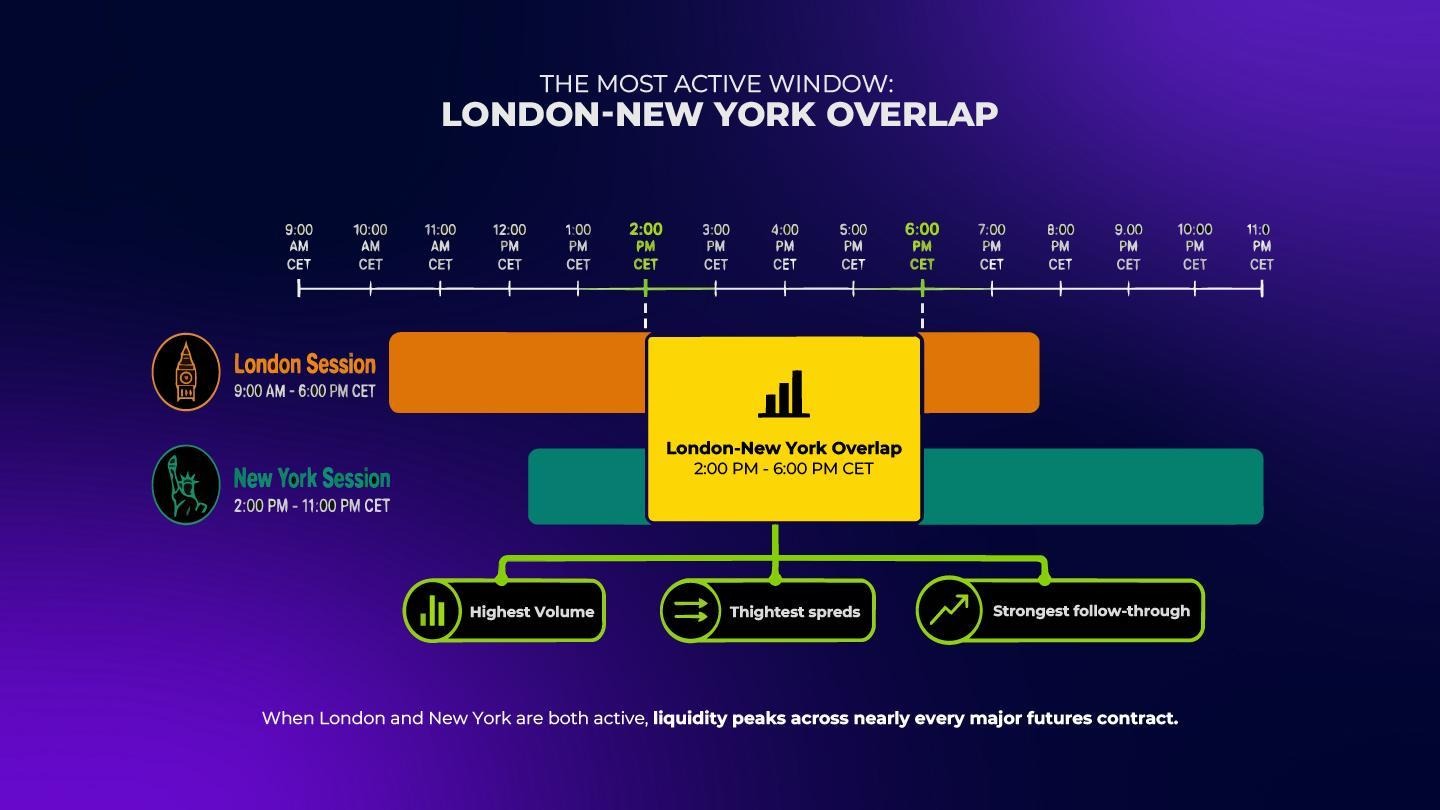
The single most consistently active period across the futures market is the overlap between the London and New York sessions, which runs from approximately 2:00 PM to 6:00 PM CET. This is the optimal trading hours window for the majority of day traders and active futures traders across nearly all instrument groups.
London-New York Overlap (CET): 2:00 PM - 6:00 PM
Characteristics:
- Highest combined trading volume of the trading day
- Tightest spreads across major futures contracts
- Strongest directional price movement and follow-through
- Most reliable price action around key technical levels
- Peak activity window for CME equity index futures (ES, MES, NQ, MNQ, YM)
During this overlap window, both European and U.S. institutional participants are active simultaneously, creating the high volume and liquidity conditions that futures traders depend on for clean execution. For traders using a trading platform connected to CME Globex, this window consistently produces the best conditions for executing a defined trading strategy.
Many professional day traders and active futures traders structure their entire trading schedule around this four-hour window, treating the hours outside of it as secondary for active trade decisions. If you consider trading only during one window per day, the London-New York overlap is the most justified choice across the widest range of futures products.
Best Trading Hours by Approved Instrument Group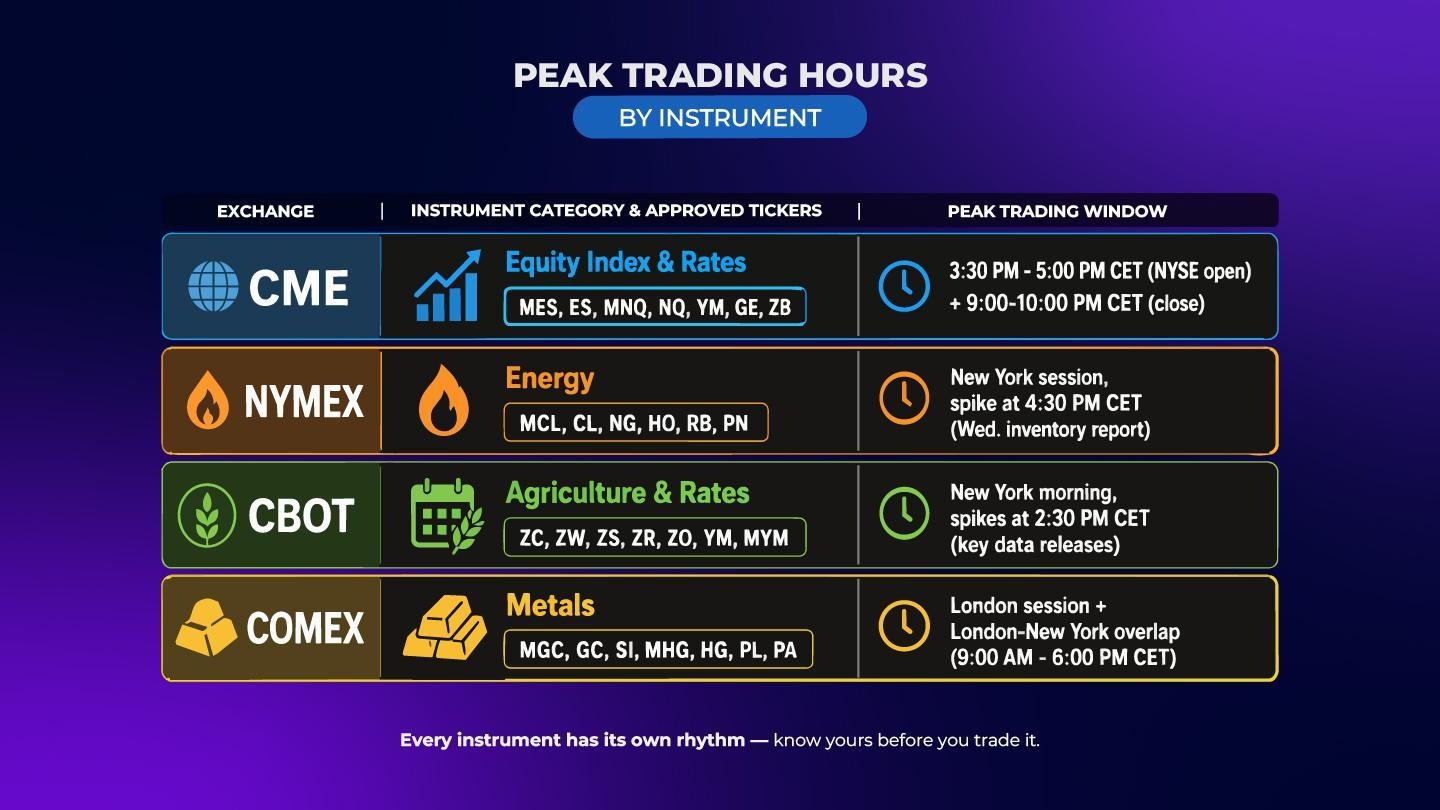
While the London-New York overlap is broadly the best time to trade futures across most markets, each of 4PropTrader's approved instrument groups has its own characteristic peak hours based on the nature of the underlying market. All times are in CET.
CME — Equity Index Futures (MES, ES, MNQ, NQ, YM, GE, ZB)
CME equity index futures are among the most actively traded futures contracts in the world. The E-mini S&P 500 futures (ES) and its micro counterpart (MES), along with the Nasdaq futures (NQ, MNQ) and Dow Jones indices futures (YM), reach peak trading volume and volatility during two specific windows:
- Primary window: 3:30 PM - 5:00 PM CET (NYSE market open — consistently the highest volume and price movement period of the trading day)
- Secondary window: 9:00 PM - 10:00 PM CET (NYSE market close — institutional position adjustments create a second period of elevated activity)
The S&P 500 futures open at the NYSE market open is one of the most-watched moments in the entire futures market. Day traders focused on equity index futures typically consider this the prime window for executing their trading strategy, given the combination of high volume, tight spreads, and strong directional price movement available at this time of day.
NYMEX — Energy Futures (MCL, CL, NG, HO, RB, PN)
NYMEX energy futures — including Crude Oil (CL, MCL), Natural Gas (NG), Heating Oil (HO), and RBOB Gasoline (RB) — see their peak trading activity during the New York session, with the highest trading volume concentrated around the following windows:
- New York morning open: 2:00 PM - 4:00 PM CET (particularly active at the start of the New York session)
- Weekly inventory report: 4:30 PM CET every Wednesday — the EIA crude oil inventory data release is one of the most market-moving news events for crude oil futures, frequently producing sharp, fast price movement in both CL and MCL
Crude oil futures are among the most volatile futures products available, and the inventory report window requires particular attention to risk management. Day traders in crude oil futures should treat these data releases as high-alert trading moments — with potential for significant opportunity and elevated risk simultaneously.
CBOT — Agriculture and Rate Futures (ZC, ZW, ZS, ZR, ZO, YM, MYM)
CBOT futures cover agricultural products — Corn (ZC), Wheat (ZW), Soybeans (ZS), Rice (ZR), and Oats (ZO) — as well as Dow Jones futures (YM, MYM). Agricultural futures see their most active trading during the U.S. morning session, with peaks at:
- 2:30 PM CET — when key U.S. agricultural and economic data is released, often producing sharp price movement in grain and oilseed futures
- 2:00 PM - 5:00 PM CET — the primary active window for most CBOT futures products, aligning with U.S. market hours
CBOT Dow Jones futures (YM, MYM) follow a similar profile to CME equity index futures, with peak activity at the NYSE market open at 3:30 PM CET and around the market close in the p.m. session. The Dow Jones indices' performance during these windows closely mirrors broader equity market sentiment.
COMEX — Metals Futures (MGC, GC, SI, MHG, HG, PL, PA)
COMEX metals futures — including Gold (GC, MGC), Silver (SI), Copper (HG, MHG), Platinum (PL), and Palladium (PA) — are classified as metals futures with a distinct trading profile compared to equity or energy futures. Gold and Silver futures see the broadest participation across multiple global sessions:
- London session: 9:00 AM - 12:00 PM CET — peak activity for metals futures as European and Asian participants are both active
- London-New York overlap: 2:00 PM - 6:00 PM CET — U.S. participants join, adding trading volume to the existing European flow
Metals futures — particularly Gold futures (GC, MGC) — are also sensitive to U.S. dollar movements, interest rate futures pricing on the CME (GE, ZB), and Federal Reserve communications. Traders in this space should monitor interest rate futures alongside metals for a fuller picture of the trading environment.
CME Globex and Futures Market Hours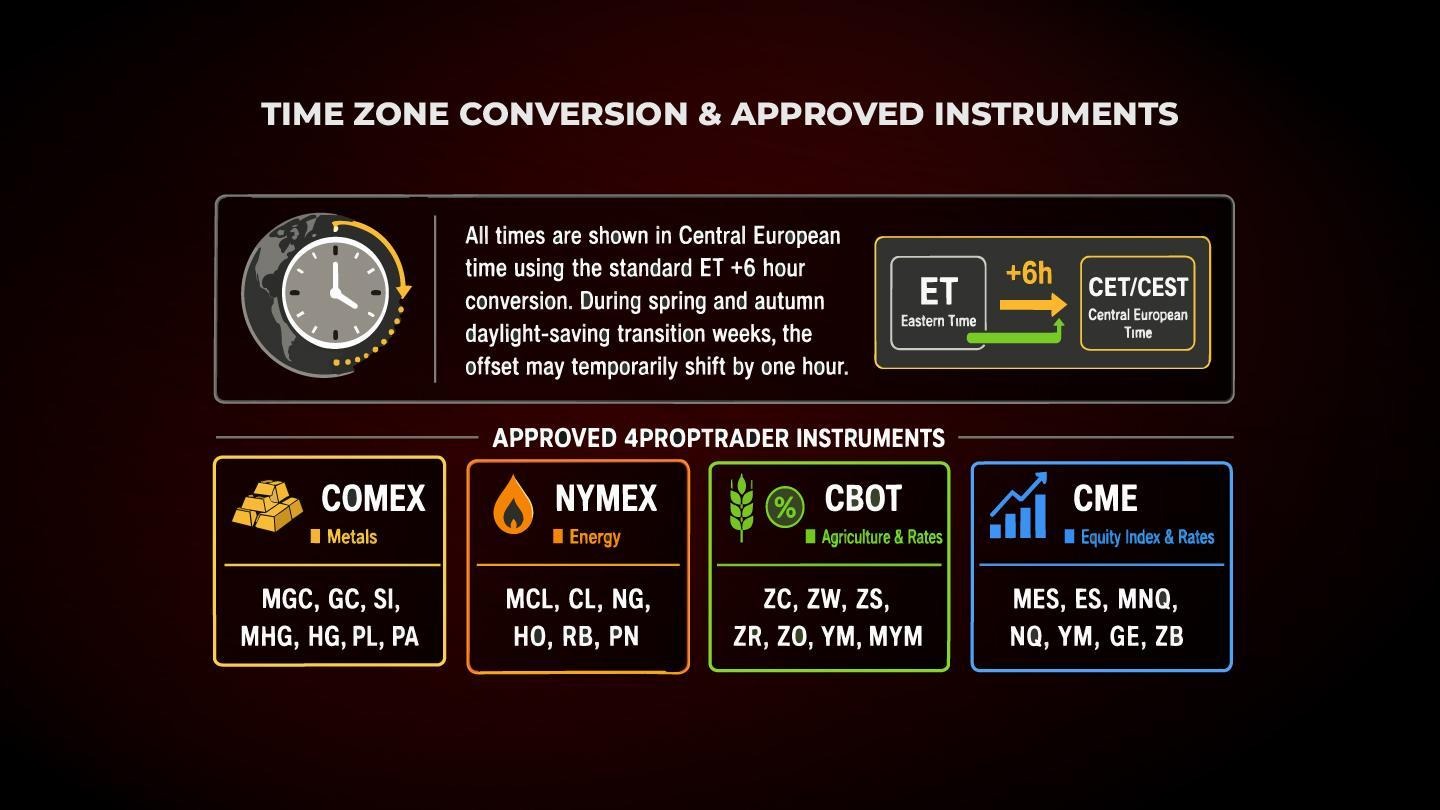
All of 4PropTrader's approved futures instruments trade on the CME Globex electronic trading platform, which operates on a near-continuous basis. Futures market hours on CME Globex run from Sunday at 7:00 PM CET to Friday at 10:00 PM CET, with a daily one-hour maintenance break — meaning futures contracts are available to trade nearly 23 hours a day on most trading days.
Within the CME Globex trading day, the regular trading hours for each product define the window of highest liquidity and tightest spreads. Outside of regular trading hours — during overnight and early morning sessions — trading volume drops significantly, and spreads can widen, particularly for equity index futures like the ES and MES.
Understanding the difference between extended CME Globex hours and the regular trading hours of each contract is important for day traders managing overnight risk. Positions held outside regular trading hours are subject to lower liquidity and potentially wider price gaps at the market open of each new session. Note that CME Globex session times are published in Central Time (CT) on the CME website — traders operating in CET should add 7 hours to convert to their local time (or 6 hours during U.S. daylight saving periods). Monitoring the US market opening at 3:30 PM CET remains the key reference point for equity index futures traders regardless of the time zone displayed on their trading platform.
Trading Around Data Releases
Beyond the regular session structure, scheduled economic data releases create concentrated windows of volatility and trading opportunities that experienced futures traders often build their schedules around. These are some of the most significant market-moving news events in the futures market calendar:
- Non-Farm Payrolls: First Friday of each month at 2:30 PM CET — the most volatile scheduled data release in the U.S. economic calendar, affecting equity index futures, interest rate futures, and metals futures simultaneously
- Federal Reserve rate decisions: 8:00 PM CET on scheduled FOMC days — followed by a press conference that frequently drives extended price movement across equity futures (ES, MES, NQ, MNQ) and interest rate futures (GE, ZB)
- CPI and inflation data: 2:30 PM CET — produces sharp price action in equity index, Treasury, and metals futures
- EIA crude oil inventory data: 4:30 PM CET every Wednesday — primary market-moving news event for NYMEX energy futures (CL, MCL, NG)
Data releases create both trading opportunities and elevated risk. Volume and volatility spike sharply in the minutes surrounding a release, which can produce strong directional price movement — but spreads can also widen briefly, and price can whipsaw before establishing direction. Day traders should clearly define in their trading strategy whether they trade through these windows or wait for conditions to stabilise before considering trading.
Trading Hours to Approach with Caution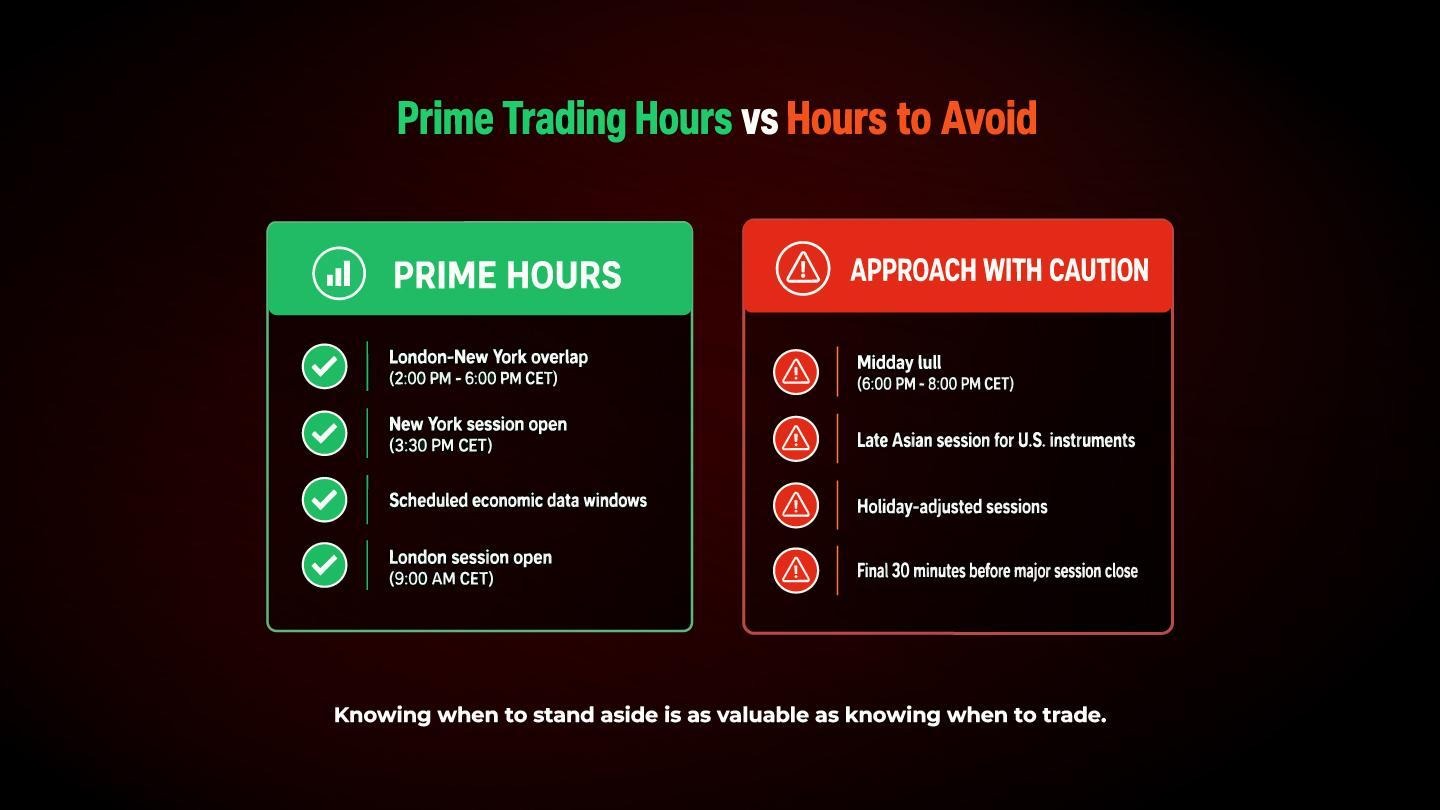
Just as certain times of day offer the best conditions across the futures market, others are best treated with caution for active trade execution:
- The midday lull: Approximately 6:00 PM - 8:00 PM CET — the period after the London session closes but before the New York session gains full momentum. Trading volume drops noticeably, and price movement tends to be choppy and range-bound
- Late Asian session for U.S. instruments: 7:00 AM - 10:00 AM CET — CME equity futures like ES and NQ see very low trading volume during this window, producing low-quality price action that does not suit most day trading styles
- Holiday-adjusted sessions: U.S. and European public holidays create significantly reduced trading activity across global markets, often producing erratic and unreliable price movement
- The final 30 minutes before session close: Liquidity can thin out unpredictably as traders finalise positions, sometimes creating volatile but low-quality price action that is difficult to trade with a defined trading strategy
A trading simulator can be a useful tool for understanding how your chosen instruments behave during these lower-quality windows before committing real capital. Many trading platforms connected to CME Globex offer simulation modes that allow traders to observe price action across different sessions without risk.
Trading Hours and Prop Firm Challenges
For traders working through a 4PropTrader evaluation challenge, session timing carries additional importance. The combination of high liquidity and defined risk management is most achievable during the peak trading hours outlined above — the London-New York overlap, the NYSE market open, and scheduled data release windows.
Day traders in particular benefit from concentrating their trading decisions during the highest-quality windows, where volume and volatility support cleaner execution. Trading during low-volume off-peak hours increases the likelihood of slippage, unpredictable price action, and drawdown erosion that is difficult to justify within the tight risk parameters of a prop firm challenge.
Understanding the optimal trading hours for each of 4PropTrader's approved instruments — and building those hours into a structured trading schedule — is one of the most practical steps any futures trader can take before starting a challenge.
Frequently Asked Questions
What is the best time to trade futures?
The best time to trade futures is during the London-New York overlap, from approximately 2:00 PM to 6:00 PM CET, and specifically around the NYSE market open at 3:30 PM CET. These windows offer the highest combined trading volume, the tightest spreads, and the most reliable price action across most CME, CBOT, NYMEX, and COMEX futures contracts.
Do futures trade nearly 24 hours a day?
Yes — futures contracts on CME Globex trade nearly 24 hours a day, specifically around 23 hours a day with a one-hour daily maintenance break. This means futures trade nearly around the clock from Sunday evening through Friday afternoon, offering significantly more trading hours than traditional equity markets.
What are the best times to trade equity index futures?
For CME equity index futures, including the E-mini S&P 500 futures (ES, MES), Nasdaq futures (NQ, MNQ), and Dow Jones indices futures (YM, MYM), the best trading hours are 3:30 PM - 5:00 PM CET around the NYSE market open, and the London-New York overlap window from 2:00 PM to 6:00 PM CET.
When is the best time to trade crude oil futures?
Crude oil futures (CL, MCL) on NYMEX see peak trading volume during the New York session from 2:00 PM CET, with the highest-volume spike occurring at 4:30 PM CET on Wednesdays when the EIA releases its weekly crude oil inventory data. This is one of the most market-moving news events for energy futures traders.
Should I use a trading simulator to practise trading different sessions?
Yes — using a trading simulator is a practical way to observe how futures products behave during different sessions and at different times of day before committing real capital. Most trading platforms connected to CME Globex offer simulation functionality that replicates live market conditions, including volume and price action, across regular trading hours and extended sessions.
Are futures and forex trading affected by the same session windows?
Yes, to a significant degree. Futures and forex trading share the same major session structure — Asian, London, and New York — and both are heavily influenced by the London-New York overlap. Forex trading and currency futures on CME Globex see peak volume during the same European and U.S. session overlap that drives equity and commodity futures activity.
Final Thoughts
The futures market may trade nearly around the clock on CME Globex, but trading opportunities are not distributed evenly across those hours. The best time to trade futures centres consistently on periods of high institutional participation — the London-New York overlap, the NYSE market open, and the windows surrounding major economic data releases.
Whether you are trading E-mini S&P 500 futures (ES) on the CME, crude oil futures (CL) on NYMEX, Gold futures (GC) on COMEX, or grain futures on CBOT, each instrument group has its own peak trading hours that reflect the activity patterns of the participants most active in that market. Aligning your trading decisions with these windows gives you the best possible conditions for executing your trading strategy.
Aligning your schedule with peak liquidity and volume does not replace the need for a sound trading strategy and disciplined risk management — but it removes one of the most commonly overlooked obstacles to consistent performance. Trading the right setup at the wrong time can produce worse results than trading a good setup during peak market hours.
Know your instrument. Know its optimal trading hours. Build your schedule around the windows where the futures market is working in your favour — and approach the quieter hours with proportional caution.
Risk Warning: Trading involves substantial risk of loss and is not appropriate for all investors. Futures trading, including futures options trading, involves leverage and can result in losses exceeding your initial deposit. Past performance is not indicative of future results.
Ready to apply your trading schedule in a structured, funded environment? Explore the futures challenges available at 4PropTrader — transparent rules, approved instruments across CME, CBOT, NYMEX, and COMEX, and a clear pathway to funded trading.