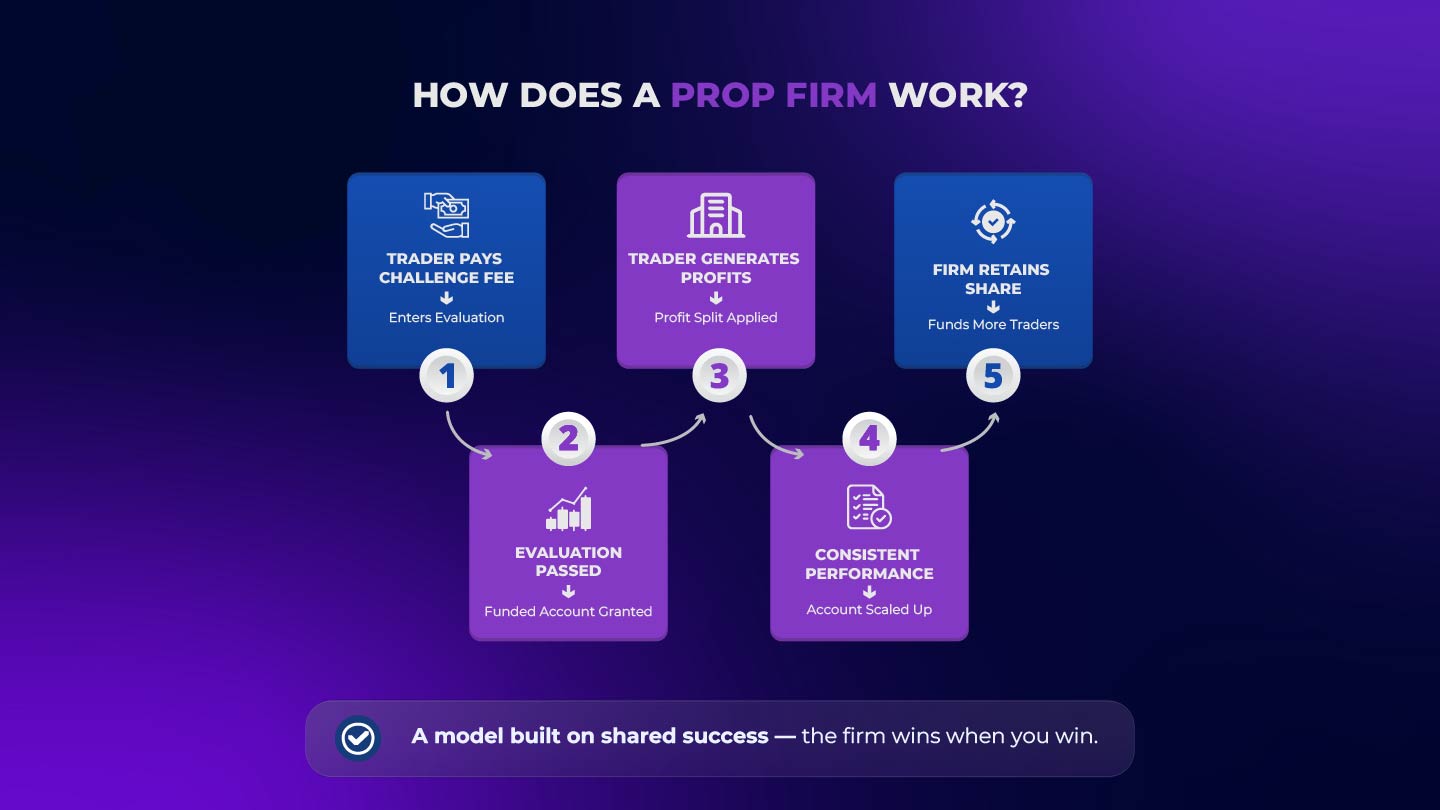
Quick Summary
A prop firm, short for proprietary trading firm, provides prop traders with access to funded accounts in exchange for a share of the profits they generate. But understanding how a prop firm works means going deeper than that simple exchange. It means understanding why the evaluation process exists, how profit splits are structured, how firms allocate trading capital, and why risk rules like drawdown limits are not arbitrary restrictions — they are the financial backbone of how the entire model operates.
This article goes inside the world of proprietary trading to explain the mechanics that most traders never fully consider — but that every serious funded trader should understand before joining a prop firm.
Introduction
Prop trading has grown into one of the most accessible routes into the financial market for independent traders. Where traditional trading required substantial personal capital to participate meaningfully, funded trading through a prop firm allows traders to access significant trading capital without risking their own savings.
Traders who pursue prop firm funding often focus entirely on passing the challenge. They study the rules, refine their trading strategies, and work to hit the profit targets. What fewer traders consider is the question sitting behind all of it: why does prop firm work the way it does — and what is the firm actually looking for?
The answer lies in the business model itself. A proprietary trading firm is not a charity. It is a commercial operation built around a carefully designed system that identifies consistent prop traders, manages risk at scale, and generates revenue through a combination of challenge fees and profit sharing. Every rule, every limit, and every condition in a funded account exists for a reason.
This article does not cover the basic definition of prop trading — that was addressed in Article 4. Here, the focus is on how proprietary trading firms operate: how they generate revenue, what the evaluation process is actually measuring, how profit splits work in practice, and why risk controls are enforced as strictly as they are. Whether you are considering joining a proprietary trading firm for the first time or already trading with a prop firm, this breakdown will sharpen your understanding of the environment you are operating in.
How a Trading Firm Is Different from a Brokerage
Before exploring the business model in depth, it is worth clarifying what makes a prop firm's structure distinct from a traditional brokerage firm or personal account setup.
In traditional trading, a trader deposits their own money into a personal account with a brokerage firm and trades using that capital. All profits belong to the trader. All losses are absorbed by the trader. The brokerage generates revenue through spreads, commissions, and fees — regardless of whether the trader profits or loses.
A trading firm is different. In the prop firm model, the firm provides the trading capital. The trader never risks their own money on live positions — they trade on behalf of the firm using the firm's capital. In return, the firm takes a percentage of the profits. Losses beyond defined thresholds result in the trader losing access to the funded account — not losing personal savings.
This structure fundamentally changes the risk dynamic for both sides. For the trader, it removes the barrier of needing large personal capital to access meaningful trading opportunities. For the firm, it creates a scalable model where trading capital is only deployed behind traders who have demonstrated they can manage risk and generate consistent returns.
This is the core of what distinguishes the world of proprietary trading from traditional trading — and it is why understanding how prop firms operate matters so much before you start trading with one.
The Prop Firm Business Model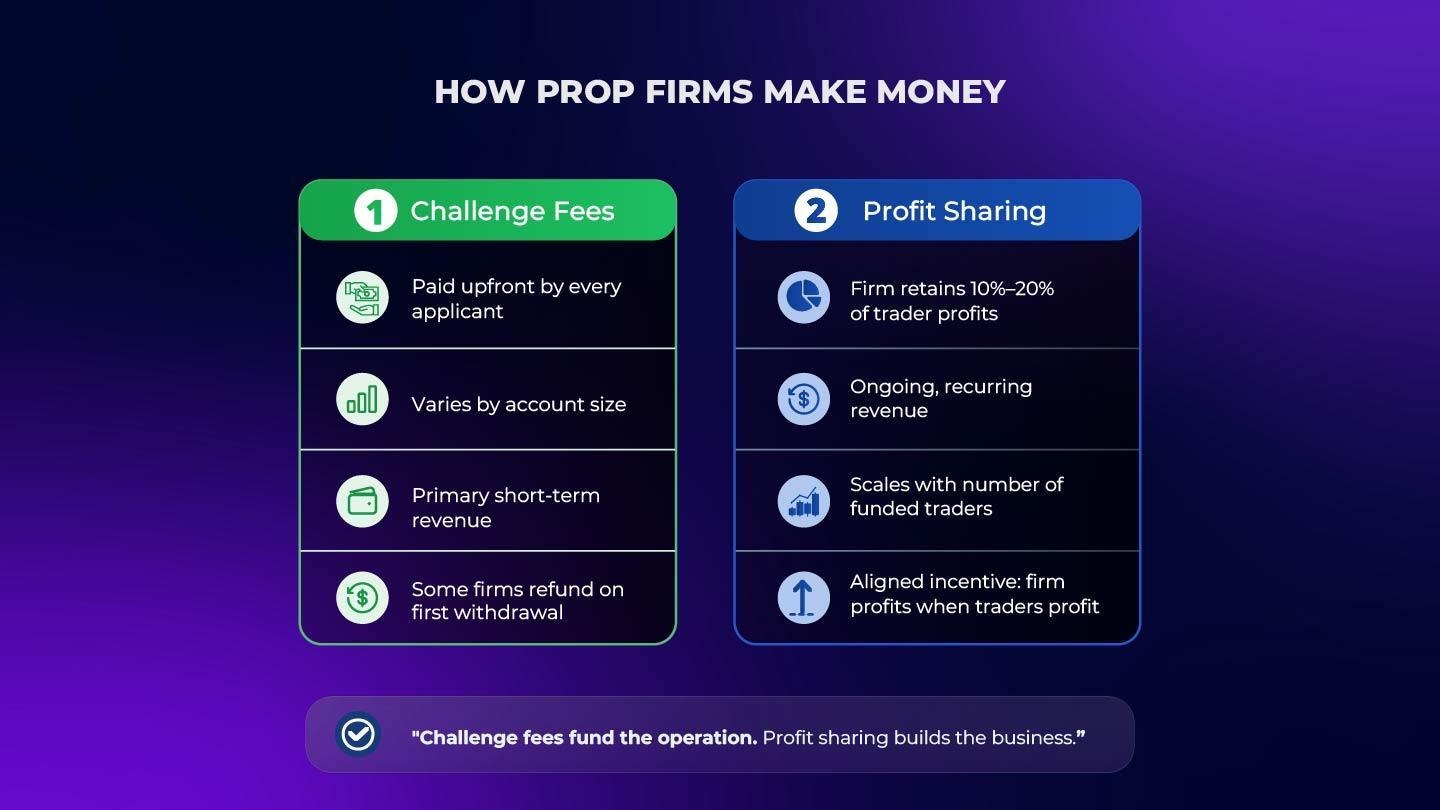
At its core, a prop firm's business model is built around one fundamental objective: identifying traders who can generate consistent, risk-controlled returns — and deploying capital for trading behind them. To do this sustainably, prop firms need a reliable mechanism for filtering out inconsistent or reckless traders before they are given access to real trading capital. That mechanism is the evaluation challenge.
Proprietary trading firms generate revenue through two primary channels:
1. Challenge Fees
Traders pay a fee to participate in an evaluation challenge. This fee is the primary upfront revenue source for the firm and covers the cost of running the evaluation infrastructure, the risk of funding firms who pass traders onto live accounts, and the firm's trading operations and overhead.
Challenge fees vary by account size — larger simulated trading account challenges carry higher fees. Reputable prop firms are transparent about their fee structures and what traders receive in return. Some firms offer refunds of the challenge fee upon the trader's first payout from a funded account, which serves as a strong incentive to attract serious applicants. Others retain the fee regardless of outcome.
From the firm's perspective, the challenge fee model creates a self-selecting pool of applicants. Traders who are serious enough to invest in an evaluation are more likely to approach it with disciplined trading — even if a significant proportion do not pass.
2. Profit Sharing
When a trader passes the evaluation and receives a funded account, the firm's ongoing revenue comes from its share of the profits that the funded trader generates. This is where the long-term business model is built.
A typical profit split might see the trader receive 80% of profits and the firm retain 20%. Some firms offer higher splits — 85% or even 90% — particularly for traders who demonstrate consistent trading performance or reach certain milestones. The firm's share, multiplied across hundreds or thousands of funded traders, generates the revenue that sustains and grows the trading operations.
This structure means the firm only profits when its traders profit — creating a genuinely aligned incentive between traders and the firm. This is one of the defining characteristics of the prop firm model and one of the key reasons why proprietary trading firms often invest in their traders' success through educational resources, advanced trading tools, and structured trading programs.
Types of Proprietary Trading Firms
Not all prop firms operate in the same way. Understanding the different types of trading firms helps you identify the right prop firm for your trading style and goals.
Retail Prop Firms (Funded Evaluation Model)
These are the firms most traders encounter when exploring funded trading. Retail prop firms like 4PropTrader provide a structured trading program — typically consisting of one or two evaluation phases — that traders must complete before receiving a funded account. Many firms in this category focus on forex prop trading, futures trading, and CFD markets.
Proprietary trading firms like these firms often provide traders with access to professional trading software, a defined trading environment, and a clear pathway from evaluation to funded status. Firms generally allow traders to use their own trading strategies and trading style, provided they operate within the firm's risk framework.
Institutional Prop Firms (Proprietary Trading Desk)
At the institutional level, a proprietary trading desk operates within a larger financial firm — a bank, hedge fund, or specialist financial institution. Traders at these firms trade on behalf of the firm using the firm's capital, engaging in a wide range of trading activities, including algorithmic trading, high-frequency trading, and market-making.
Joining a proprietary trading firm at the institutional level typically requires formal employment, relevant qualifications, and an extensive interview and assessment process. The trading experience and capital access available are significantly greater — but so are the requirements and the pressure. This type of trading is fundamentally different from the retail prop firm model in both structure and scale.
Futures-Focused Prop Firms
Some prop firms specialise specifically in trading futures. These firms often provide live funded accounts — where the trader's positions are executed in real financial markets — rather than simulated accounts. Trading futures through a prop firm typically involves stricter evaluation requirements and more rigorous ongoing risk controls, because the trading capital at risk is real and the leverage involved in futures trading is significant.
For traders whose trading style and goals align with futures markets — particularly day trading on indices, commodities, or interest rate futures — these firms offer a compelling pathway to get funded with access to meaningful capital for trading.
The Evaluation Process: What Is It Actually Measuring?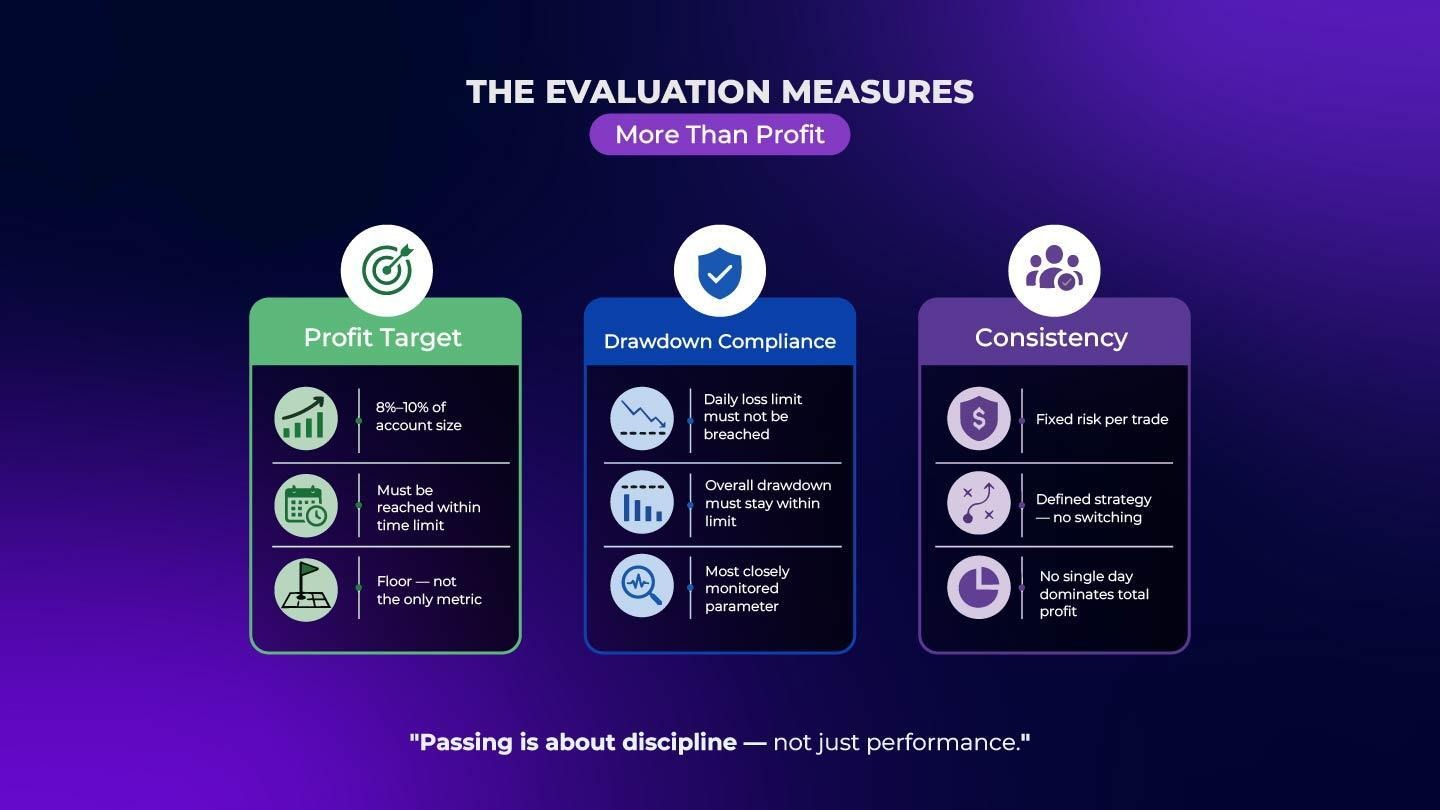
The evaluation challenge is the gateway to a funded account. Many firms require traders to complete one or two phases before receiving funding — and it is worth understanding what the challenge is designed to assess, because it is not simply a test of whether you can make money.
Prop firms are not looking for traders who can generate spectacular returns over a short period. They are looking for prop traders who can manage risk consistently, follow rules under pressure, and demonstrate the kind of disciplined trading behaviour that scales safely when real trading capital is deployed behind it. The evaluation is essentially a structured way to test your trading skills under real market conditions before the firm commits capital.
Many firms require traders to use a demo trading or simulated trading environment during the evaluation phase. While the positions are not live, the market conditions are real — prop firms typically use live market data feeds so the trading environment accurately reflects what the trader will experience on a funded account.
The evaluation typically measures three things:
1. Profit Target Achievement
Most challenges require traders to reach a defined profit target — typically 8% to 10% of the trading account size — within a set number of trading days. This is the threshold that demonstrates the trader can generate returns above a minimum standard and has the trading skills to do so consistently.
However, hitting the profit target is only one part of the equation. A trader who reaches the target by taking reckless risks or never trading within the spirit of the rules is not the type of trader a prop firm wants to fund. The profit target is a floor — not the only metric.
2. Drawdown Compliance
Every evaluation includes maximum drawdown limits — both daily and overall. These are the most closely monitored parameters in the entire challenge. Breaching either limit results in immediate disqualification, regardless of how much profit has been accumulated.
The drawdown limits exist because they directly mirror the risk parameters prop firms implement when real capital is deployed. A trader who cannot stay within a 5% daily loss limit during an evaluation will not be trusted with a $200,000 funded trading account. The evaluation is the proof of concept — and the risk of trading without discipline is exactly what these limits are designed to expose.
3. Consistency and Trading Behaviour
Beyond the numbers, prop firms look at how traders behave throughout the evaluation. Are they applying the same risk per trade consistently? Are they using a defined trading style or switching approaches based on results? Are they avoiding high-risk periods? Prop firms typically look for traders who demonstrate repeatable, process-driven behaviour — not traders who got lucky once.
Some firms apply a consistency rule — limiting how much of the total profit target can come from a single trading day. This rule exists to prevent traders from passing through one outsized lucky day rather than demonstrating genuine, repeatable trading skills. It is one of the clearest examples of how allowing traders to exploit loopholes is something prop firms design their programs to prevent.
Trading Tools and Environment
One of the advantages of trading with a prop firm — particularly for traders coming from a retail background — is access to the tools and infrastructure that proprietary trading firms often provide as part of their funded trading programs.
Firms often provide access to:
- Professional trading software and trading platforms not always available to retail traders
- Advanced trading analytics and performance tracking tools
- Real trading data and execution infrastructure
- Risk management dashboards showing live drawdown, margin utilisation, and trading account metrics
- Educational resources and structured support for traders developing their trading skills
The quality of the trading platform and trading software provided varies significantly between firms. When evaluating the right prop firm for your needs, the trading environment — including execution speed, available instruments, and platform reliability — should be a key consideration alongside the profit split and challenge fee structure.
Many prop firms use well-established trading platforms such as MetaTrader 4, MetaTrader 5, or proprietary platforms developed specifically for their trading programs. Some firms also support algorithmic trading and automated trading setups — though the rules governing these trading strategies vary between firms and should be reviewed carefully before you start trading.
What Happens After You Pass the Evaluation?
Passing the evaluation is the beginning of the funded trader relationship — not the end of the process. Once a trader has demonstrated compliance with all evaluation conditions, they are moved to a funded account. How that account is structured depends on the type of prop firm.
Simulated Funded Accounts
Many prop firms — particularly in the CFD and forex prop space — operate funded accounts on simulated trading capital. The trader sees a live trading account with a defined balance, trades it under real market conditions using real market data, and receives a real cash payout based on their profit percentage. The underlying capital, however, is not deployed in live markets — the firm manages its risk separately.
This model allows firms to scale their funded trader base rapidly without the liquidity constraints of deploying real capital behind every trader. Firms use this approach to offer larger account sizes and more accessible challenge fees while maintaining sustainable trading operations. For the trader, the experience is functionally identical to real trading — they trade, they earn, they receive their payout.
Live Funded Accounts
Some prop firms — typically those focused on trading futures — provide genuinely live funded accounts, where the trader's positions are executed in real financial markets. These firms tend to have more rigorous evaluation requirements and stricter ongoing risk controls, because the trading capital at risk is real and market exposure is direct.
In both models, the funded trader is expected to continue operating within the same risk parameters established during the evaluation. The drawdown limits, position sizing requirements, and trading rules do not disappear after passing — they become permanent conditions of the funded trading account. Firms generally enforce these rules automatically through their trading platform infrastructure.
Scaling Plans
Most prop firms offer a scaling mechanism — a pathway for consistently profitable funded traders to access larger account sizes over time. A trader who starts with a $100,000 funded account and demonstrates consistent trading performance over a defined period may be eligible to have their account scaled to $200,000 or beyond.
Scaling plans are a key part of how the prop firm model creates long-term value for both traders and the firm. For the trader, it means growing income potential without additional risk to personal capital. For the firm, it means deploying more trading capital behind proven performers, which increases the firm's revenue from profit sharing. Prop trading firms tend to prioritise scaling for traders who demonstrate not just profitability, but consistent adherence to the firm's risk framework.
How Profit Splits Work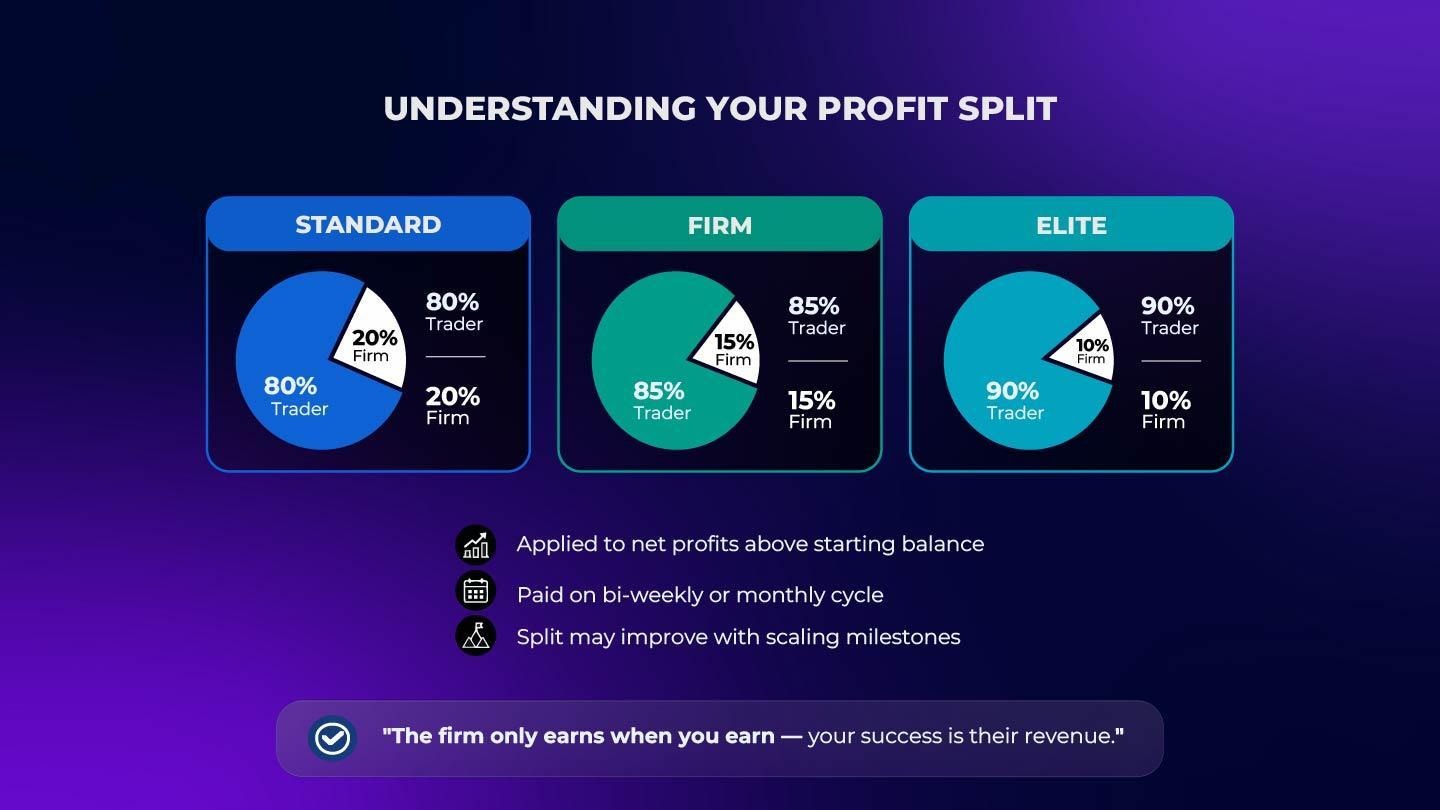
The profit split is the financial agreement between traders and the firm that governs how trading profits are divided. It is one of the most important terms to understand before joining a prop firm — and one of the clearest indicators of how aligned the firm's incentives are with yours.
Typical profit split structures across reputable prop firms look like this:
Standard split: 80% trader / 20% firm
Performance split: 85% trader / 15% firm (after milestones)
Elite split: 90% trader / 10% firm (top-tier performers)
The split applies to net profits — the gains generated above the starting trading account balance during the payout period. Most firms operate on a bi-weekly or monthly payout cycle, though some allow traders to request a payout at any time once a minimum profit threshold is met.
When evaluating the best prop firm for your trading goals, the profit split should be read alongside the full terms — including whether the split improves with scaling, how payouts are processed, and whether there are any conditions attached to withdrawals. Prop firms typically make these terms available upfront, and reputable prop firms will never obscure the profit split structure.
From the firm's perspective, the profit split is sustainable because of scale. A single funded trader generating $5,000 per month at an 80/20 split produces $1,000 for the firm. Firms allocate this revenue across their trading operations, technology infrastructure, risk management, and the ongoing costs of supporting their funded trader base. Multiply that across hundreds of funded traders, and the prop firm's business model becomes financially clear.
Why Risk Rules Are Enforced So Strictly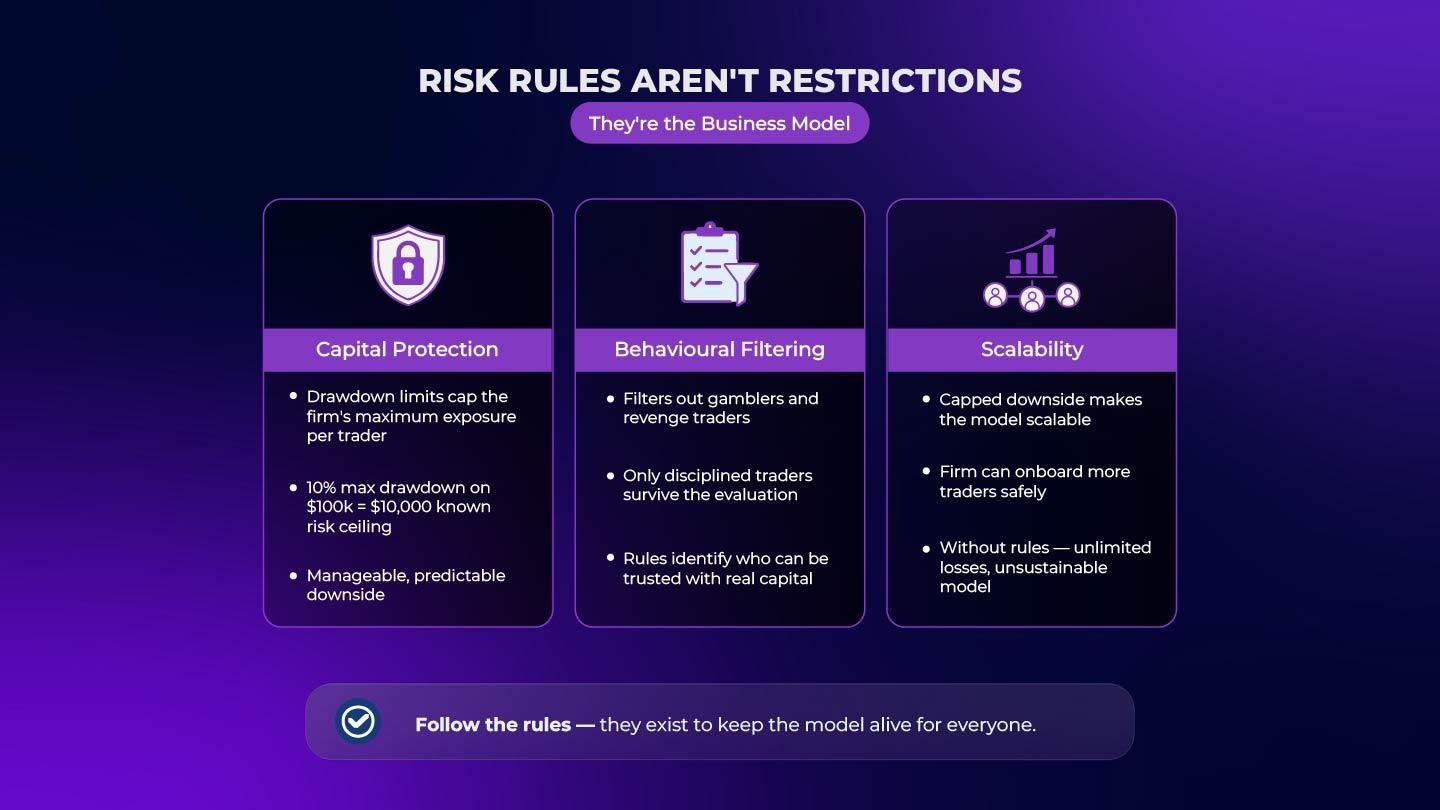
Traders sometimes experience a prop firm's risk rules — particularly drawdown limits — as frustrating constraints. Understanding why these rules exist changes that perspective entirely — and makes disciplined trading not just a requirement, but a logical choice.
From the firm's point of view, every funded trader represents a risk exposure. The firm is either deploying real capital on behalf of that trader or carrying a financial obligation to pay out profits on simulated capital. In either case, a trader who suffers a catastrophic loss creates a direct financial problem. Prop firms implement strict risk controls precisely to prevent this.
Risk rules serve three specific functions in the prop firm model:
Capital protection:
- Drawdown limits cap the maximum loss the firm can sustain from any single funded trader. A 10% maximum drawdown on a $100,000 trading account means the firm's maximum exposure to that trader is $10,000 — a known, manageable figure that allows firms to operate predictably across their entire funded trader base.
Behavioural filtering:
- Strict risk rules ensure that only traders who can work within defined parameters make it through the evaluation and retain their funded accounts. This filters out gamblers, revenge traders, and those without genuine risk management discipline — the traders who would cost the firm money if funded.
Scalability:
- A prop firm cannot scale its funded trader base if individual traders can generate unlimited losses. Risk rules make the model mathematically scalable — allowing traders to be onboarded with confidence because the downside of each funded account is capped and predictable.
When you view risk rules through this lens, they are not arbitrary restrictions designed to make the challenge harder. They are the structural mechanism that makes the entire prop firm model viable — for the firm and for the prop traders it funds. Disciplined trading is not just a requirement for passing — it is the reason the model exists at all.
Choosing the Right Prop Firm for Your Trading Style and Goals
With so many funding firms now operating in the market, identifying the right prop firm for your specific trading style and goals requires careful evaluation. Not all firms are equal — and the differences between them can significantly affect your trading experience, your payout structure, and your long-term development as a funded trader.
When assessing whether to join a prop firm, consider the following:
- Trading instruments: Does the firm support the markets you trade? Forex prop firms, futures trading specialists, and multi-asset platforms all serve different trader profiles
- Challenge structure: How many evaluation phases are required? What are the profit targets and drawdown limits? Are they realistic for your trading style?
- Profit split and payout: What percentage do you keep? How frequently can you withdraw? Are there conditions attached to the payout?
- Trading platform and software: Does the firm's trading software support your trading strategies and trading setups? Is algorithmic trading permitted?
- Scaling plan: Is there a clear pathway to grow your trading account over time based on trading performance?
- Reputation: Is the firm transparent about its rules and trading operations? Do funded traders report consistent, reliable payouts?
Reputable prop firms are transparent about all of these factors upfront. If a firm is unclear about its profit split, its risk rules, or how its funded accounts operate, that lack of transparency is itself a signal. The best prop firms make it straightforward to understand exactly what you are signing up for — and what is expected of you as a funded trader.
Many prop firms also offer a demo trading environment or trial period that allows traders to familiarise themselves with the trading platform and trading environment before committing to a paid evaluation. Taking advantage of these opportunities is a sensible step, particularly if you are new to trading with a prop firm or transitioning from a personal account or brokerage firm setup.
Frequently Asked Questions
How does a prop firm work?
A prop firm — short for proprietary trading firm — provides traders with access to a funded trading account in exchange for a share of the profits. Traders complete an evaluation challenge to demonstrate their trading skills and risk management discipline. Once funded, they trade the firm's capital and receive a payout based on their profit split. The firm generates revenue through challenge fees and its share of trader profits.
Is trading with a prop firm different from trading a personal account?
Yes — significantly. In a personal account with a brokerage firm, you trade your own capital and keep all profits. In a prop firm account, you trade the firm's capital and share profits according to the agreed split. The key advantage is access to significantly larger trading capital without risking personal savings. The key constraint is operating within the firm's risk rules at all times.
What trading strategies are allowed in a prop firm?
Most prop firms allow traders to use their own trading strategies, provided they operate within the firm's risk framework. Common restrictions include no holding positions over weekends, no trading during major news events, and no high-frequency trading or certain algorithmic trading approaches. Always review the specific rules of the firm you are joining before you start trading.
What is a profit split in prop trading?
A profit split is the agreement that determines how trading profits are divided between traders and the firm. A typical split is 80% to the trader and 20% to the firm, though many prop firms offer improved splits of 85% or 90% for traders who reach performance milestones or scale their accounts.
How do I get funded by a prop firm?
To get funded, you must pass the firm's evaluation challenge — typically by hitting a defined profit target while staying within drawdown limits and following the firm's trading rules. Once you pass, you receive access to a funded trading account and begin earning payouts based on your profit split.
Can I use algorithmic trading in a prop firm?
This depends on the firm. Some prop firms support algorithmic trading and automated trading setups, while others restrict or prohibit them entirely. If algorithmic trading is central to your trading style, confirm with the firm that it is permitted, and review any specific conditions that apply — before joining.
Final Thoughts
Understanding how a prop firm works — not just the rules, but the business model behind them — is one of the most valuable things a funded trader can do. It transforms how you read the challenge conditions, how you approach the evaluation, and how you manage a funded account once you have it.
Proprietary trading firms operate on a model built around identifying and backing disciplined, consistent traders. The evaluation exists to protect the firm's capital and filter for the trading skills and behavioural discipline that make a funded trader viable at scale. The profit split exists because the firm's revenue is tied directly to your performance. The risk rules exist because, without them, the trading operations cannot scale, and without scale, the firm cannot fund traders at all.
Whether you are just beginning to explore the world of proprietary trading or are already working through an evaluation, understanding the mechanics of the model gives you a clearer picture of what is expected and why. When the rules make sense, following them becomes a strategy in itself. And disciplined trading, applied consistently within a well-structured prop firm environment, is the foundation of everything that follows.
Experience how a modern prop firm works, start your evaluation with 4PropTrader, and trade Futures or CFDs with transparent rules and real capital.