Quick Summary
Margin in trading refers to the deposit required to open and maintain a leveraged position. It is not a fee — it is collateral. Margin means borrowing money from your broker to control a position larger than your initial investment, and understanding exactly how it works is essential for any trader operating in CFD, futures, or forex markets.
This guide to margin trading covers the technical mechanics in full — including initial margin, maintenance margin, margin calls, and how to avoid the most costly mistakes. It builds directly on the leverage concepts introduced in Article 19. If you have not read that article yet, it provides useful context on how leverage and margin interact at a foundational level.
Introduction
Most traders encounter margin early in their trading journey — but few take the time to understand exactly what it means, how it is calculated, and what happens when it runs out. Margin trading can amplify profits significantly, but it introduces a layer of risk that must be understood before you start trading with borrowed capital.
Buying on margin means you are using a combination of your own funds and a margin loan from your broker to open a position that would otherwise be beyond the reach of your account balance. Trading on margin work in a straightforward way on the surface, but the mechanics beneath it, particularly around margin calls and liquidation, are where many traders are caught off guard.
For prop firm traders in particular, understanding margin is not just about avoiding losses. It is about understanding the structural mechanics of the accounts they are currently trading — and why maintaining adequate margin is inseparable from passing a challenge and retaining a funded account.
This article is a practical guide to margin trading — covering everything from how to open a margin account and the types of margin involved, to what happens when a margin call can result in automatic liquidation of your positions.
What Is Margin in Trading?
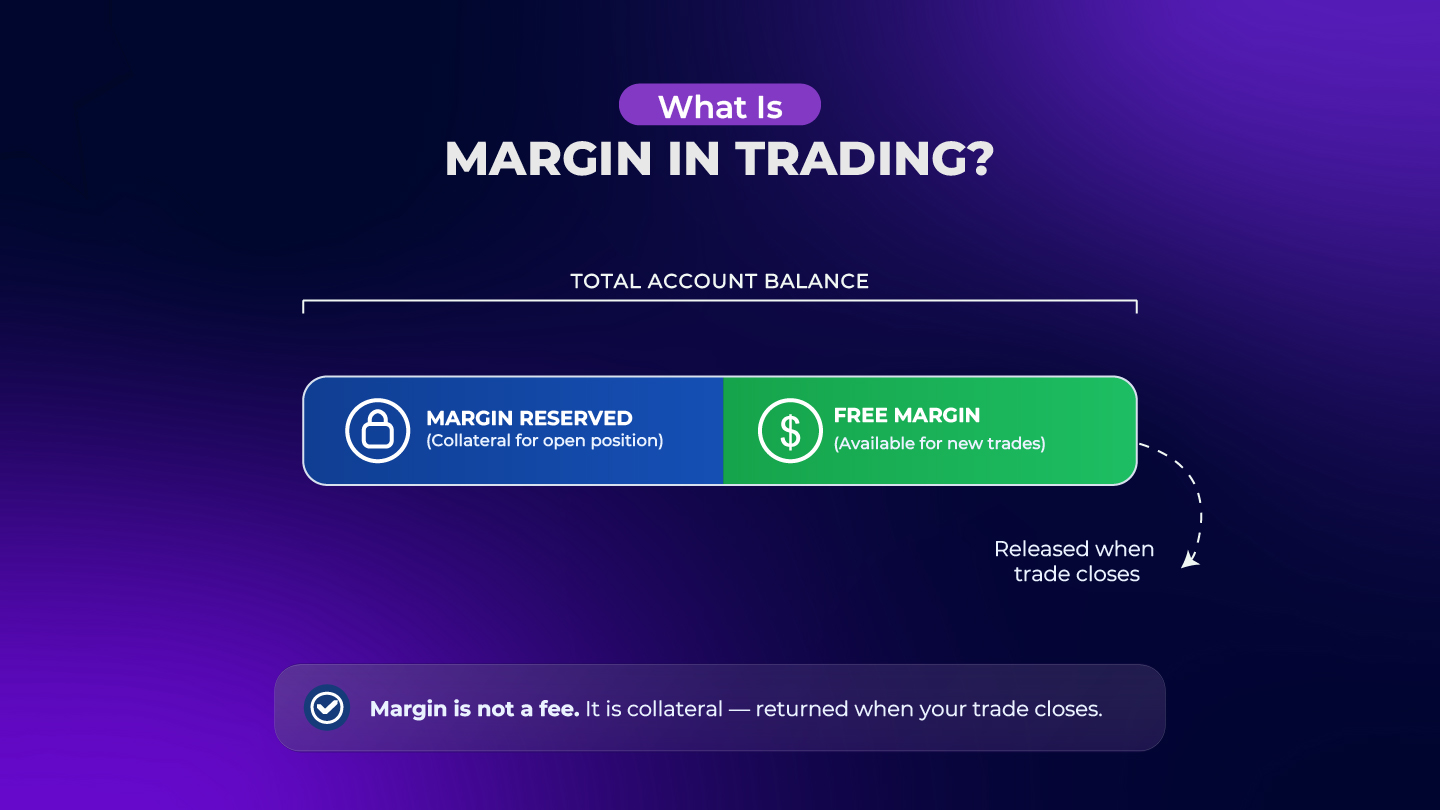
Margin in trading is the amount of capital you are required to deposit in order to open a leveraged position. It acts as collateral for the margin loan provided by your broker or prop firm — a good-faith deposit held to cover potential losses on your trade.
Margin is not the cost of the trade. It is a portion of your own trading account balance that is set aside and reserved for as long as the position remains open. Once the position is closed, the margin deposit is released back into your available balance — adjusted for any profit or loss.
Margin means borrowing money to increase your exposure to a financial market. When you trade on margin, your brokerage firm effectively provides a margin loan to cover the difference between your initial investment and the full value of the position. You pay margin interest on this borrowed amount for as long as the position is held open.
Margin is expressed as a percentage of the total value of the position — known as the margin requirement. The margin requirement is directly linked to the leverage ratio applied:
Leverage 10:1 → Margin requirement = 10%
Leverage 20:1 → Margin requirement = 5%
Leverage 50:1 → Margin requirement = 2%
Leverage 100:1 → Margin requirement = 1%
The lower the margin requirement, the higher the leverage — and the greater your market exposure relative to your deposited capital. Margin can magnify both your gains and your losses, which is why understanding the risks of margin trading is essential before using it.
How Does Margin Trading Work?
Margin trading allows investors to access larger positions than their own capital would normally permit. Here is how trading on margin works in practice:
To start trading on margin, you must first open a margin account with your broker. A standard cash account does not support margin trading — you must have a margin account specifically set up for this purpose. When you open a margin account, you will be required to sign a margin agreement outlining the terms of the margin loan, the applicable margin interest rate, and the broker's maintenance margin requirements.
Once your margin trading account is active, you can borrow money from your brokerage to purchase securities or open leveraged positions. In traditional equity markets, regulations typically allow you to borrow up to 50% of the purchase price of a security — meaning you fund at least half from your own capital and take out a margin loan for the remainder. In forex and CFD markets, the borrowing ratios are often significantly higher due to the leverage structures of those instruments.
When you use margin, your broker holds the securities in your account — or your open positions — as collateral for the margin loan. The value of the securities or positions in your account directly affects your available margin and your exposure to a margin call.
It is important to understand that margin trading incurs costs. The margin loan balance accrues margin loan interest at the margin interest rate set by your broker. Margin rates vary between brokers and are typically tied to a benchmark interest rate. You pay margin interest for every day you hold a position open using borrowed funds — this is a real cost that affects your net profitability, particularly on positions held for extended periods.
How to Open a Margin Account
To set up a margin trading account, you will need to apply through your chosen brokerage. Not all brokers offer margin trading, and the requirements to open a margin account vary between firms. In general, the process involves:
- Completing an application with your trading broker that includes financial and experience disclosures
- Signing a margin agreement that outlines the terms of borrowing, the margin interest rate, and the broker's maintenance margin requirements
- Meeting the minimum margin deposit requirement — the minimum amount required to activate the margin account, sometimes known as the minimum margin
- Acknowledging that you understand the risks of trading on margin and that the broker may issue a margin call or liquidate positions without prior notice
In the United States, the Financial Industry Regulatory Authority (FINRA) — the financial industry regulatory authority overseeing brokerage conduct — sets minimum standards for margin accounts. Under FINRA rules, the minimum margin required to open a margin account is $2,000 or 100% of the purchase price of the securities, whichever is less. Individual brokers may impose higher minimums.
Once your brokerage account is approved for margin trading, you can begin using margin to open positions. Always review the margin agreement carefully before you begin — the terms governing your margin loan, including margin loan rates and the conditions under which a margin call can result in forced liquidation, are legally binding.
Initial Margin: What You Need to Open a Position
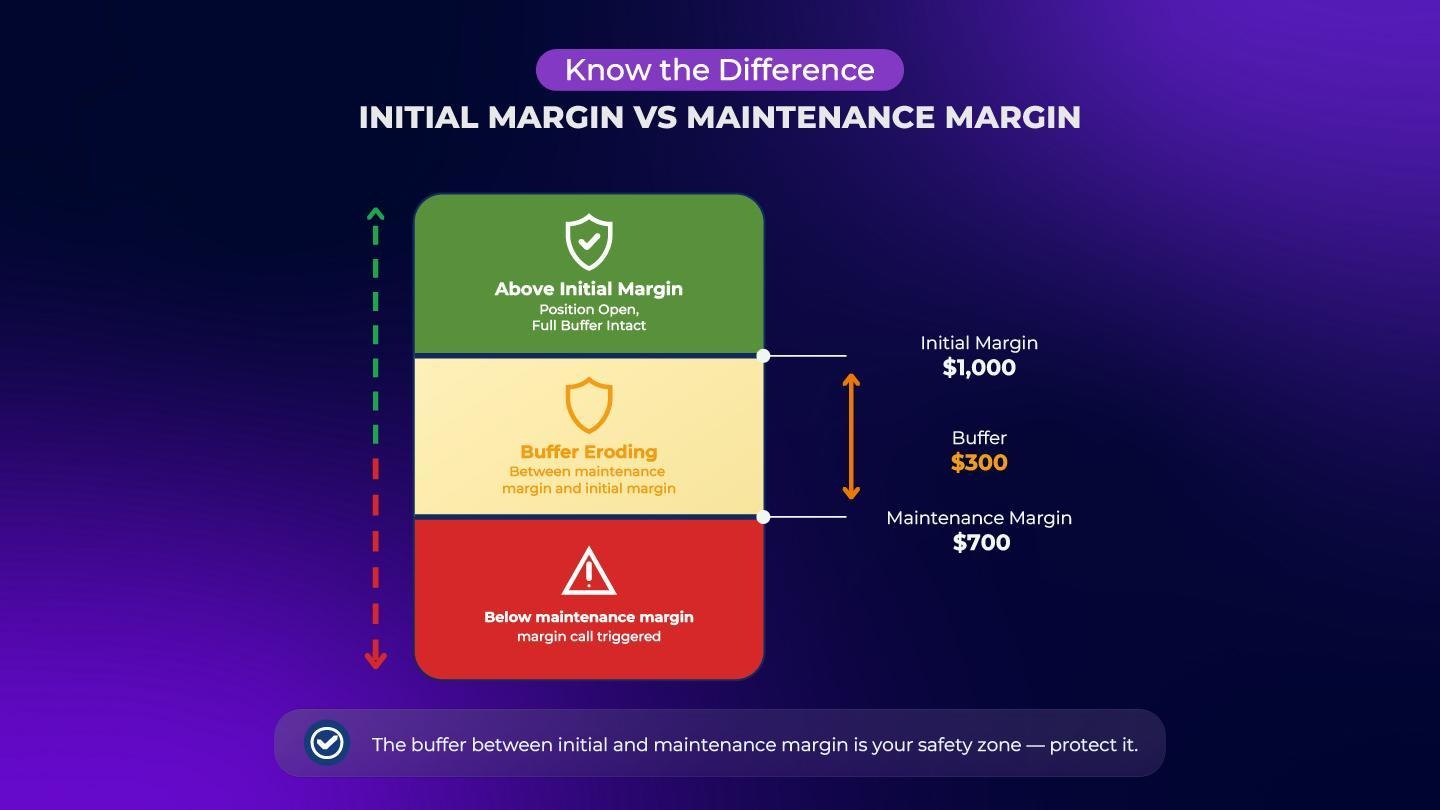
The initial margin — also known as the initial margin requirement — is the minimum amount of capital required to open a leveraged position. It is known as the initial margin threshold that your account must meet before a trade can be executed.
Think of initial margin as the entry requirement. Before your order is filled, your trading platform checks whether your account value is sufficient to meet this requirement. If it is not, the trade will not open.
Initial Margin Example — Forex CFD:
Position size: $100,000 (1 standard lot, EUR/USD)
Margin requirement: 1% (leverage 100:1)
Initial margin required: $100,000 × 1% = $1,000
In this example, $1,000 is immediately reserved from your trading account balance the moment the trade opens. That $1,000 is your margin deposit — it is not available for other trades until this position is closed. The margin is required to remain in your account for the duration of the trade.
Initial Margin Example — Futures:
In futures markets, initial margin is set by the exchange rather than the broker. It is a fixed dollar amount per contract, updated periodically based on market volatility. This is a type of margin that functions differently from CFD margin — the amounts are set externally and can change overnight.
Instrument: E-mini S&P 500 (ES) futures
Notional value: $250,000 (approx. at index level 5,000)
Exchange initial margin: ~$12,000–$15,000 per contract
Futures traders must ensure they have sufficient capital in their brokerage account at all times to meet these requirements, as they can be updated by the exchange with little notice.
Maintenance Margin: What You Need to Keep a Position Open
The maintenance margin is the minimum account balance required to keep an open position running. It is always lower than the initial margin — and it is the threshold that, when breached, triggers a margin call. This is known as the minimum margin level in some broker frameworks.
While the initial margin is a one-time requirement at trade entry, the maintenance margin requirement is ongoing. As your trade moves into profit or loss, the equity in your account changes. Falls below the maintenance margin level — even temporarily — and your broker will act.
The gap between the initial margin and the maintenance margin represents your buffer. Understanding this buffer tells you how much adverse price movement your open position can absorb before your account is at risk of a margin or maintenance call.
Maintenance Margin Example:
Initial margin: $1,000
Maintenance margin: $700
Buffer before margin call: $300
If your account equity falls below $700,
the broker's maintenance margin requirements are breached
and a margin call is triggered.
In CFD trading, the maintenance margin is typically set as a percentage of the initial margin. In futures markets, exchanges publish both levels separately for each contract. Traders must monitor both levels actively — not just at trade entry, but throughout the life of the position.
Margin Interest: The Cost of Borrowing
One aspect of margin trading that many new traders overlook is the cost of the margin loan itself. When you trade on margin, you are borrowing money from your brokerage firm — and that borrowing comes at a cost: margin interest.
Margin interest is charged on the margin loan balance — the amount you have borrowed — at the margin interest rate set by your broker. Margin loan rates vary between brokers and are typically expressed as an annual percentage rate (APR), applied on a daily basis for each day the position is held.
For short-term trades, margin loan interest may be negligible. For positions held over days or weeks, the interest charges can add up significantly and erode your profit margin. This is a critical factor when evaluating the benefits and risks of margin trading — particularly for swing traders or anyone using a margin account for longer-duration positions.
Before you take out a margin loan, always calculate the potential margin interest cost over your expected holding period. Some brokers offer tiered margin loan rates — where larger loan balances attract lower rates — while others apply a flat margin interest rate regardless of the loan size. Understanding how your broker structures margin rates is part of responsible margin investing.
Margin Calls: What They Are and How They Work
A margin call — sometimes referred to as a margin or maintenance call — is a notification from your broker that your account equity has fallen below the maintenance margin level. It is a demand for immediate action: either deposit additional funds to meet the margin call, or reduce your exposure by closing open positions.
A margin call is not a suggestion. It is a contractual obligation under your margin agreement. If you fail to meet a margin call within the timeframe set by your broker, the brokerage firm has the right to liquidate your positions — including the securities in your account used as collateral for the margin loan — without your consent.
What Triggers a Margin Call?
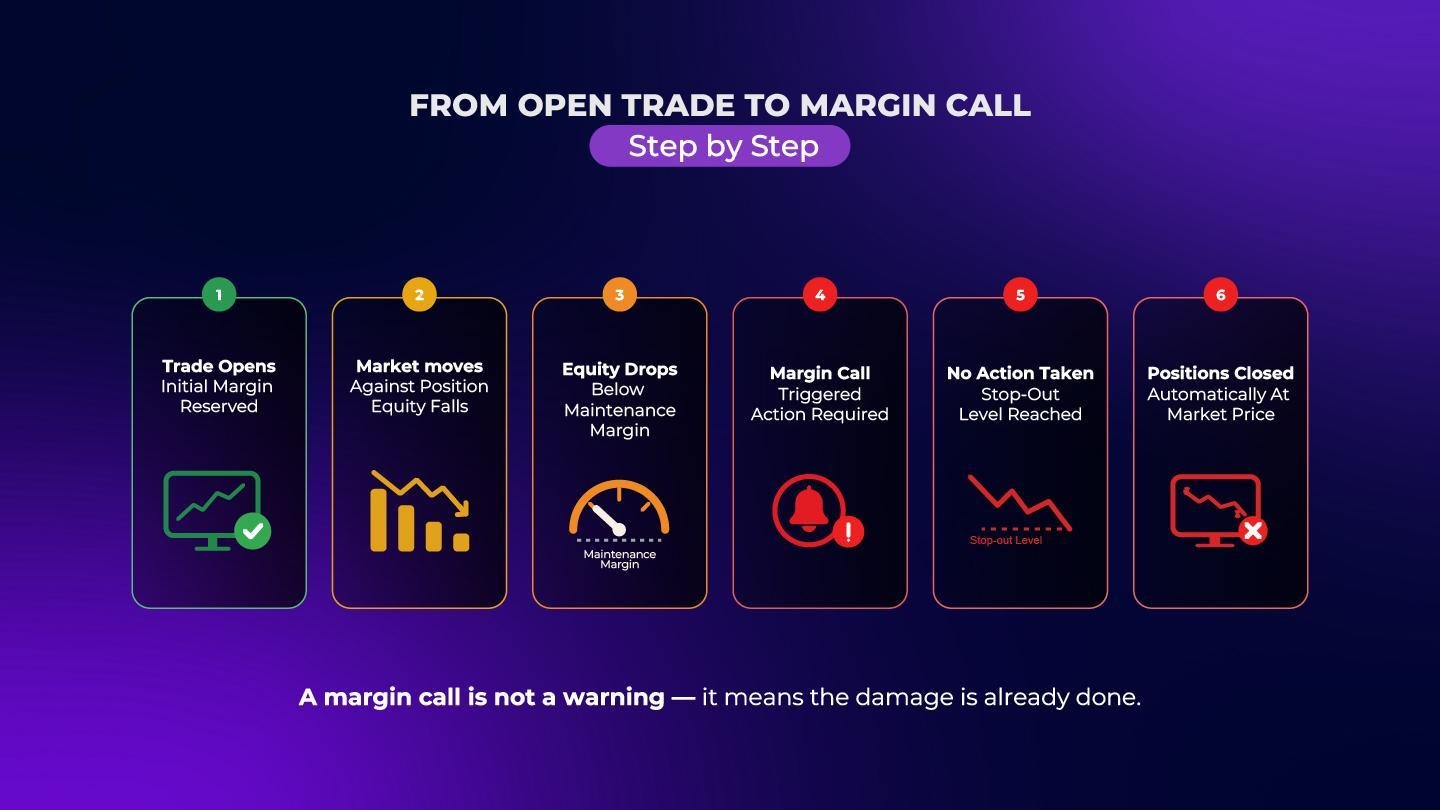
A margin call is triggered when your account equity — your balance adjusted for any unrealised profit or loss on open positions — falls below the maintenance margin requirement. This can happen because:
- A trade moves significantly against you, reducing the equity in your account below the maintenance margin threshold
- Multiple positions simultaneously move against you, compounding the drawdown on your trading account
- The value of the securities purchased on margin declines sharply, reducing the collateral value backing your margin loan
- Overnight price gaps cause your account value to fall below the required level before you have the opportunity to act
- Your broker updates its maintenance margin requirements, raising the threshold your account must meet
How to Meet a Margin Call:
When you may face a margin call, you have two options to meet the margin call:
- Deposit additional funds into your margin trading account to restore your equity above the maintenance margin requirement
- Close one or more open positions to reduce your margin loan balance and free up equity in your account
If you do not act quickly enough — or if your account equity continues to fall — your broker will move to automatic liquidation. Positions are closed at market price, which in fast-moving conditions can mean significantly worse exit prices than you would have chosen yourself.
Automatic Liquidation: When the Broker Acts Without You
If your account equity falls below the stop-out level — the critical threshold below which your broker begins closing positions automatically — your open trades will be liquidated without your input. This is the final consequence of failing to meet a margin call.
Automatic liquidation is designed to protect the brokerage from losses that exceed your deposited capital — not to protect you. The broker's maintenance margin requirements exist precisely to ensure there is always enough collateral for the margin loan. When that collateral falls short, the broker acts.
Total margin in use: $2,000
Stop-out level: 50%
Automatic liquidation at: $1,000 account equity
If equity falls to $1,000 or below,
positions are closed automatically at the market price.
Reaching the stop-out level should be treated as a complete risk management failure. It means your trading strategies did not include adequate stop-loss protection, your position sizing was too aggressive, or both. In a prop firm challenge, it almost certainly means the challenge is over.
The Benefits and Risks of Margin Trading
Understanding the benefits and risks of margin trading is essential before you open a margin account or take out a margin loan. Margin trading increases your market exposure — which cuts both ways.
Benefits of Margin Trading:
Margin trading allows investors to access trading opportunities that would otherwise be out of reach with their available capital. The key benefits include:
- Amplified returns: Margin trading can amplify profits on successful trades — a smaller move in the market produces a larger return on your initial investment
- Access to more markets: Using a margin trading account gives you access to a wider range of instruments and position sizes than a cash account alone
- Capital efficiency: Margin trading allows you to deploy your capital across multiple positions simultaneously, rather than tying it all up in a single trade
- Flexibility in trading strategies: Margin trading allows for short selling, hedging, and other advanced trading strategies that are not possible in a standard cash account
Risks of Margin Trading:
The risks of margin trading are equally significant and must be understood in full before you start trading on margin:
- Magnified losses: Margin can magnify losses just as effectively as it magnifies profits — a small adverse move can produce a large loss relative to your initial investment
- Margin calls: If the equity in your account falls below the maintenance margin requirement, you may face a margin call — and forced liquidation if you cannot respond in time
- Margin interest costs: Every day you hold a leveraged position, you pay margin interest on the margin loan balance — a cost that compounds over time
- Amplified risk in volatile markets: Margin trading increases risk exposure during periods of high volatility, where price swings can quickly erode your margin buffer
- Obligation to repay: The margin loan must be repaid regardless of whether your trades are profitable — you are borrowing money, and that obligation does not disappear with a losing trade
Understanding the risks of margin is not optional — it is the foundation of responsible margin investing. Before you use margin, always ask yourself whether the potential benefits justify the borrowing cost and the additional risk exposure.
Types of Margin in Trading
There are several distinct types of margin that traders should be familiar with. Each plays a different role in how your margin trading account functions:
- Initial margin:
The deposit required to open a new position. Also known as the initial margin requirement. This is what you must have in your account before a trade can be executed.
- Maintenance margin:
The minimum equity required to keep a position open. Falling below this level triggers a margin call.
- Minimum margin:
Known as the minimum margin, this is the absolute minimum balance required to maintain a margin account — set by regulators or the broker. Dropping below this can result in account restrictions.
- Variation margin:
In futures trading, this refers to the daily settlement of gains and losses against the margin account balance — positions are marked to market daily, and the margin account is debited or credited accordingly.
- Margin deposit:
The actual funds deposited into your margin trading account to satisfy margin requirements. This is the capital your broker holds as collateral for the margin loan.
Margin in CFD and Futures Trading
Margin in CFD Trading
In CFD markets, margin is set by the broker and varies by instrument. When you trade securities on margin through CFDs, you are speculating on price movements without owning the underlying asset. The margin requirement determines how much of your own capital must be present in your brokerage account to open and hold each position.
Trading securities on margin via CFDs is governed by your broker's maintenance margin requirements, which can be updated at any time. Traders who use margin investing through CFDs must monitor their open positions actively — particularly during volatile sessions where the value of the position can shift rapidly.
Margin in Futures Trading
Futures margin operates differently. In futures markets, the initial margin requirement is set by the exchange and applies to all participants equally. When you buy on margin in the futures market, you are committing to a standardised contract with a fixed notional value — often far exceeding your initial margin deposit.
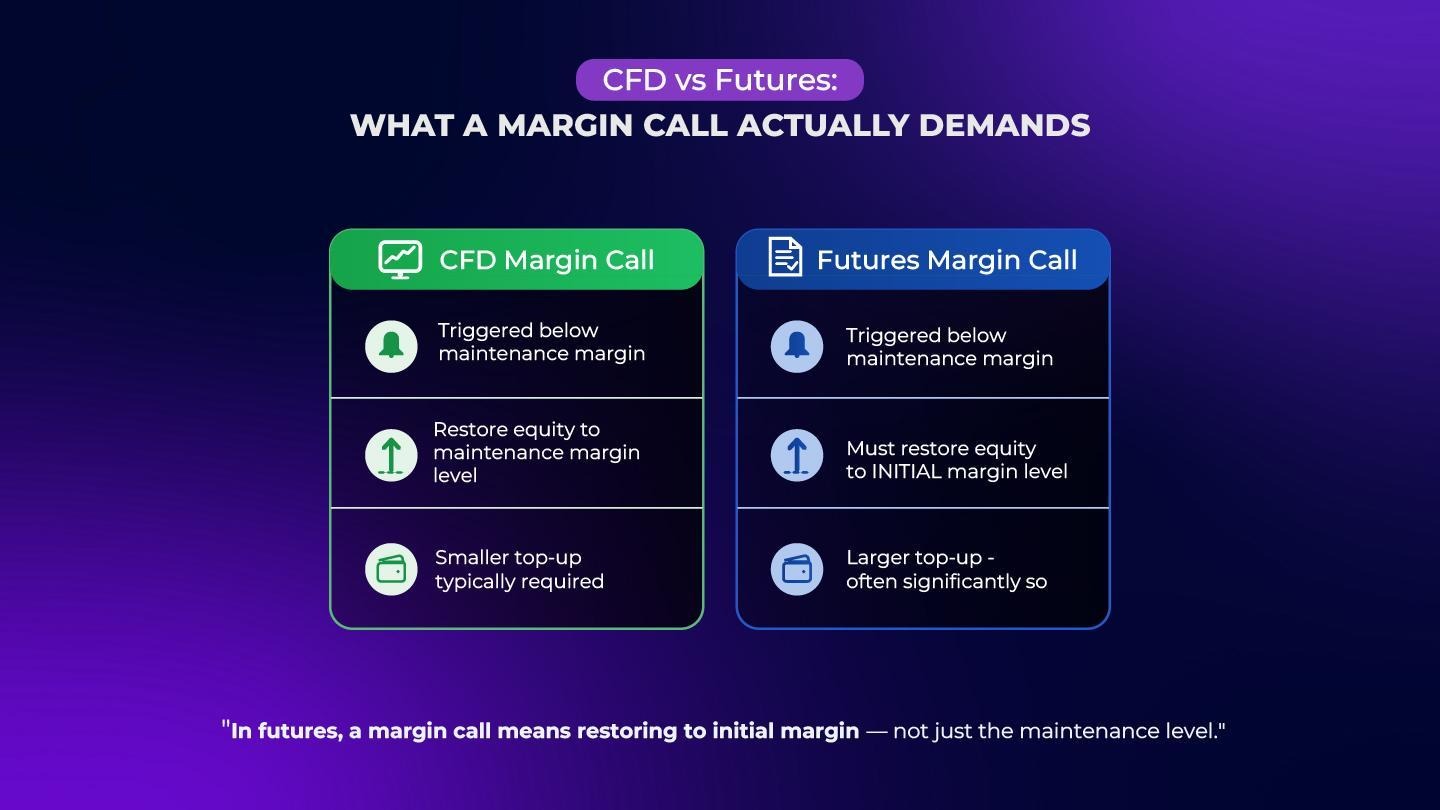
A critical distinction in futures trading is that a margin call requires you to restore your balance to the initial margin level — not just the maintenance margin level. This means the top-up required to meet a margin call in futures can be significantly larger than many traders anticipate.
Instrument: Crude Oil Futures (CL)
Initial margin: $6,000 per contract
Maintenance margin: $5,000 per contract
If account equity drops to $4,800:
→ Margin call triggered
→ Must deposit to restore to $6,000 (initial margin)
→ Required top-up: $1,200
This distinction — that futures margin calls require restoration to initial margin, not maintenance margin — is one of the most commonly misunderstood aspects of margin in trading. Every futures trader must understand it before they open a position.
Margin and Options Trading
Options trading introduces another dimension of margin requirements. When you sell options contracts, your broker will typically require a margin deposit to cover the potential obligation you are taking on. The margin requirement for options trading is calculated differently from standard leveraged positions — it is based on the risk of the options strategy being used rather than a simple percentage of the notional value.
For traders using a margin account for options trading, it is essential to understand how your broker calculates margin for each type of option strategy. Some strategies — such as naked short options — carry significant margin requirements due to the theoretically unlimited risk they involve. Others, such as covered calls or spreads, have lower margin requirements because the risk is defined and limited.
Whether you are using margin for forex, futures, CFDs, or options trading, the underlying principle remains the same: margin is required as collateral, and falling below the required level triggers a margin call.
Margin in Prop Firm Challenges
In a prop firm environment, margin mechanics work in the same way as in a standard brokerage account — but the consequences of mismanaging margin are compounded by the challenge rules. A margin call in a prop firm account does not just mean you need to deposit additional funds. It often means you are already deep into a drawdown that could end your challenge entirely.
Prop firm traders must have a margin account that is managed with exceptional discipline. The key habits are:
- Always know your margin utilisation — what percentage of your available margin is currently in use across all open positions
- Never open positions that would bring your margin utilisation above a safe threshold — the requirement at any time should leave sufficient buffer for adverse moves
- Factor the margin requirement into your position sizing — not just your risk percentage
- Avoid holding leveraged positions through high-risk events such as major economic data releases
- Monitor the equity in your account actively — do not wait for a margin call notification to assess your exposure
In a prop firm challenge, a margin call is rarely a recoverable situation. Understanding the risks of trading on margin — and managing them proactively — is what separates traders who pass challenges from those who do not.
How to Avoid Margin Calls
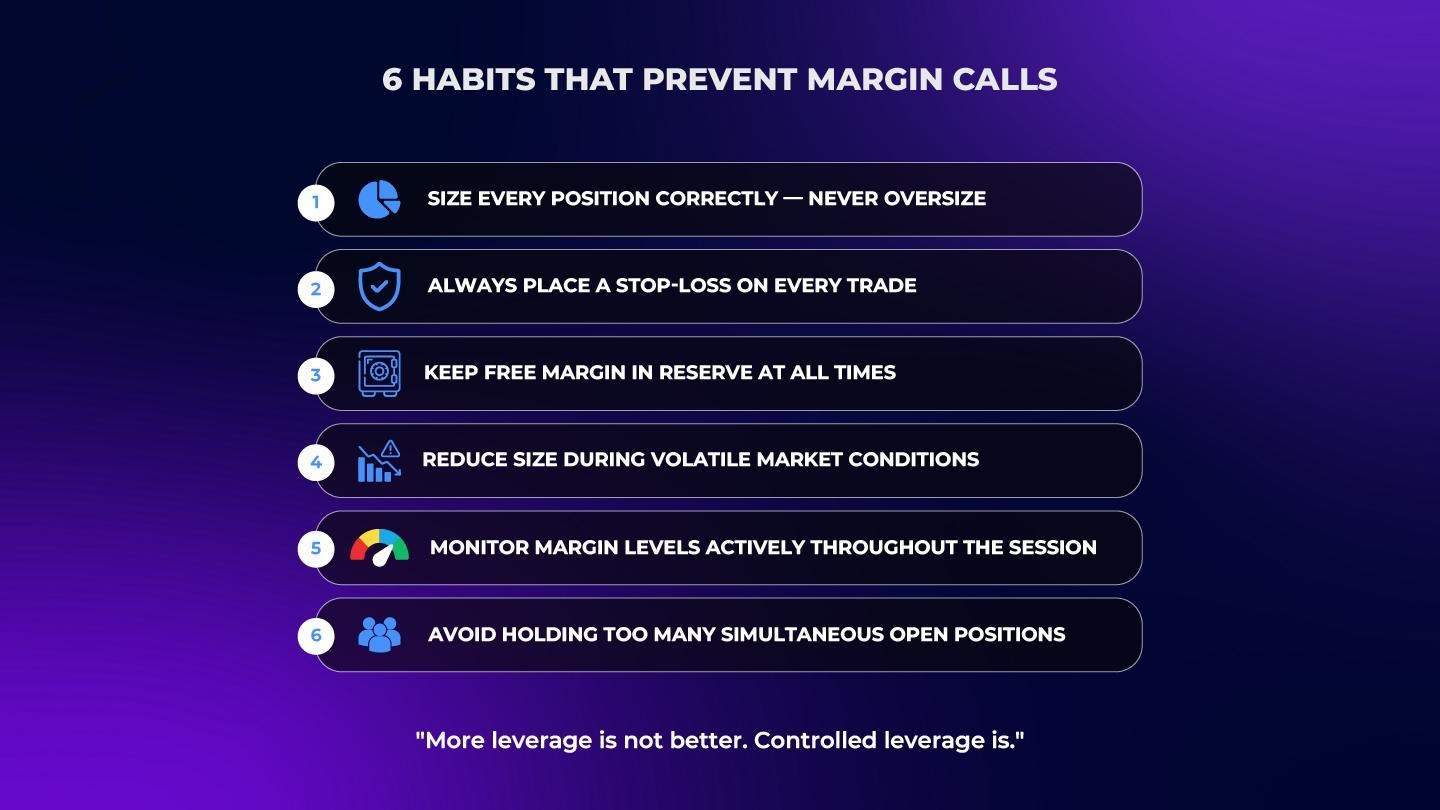
Margin calls are not random events. They are the predictable result of taking on more risk than your account balance can support. The risks of margin are real — but they are manageable with the right habits:
- Size every position correctly: Oversized positions are the primary cause of rapid margin erosion and the most common reason traders face a margin call
- Always use a stop-loss: A defined stop-loss limits how far a trade can move against you before it closes — without one, a single adverse move can consume your entire margin buffer
- Keep free margin in reserve: Do not deploy your entire account value into open positions. Maintaining a free margin buffer gives your account room to absorb adverse moves
- Reduce position size in volatile conditions: Higher volatility means larger price swings — your maintenance margin buffer can be consumed faster than expected
- Monitor your margin loan balance: Keep track of how much you have borrowed and what the associated margin interest costs are adding up to over time
- Avoid overtrading: Holding too many simultaneous positions multiplies your margin requirement and narrows your buffer against adverse moves
- Understand the risks before you use margin: The risks of margin trading are significant — always understand the risks fully before you increase your leverage or open a new margin position
Frequently Asked Questions
What is margin in trading?
Margin in trading refers to the deposit required to open and maintain a leveraged position. Margin means borrowing money from your broker to control a larger position than your own capital would allow. It is collateral — not a fee — and is returned to your account when the position is closed.
How does margin trading work?
Margin trading works by allowing you to open a position larger than your account balance by using a margin loan from your broker. You deposit the initial margin requirement, the broker provides the remainder, and you pay margin interest on the borrowed amount for as long as the position is open.
What is the difference between initial margin and maintenance margin?
The initial margin is the deposit required to open a position. The maintenance margin requirement is the minimum equity needed to keep it open. If your account equity falls below the maintenance margin, a margin call is triggered. In futures trading, meeting a margin call requires restoring your balance to the initial margin level — not just the maintenance level.
What happens when you get a margin call?
When a margin call is triggered, you must either deposit additional funds to meet the margin call or close open positions to reduce your margin loan balance. If you fail to act, your broker will begin automatic liquidation of your positions at market price.
Do I need a special account to trade on margin?
Yes — you must have a margin account to trade on margin. A standard cash account does not permit margin trading. To open a margin account, you will need to apply with your brokerage, sign a margin agreement, and meet the minimum margin deposit requirement.
What is margin interest?
Margin interest is the cost of the margin loan. It is charged at the margin interest rate set by your broker and accrues daily on the margin loan balance for as long as you hold a leveraged position. You pay margin interest whether the trade is profitable or not — it is a borrowing cost, not a trading fee.
How do I avoid a margin call?
The most reliable way to avoid a margin call is to size positions conservatively, always use a stop-loss, keep free margin in reserve, and avoid overtrading. Monitoring the equity in your account and your margin loan balance actively throughout the session is essential — do not wait for a notification to check your exposure.
Final Thoughts
Margin in trading is one of the most technically important concepts in leveraged markets — and one that traders cannot afford to misunderstand. Margin means borrowing money to amplify your market exposure. That amplification creates opportunity — but it also creates obligation.
The margin loan must be repaid. The margin interest accrues. The maintenance margin requirement must be maintained. And when the equity in your account falls short, the broker acts — automatically, and without waiting for your input.
Understanding the risks of margin trading in full — the margin call mechanics, the cost of borrowing, the maintenance margin requirements, and how automatic liquidation works — is the foundation of responsible margin investing. Whether you are trading forex, futures, CFDs, or using a margin account for options trading, the principles are the same.
Trading involves risk. Know your margin. Know your levels. Trade within your means — and within your rules. Learn to manage margin effectively in a structured trading environment — apply for a funded account with 4PropTrader and trade with professional risk parameters.