Quick Summary
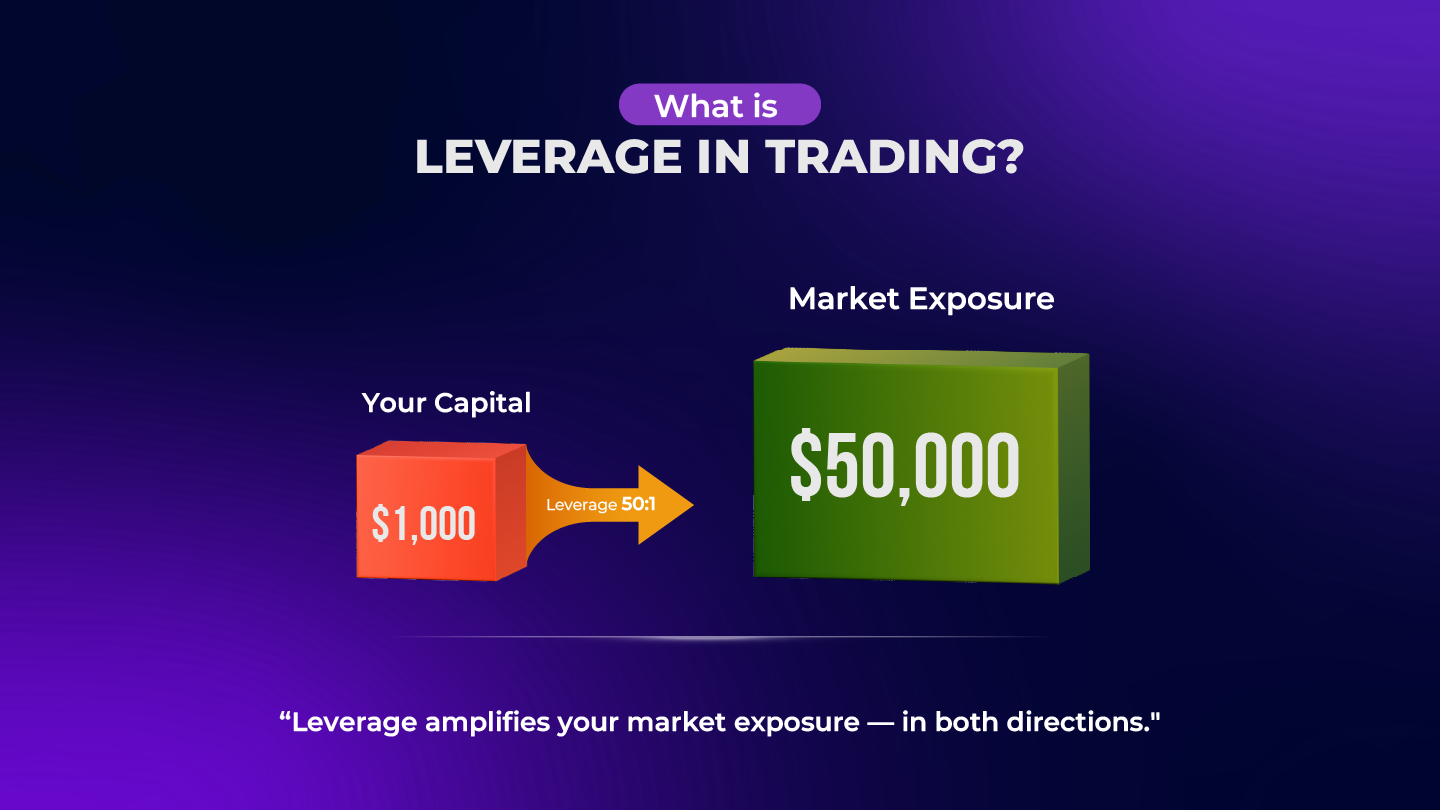
Leverage in trading is a capital amplification mechanism that allows you to control a position much larger than the amount of capital you have deposited. It is one of the most powerful tools available to traders — and one of the most misunderstood. Used correctly, leverage expands what is possible with a smaller amount of capital. Used carelessly, it can magnify losses just as effectively as it magnifies gains — and in extreme cases, lead to losing money rapidly due to leverage.
This article explains what leverage is, how leverage works, how it differs from margin, and how to approach it responsibly — particularly in CFD and futures trading environments where accounts lose money when trading CFDs at a high rate when leverage is misused.
Introduction
Leverage is one of the first concepts new traders encounter — and one of the last they truly master. It sounds straightforward on the surface: borrow money to control a bigger position. But the implications of that amplification run deep, and misunderstanding them is costly.
Understanding what leverage is in trading means understanding that it does not change the direction of the market, the quality of your strategy, or the reliability of your analysis. What it changes is the scale of the outcome. Every movement in price — up or down — is multiplied. Market movements that might seem small can produce outsized results on your account balance.
For traders operating in prop firm environments, understanding leverage is not optional. It is a fundamental part of how these accounts are structured. Using leverage trading without fully understanding it is one of the fastest ways to fail a challenge — and one of the primary reasons accounts lose money when trading CFDs and futures.
This article is part of an ongoing trading education series designed to help traders build a strong foundation in risk management and market mechanics. If you are new to leverage or want to sharpen your understanding before you trade with leverage on a funded account, this is where to start.
What Is Leverage in Trading?
Leverage is the use of borrowed capital — provided by a broker or prop firm — to increase your exposure to a financial market beyond what your initial capital alone would allow. In simple terms, leverage is a tool: a multiplier that scales up the size of your trading position relative to the amount you have actually committed.
Leverage allows you to control a larger position with a small amount of money. For example, with 10:1 leverage, you can control a $10,000 position using only $1,000 of your own funds. With 100:1 leverage, that same $1,000 controls a $100,000 position.
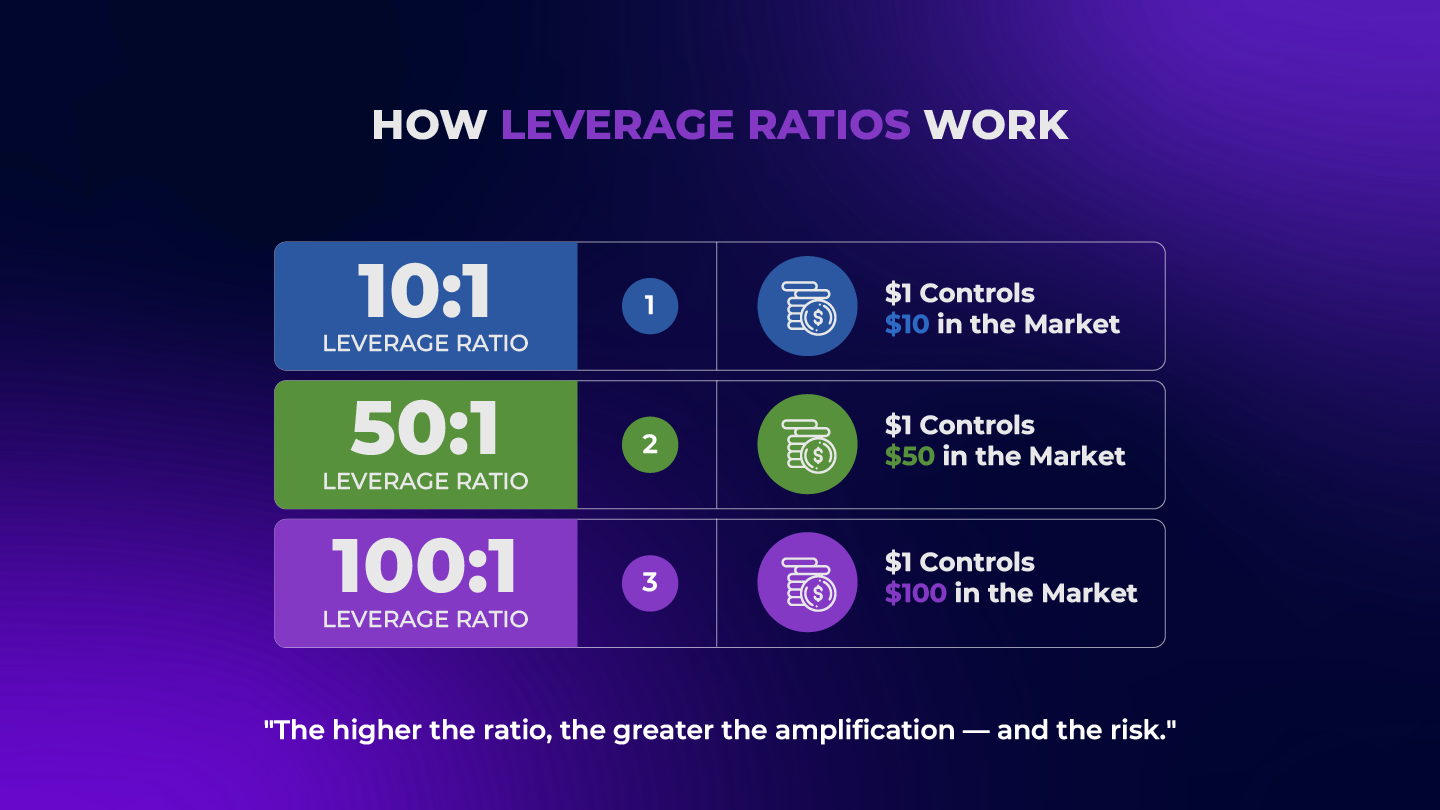
The leverage ratio tells you exactly how much market exposure you gain for every unit of capital you put in:
- 10:1 leverage ratio — every $1 of your capital controls $10 in the market
- 50:1 leverage ratio — every $1 of your capital controls $50 in the market
- 100:1 leverage ratio — every $1 of your capital controls $100 in the market
The higher the leverage, the greater your exposure to an underlying asset — and the greater the impact of every price movement on your account balance. This is why the amount of leverage you choose to use is one of the most consequential decisions you make as a trader.
It is worth noting that the history of leverage in financial markets goes back centuries, originally used by merchants and later institutionalised through margin accounts in equities and futures markets. Today, leverage is a standard feature of forex trading, CFD trading, and futures trading, and is available through most regulated trading platforms.
Leverage and Margin: Understanding the Difference
Leverage and margin are two terms that are often used interchangeably — but they describe different things, and confusing them leads to poor decision-making. Understanding both is essential before you trade with leverage.
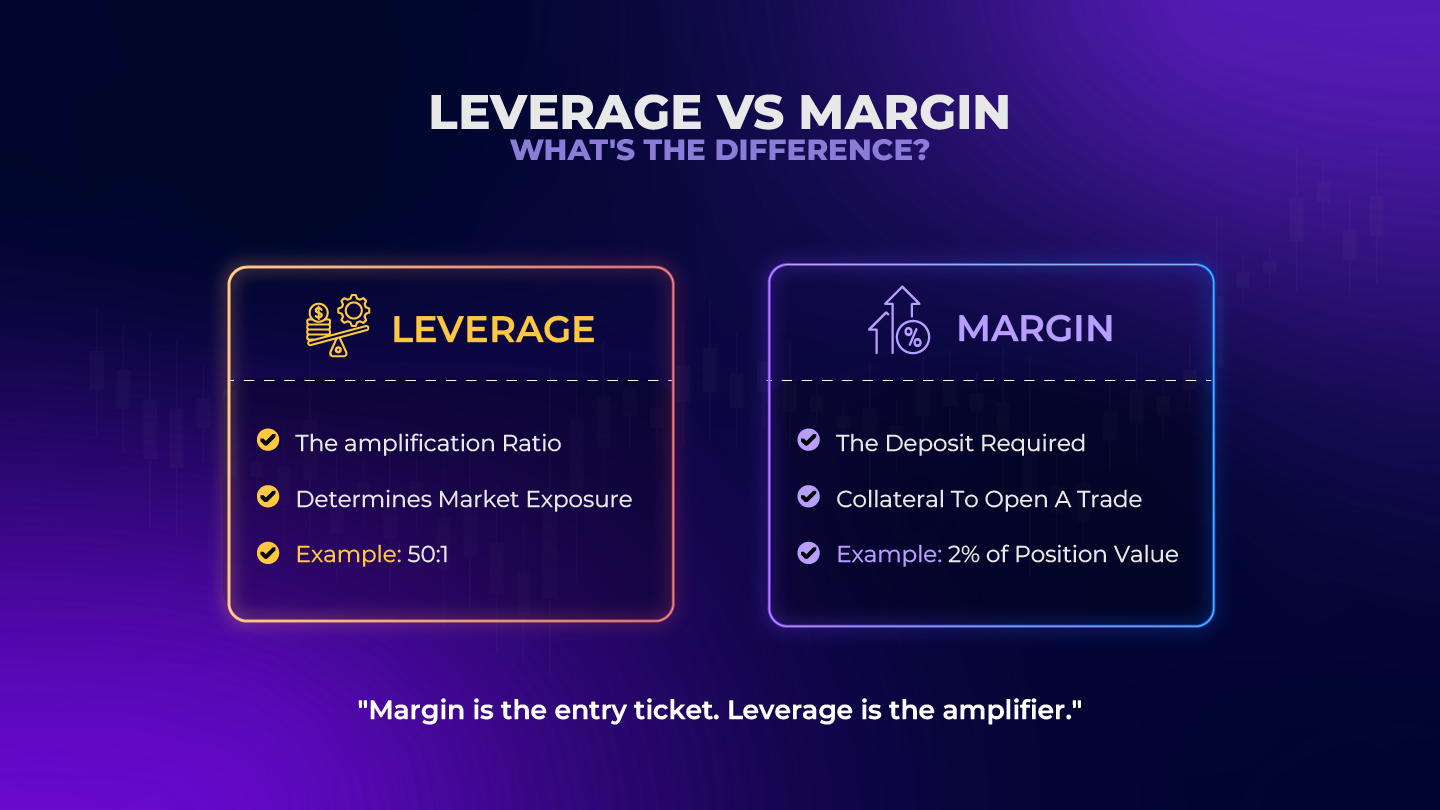
Leverage is the amplification ratio — the multiplier that determines how much market exposure you gain relative to your capital.
Margin — also known as margin requirement — is the deposit required to open and maintain a leveraged position. It is the portion of your own funds that your broker or prop firm sets aside as collateral when you enter a trade. Margin trading is simply the practice of trading using a margin account, where you put up a fraction of the full value of your position and the broker provides the rest.
Think of it this way: margin is what you pay to access leverage. The margin requirement is determined by the leverage ratio offered:
Leverage 10:1 → Margin requirement = 10% of position value
Leverage 50:1 → Margin requirement = 2% of position value
Leverage 100:1 → Margin requirement = 1% of position value
In a margin account, you are essentially using a smaller amount of capital to control a much larger position. The broker or prop firm makes up the difference. This is the fundamental mechanics behind leverage and margin working together.
It is important to understand that different brokers and instruments may have different margin requirements. Forex trading pairs, indices, and commodities often carry different leverage and margin structures — and these can be subject to change depending on regulatory requirements or market conditions.
One concept closely related to margin is the margin call. When your account balance falls below the maintenance margin — the minimum amount required to keep a position open — your broker may issue a margin call, requesting additional funds to cover the shortfall. If you cannot provide the additional funds, your position will be closed automatically. The full mechanics of margin calls will be covered in detail in Article 20.
How Leverage Can Magnify Gains and Losses
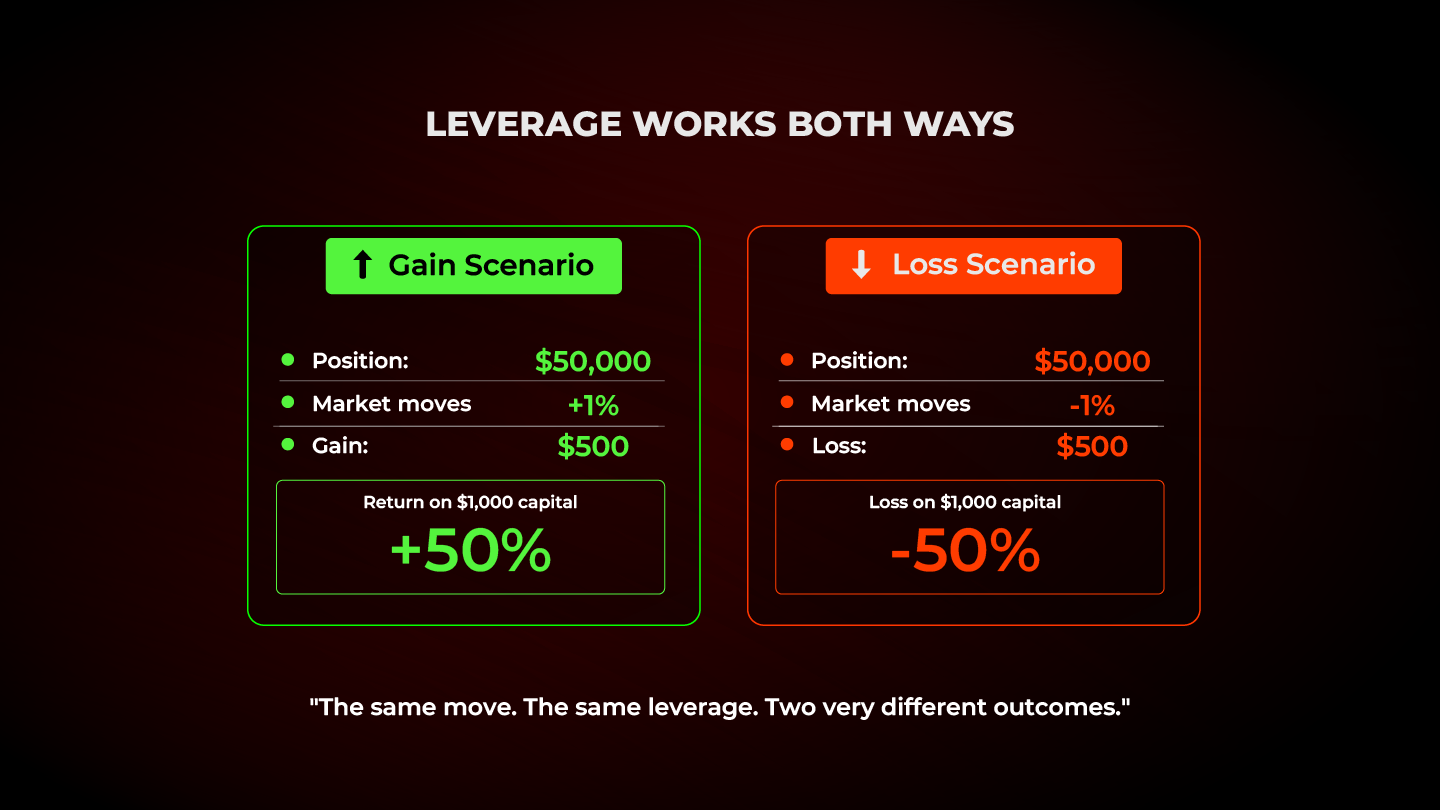
This is where leverage becomes both powerful and dangerous. Because leverage can magnify your market exposure, it magnifies the financial impact of every price movement — in both directions. Leverage can magnify profits significantly, but it will magnify losses with equal force.
Example 1: Leverage Amplifying a Gain
Suppose you have $1,000 in your trading account and you use 50:1 leverage to open a $50,000 position on one of the major currency pairs in forex trading.
Position size (full value): $50,000
Your initial capital: $1,000
Leverage ratio: 50:1
Price moves in your favour by 1%:
Gain on position = $50,000 × 1% = $500
Return on capital = $500 ÷ $1,000 = 50%
A 1% move in the market produced a 50% return on your initial investment. That is the power of leverage as a capital amplification mechanism — and why using leverage trading appeals to traders who want increased exposure to an underlying asset without committing large amounts of capital.
Example 2: Leverage Amplifying a Loss
Now consider the same position, but the market moves against you by 1%.
Position size (full value): $50,000
Your initial capital: $1,000
Leverage ratio: 50:1
Price moves against you by 1%:
Loss on position = $50,000 × 1% = $500
Loss on capital = $500 ÷ $1,000 = 50%
The same amplification that produced a 50% gain now produces a 50% loss on your account balance. A 2% adverse move wipes out the entire $1,000 deposit. This is the reality of high leverage — the potential loss is not limited to a small percentage of the position. It is tied directly to your initial capital, and with high leverage ratios, that capital can disappear very quickly.
This is precisely why the risk of losing money rapidly due to leverage is a regulated disclosure requirement for CFD brokers across most jurisdictions. CFDs are complex instruments, and the statistics on retail traders bear this out — a significant proportion of retail investor accounts lose money when trading CFDs with leverage.
The lesson is not to avoid leverage altogether — it is to understand that whether you can afford to take the high risk that comes with it depends entirely on your risk management framework, your position sizing discipline, and your stop-loss strategy.
Leverage in CFD and Futures Trading
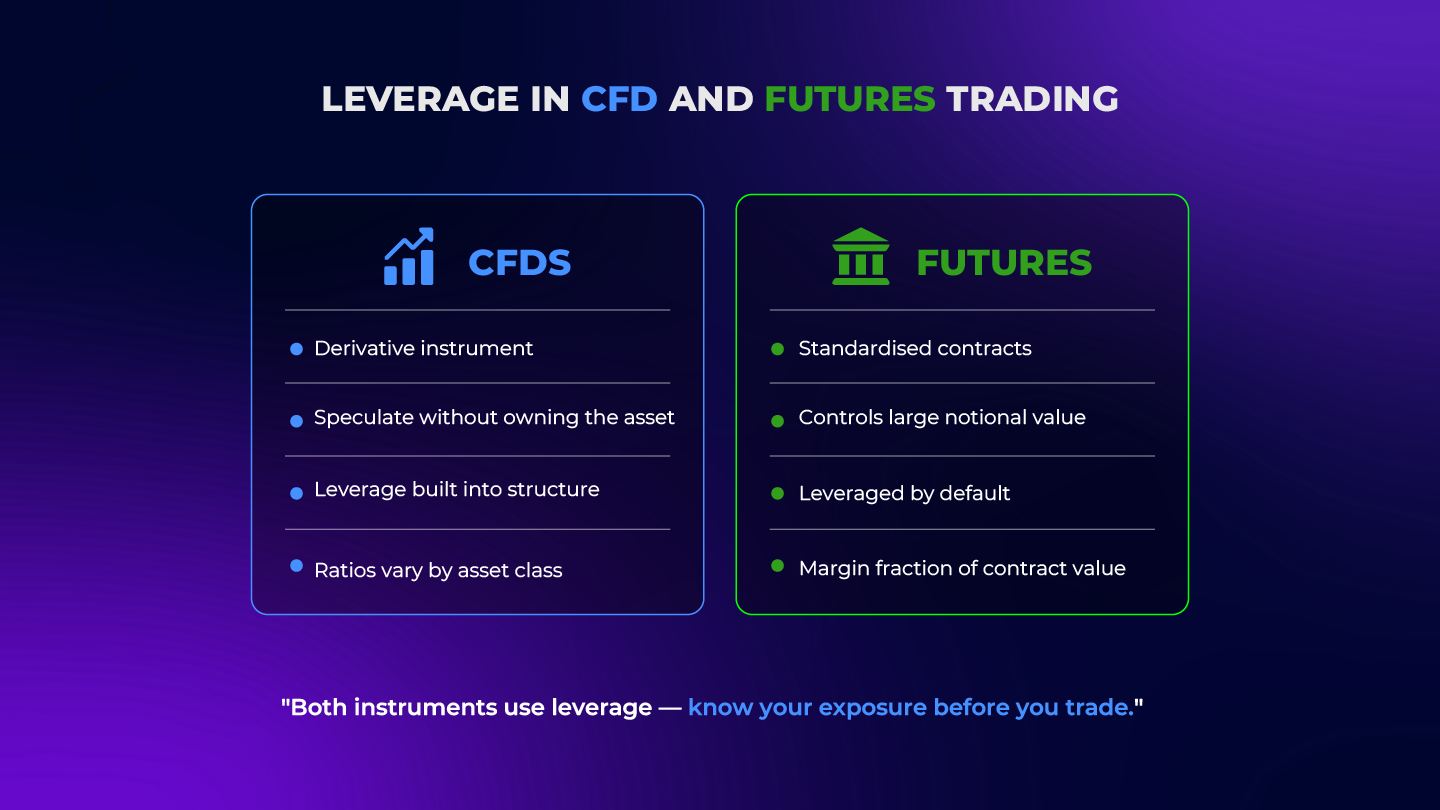
Leverage is a core feature of both CFD and futures trading — the two most common instruments used in prop firm environments. Understanding how leverage applies to each is essential for anyone looking to trade with leverage professionally.
Leverage in CFD Trading
CFDs — Contracts for Difference — are derivative instruments that provide exposure to the underlying asset without requiring you to buy or sell the asset itself. CFDs are complex instruments and come with a high risk of losing money rapidly due to leverage. This is not a warning to be dismissed — it is a structural reality of how CFDs work.
In CFD trading, leverage is built into the product. You open a trading position based on a fraction of the full value of your position, with the remainder effectively provided by your broker. This increased leverage gives you increased exposure to an underlying asset — which is the appeal — but it also means that adverse price movements affect your account balance at a multiplied rate.
CFD leverage ratios vary by asset class. Major forex currency pairs typically offer the highest leverage available. Indices and commodities sit in the middle range. Individual stocks generally carry lower leverage ratios. Different brokers may have different margin requirements across these categories, and maximum leverage limits are often set by financial regulators.
It is also worth noting that the leverage available in your account may differ depending on whether you are a retail or professional client — a distinction that matters for prop firm traders who operate across multiple trading platforms.
Leverage in Futures Trading
Futures contracts are standardised agreements to buy or sell an underlying asset at a set price on a future date. Like CFDs, futures are inherently leveraged — each contract controls a fixed, often substantial notional value that far exceeds the initial capital required to hold the position.
For example, a single E-mini S&P 500 futures contract controls a notional value of approximately $50 times the index level. At an index level of 5,000, that represents a $250,000 notional position — controlled with a margin requirement that is a fraction of that amount. Without leverage, a trader would need the full $250,000 in their account to control that position. With leverage, a small amount of capital achieves the same exposure.
In futures trading, understanding the full value of your position — and how that relates to your account balance — is essential. The leverage is significant by default, and the price movements in futures markets can be rapid. This makes risk management and position sizing non-negotiable skills for any futures trader.
The Benefits and Risks of Using Leverage
Leverage trading comes with genuine advantages — but they are inseparable from the risks. Understanding both sides is part of what it means to learn about leverage properly.
Benefits of Using Leverage:
- Capital efficiency: You can gain exposure to large positions with a small amount of capital, freeing up funds for other trades or opportunities
- Increased exposure: Leverage allows you to participate in markets and position sizes that would be inaccessible with your initial investment alone
- Profit amplification: When trades go in your favour, the returns on your initial capital are significantly higher than they would be without leverage
- Flexibility: Leverage is available across multiple asset classes and trading platforms, giving traders access to forex, indices, commodities, and stocks with a relatively small amount of money
Risks of Using Leverage:
- Magnified losses: Leverage can magnify losses just as effectively as it magnifies profits — and in highly volatile conditions, this can mean losing money rapidly
- Margin calls: If your account balance drops below the maintenance margin, your broker may issue a margin call or close your position automatically
- Entire account at risk: With high leverage ratios and no stop-loss, a single adverse move can threaten your entire account
- Psychological pressure: Increased leverage creates increased exposure, which amplifies the emotional impact of market movements and can lead to poor decision-making
- Complexity: CFDs are complex instruments and leverage adds a layer of risk that requires genuine understanding — trading can be risky without it, and significantly more so with it
The benefits and risks of leverage are two sides of the same coin. The traders who benefit from leverage consistently are those who understand both sides equally — and who never use leverage without a clear risk management plan in place.
Leverage in Prop Firm Challenges
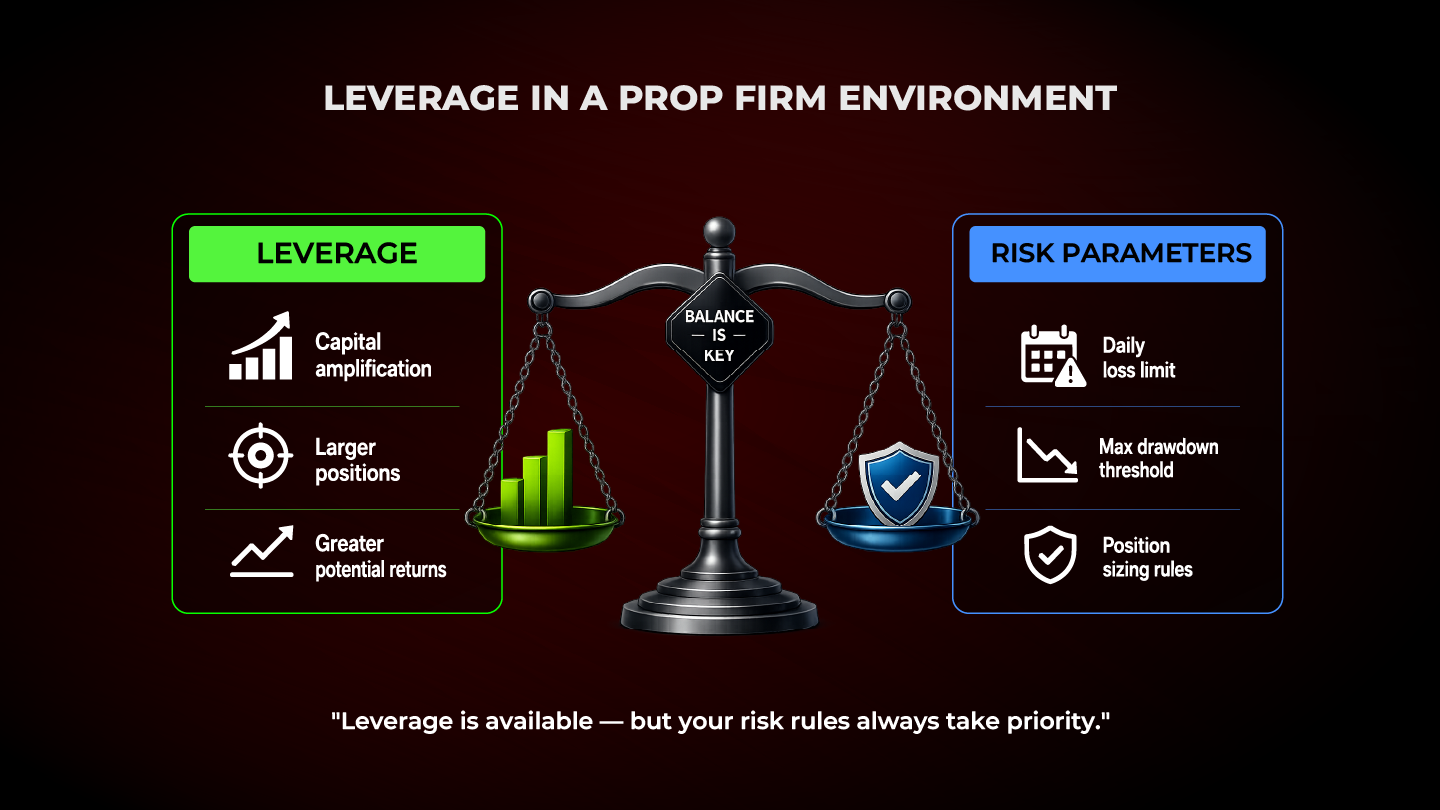
Prop firms provide traders with access to significantly larger capital than they could typically trade on their own. This capital comes with leverage built in — and with strict risk parameters designed to protect both the trader and the firm.
Most prop firm challenges define maximum leverage levels, daily loss limits, and overall drawdown thresholds. The leverage available in a funded account is a significant advantage — but it must be used within the boundaries of those rules. Increased leverage without discipline is the fastest way to breach a drawdown limit and lose a funded account.
The key principle for prop firm traders is this: just because high leverage is available does not mean it should be maximised. The goal is not to use the maximum leverage on every trade. It is to use the amount of leverage that your risk management framework supports — where your position sizing, stop-loss placement, and account balance all align.
Traders who treat leverage as a tool — rather than a shortcut to profits — are the ones who pass challenges and maintain funded accounts over time. Those who use leverage trading without discipline are the reason why the statistics on accounts that lose money when trading CFDs are as high as they are.
Managing Leverage Responsibly
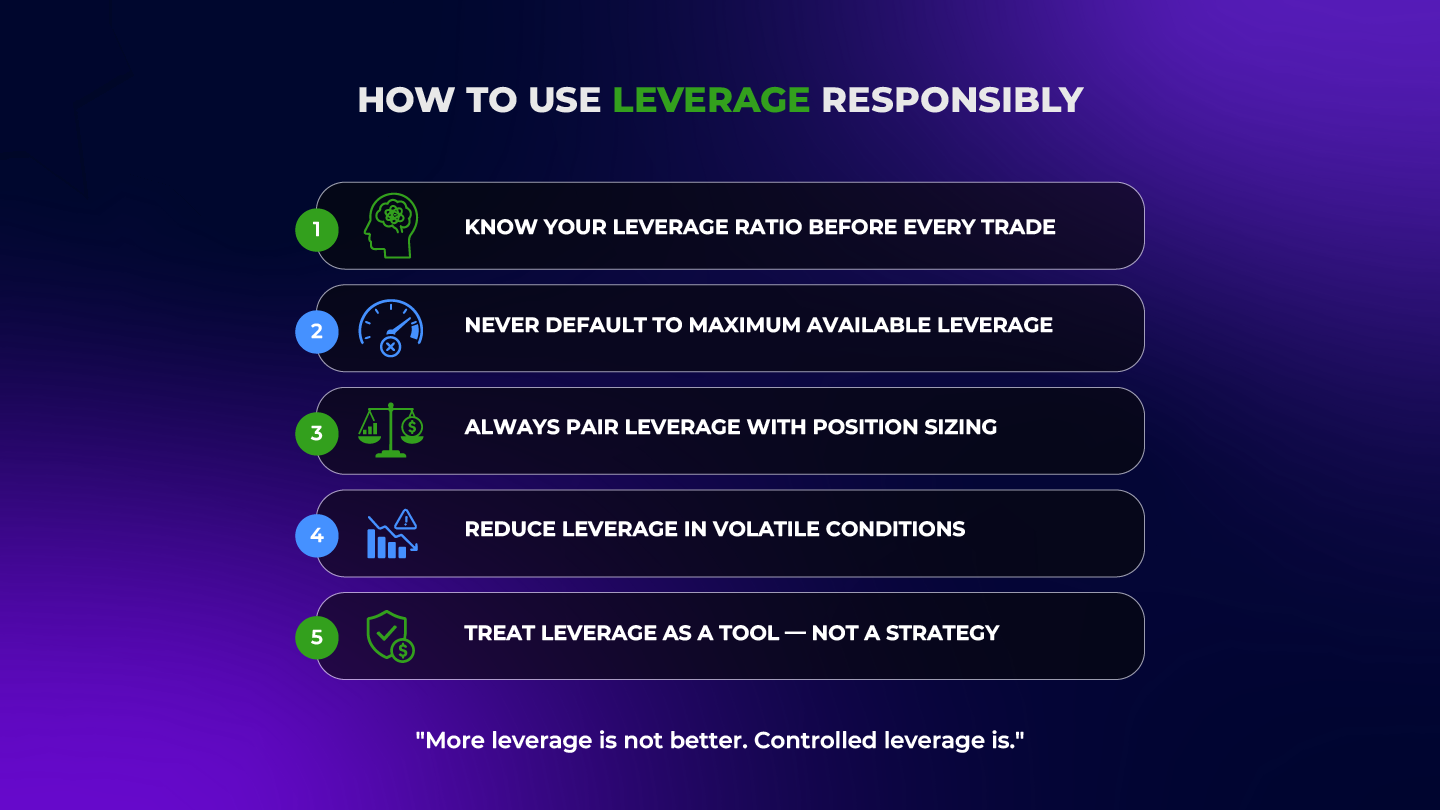
Responsible use of leverage is not complicated — but it requires consistent discipline. Here are the core habits every trader should build:
- Know your leverage ratio before opening any position — understand what a 1% market move means in real dollar terms for your account balance
- Never use maximum leverage by default — higher the leverage, the smaller the price movement needed to produce a significant loss
- Pair leverage with position sizing — your risk per trade should always be calculated based on the full value of the leveraged position, not just your margin deposit
- Reduce leverage in volatile market conditions — increased leverage in fast-moving markets dramatically increases the risk of losing money rapidly due to leverage
- Use a demo account first — if you are new to leverage trading or testing a new strategy, a demo account allows you to learn about leverage in a risk-free environment before committing real capital
- Consider whether you understand how leverage works before increasing it — if you are unsure about the full value of your position or how losses are calculated, do not increase your leverage ratio until you do
- Always ask yourself whether you can afford to take the high risk associated with the leverage level you are using — if the answer is uncertain, reduce your exposure
The traders who use leverage most effectively are not those who use the most of it. They are the ones who understand exactly what it does to their risk profile — and who size their positions accordingly, every single time.
Leverage and Ongoing Trading Education
Understanding leverage is not a one-time lesson. Markets evolve, instruments change, and the leverage available in your account may shift as regulations or broker policies are updated and subject to change. Staying informed is part of trading professionally.
As part of your ongoing trading education, it is worth regularly reviewing:
- The leverage ratios offered by your broker or prop firm across different instruments
- How margin requirements may have changed for the assets you trade
- Whether the amount of leverage you are using still aligns with your current risk management plan
- How leverage interacts with your position sizing and stop-loss strategy in your current market conditions
The best traders treat leverage as something to be understood continuously — not mastered once and forgotten. Using leverage trading effectively is an ongoing practice, not a fixed skill.
Frequently Asked Questions
What is leverage in trading?
Leverage in trading is a mechanism that allows you to control a larger position than your initial capital would normally allow. It is provided by a broker through a margin account and expressed as a ratio — for example, 50:1 means $1 of your capital controls $50 of market exposure.
How does leverage work?
Leverage works by amplifying your market exposure. When you open a leveraged position, your broker provides the additional funds required to control the full value of the position. You only need to deposit the margin requirement — a fraction of the total position value. Any profits or losses are calculated based on the full value of your position, not just your deposit.
What is the difference between leverage and margin?
Leverage is the multiplier that determines your market exposure. Margin is the deposit required to open and hold a leveraged position. They are directly related — higher leverage means a lower margin requirement — but they describe different aspects of the same trade.
Is leverage a tool or a risk?
Leverage is a tool — but it comes with a high risk of losing money if misused. Leverage is a tool that amplifies both gains and losses. Whether it helps or harms you depends entirely on how it is applied — specifically, whether it is paired with disciplined risk management, proper position sizing, and a clearly defined stop-loss.
What leverage should I use on a prop firm challenge?
Use only as much leverage as your position sizing and risk management framework supports. More leverage is not better. The leverage available in your account is a ceiling — not a target. Most experienced prop firm traders use a fraction of the maximum leverage available to them.
Why do so many accounts lose money when trading CFDs?
CFDs are complex instruments, and the high risk of losing money rapidly due to leverage is real. Most retail accounts lose money when trading CFDs because traders use too much leverage without adequate risk management, trade without a defined stop-loss, or fail to understand the full value of their position before entering a trade.
Should I use a demo account before trading with leverage?
Yes — especially if you are new to leverage trading or unfamiliar with a specific instrument. A demo account allows you to learn to trade with leverage in a simulated environment, understand how price movements affect your account balance, and test your risk management approach before any real capital is at risk.
Final Thoughts
Leverage in trading is one of the defining features of modern financial markets — and one of the most important concepts to understand before you risk real capital.
At its core, leverage is a tool. It gives you access to a larger position and greater exposure to an underlying asset than your account balance alone would allow. That amplification works in your favour when trades go well — and against you when they do not. The market does not distinguish between the two, and neither does leverage.
The use of leverage is not inherently dangerous. What is dangerous is using it without understanding it — without knowing the full value of your position, without a stop-loss in place, and without a risk management framework that accounts for what happens when price movements go against you.
Trading can be risky at the best of times. Leverage amplifies that risk. But it also amplifies opportunity — and for traders who learn about leverage properly, apply it with discipline, and treat it as the tool it is, it remains one of the most valuable mechanisms available in the markets.
Use leverage wisely. Trade leveraged products responsibly with 4PropTrader’s funded accounts — access professional capital while operating under clear risk management guidelines.