Quick Summary
The consistency rule in prop trading is a payout eligibility requirement that limits how much of a trader's total profit can come from a single trading day. It exists to ensure that payouts reflect genuine, repeatable trading skill rather than one oversized trade or one lucky session. Most prop firm consistency rule structures require that no single day's profit exceed a defined percentage of total profit — commonly 40% — before a trader can request a payout.
This article goes deep into the consistency rule specifically — the full calculation method, multiple worked examples, why every prop firm enforces some version of this rule, and exactly how to structure your trading behavior to remain compliant.
Introduction
Every prop trader eventually encounters the consistency rule — usually right when they are preparing to make a payout for the first time. It can feel like an unwelcome surprise: an account that looks profitable on paper suddenly fails to meet the requirement because one single trading day produced a disproportionate share of the total profit.
This is not a technicality designed to withhold payouts. The consistency rule exists because prop firms need a reliable way to distinguish between traders who have a repeatable edge and traders who got lucky on one trade. Understanding exactly how the consistency rule works — the calculation, the threshold, and the trading behavior it rewards — is essential for any funded account holder who wants to request a payout without unnecessary delay.
This guide covers the consistency rule in prop trading in full detail, including the calculation, real worked examples, and a practical framework for keeping your trading style compliant across every payout cycle.
What Is the Consistency Rule in Prop Trading?
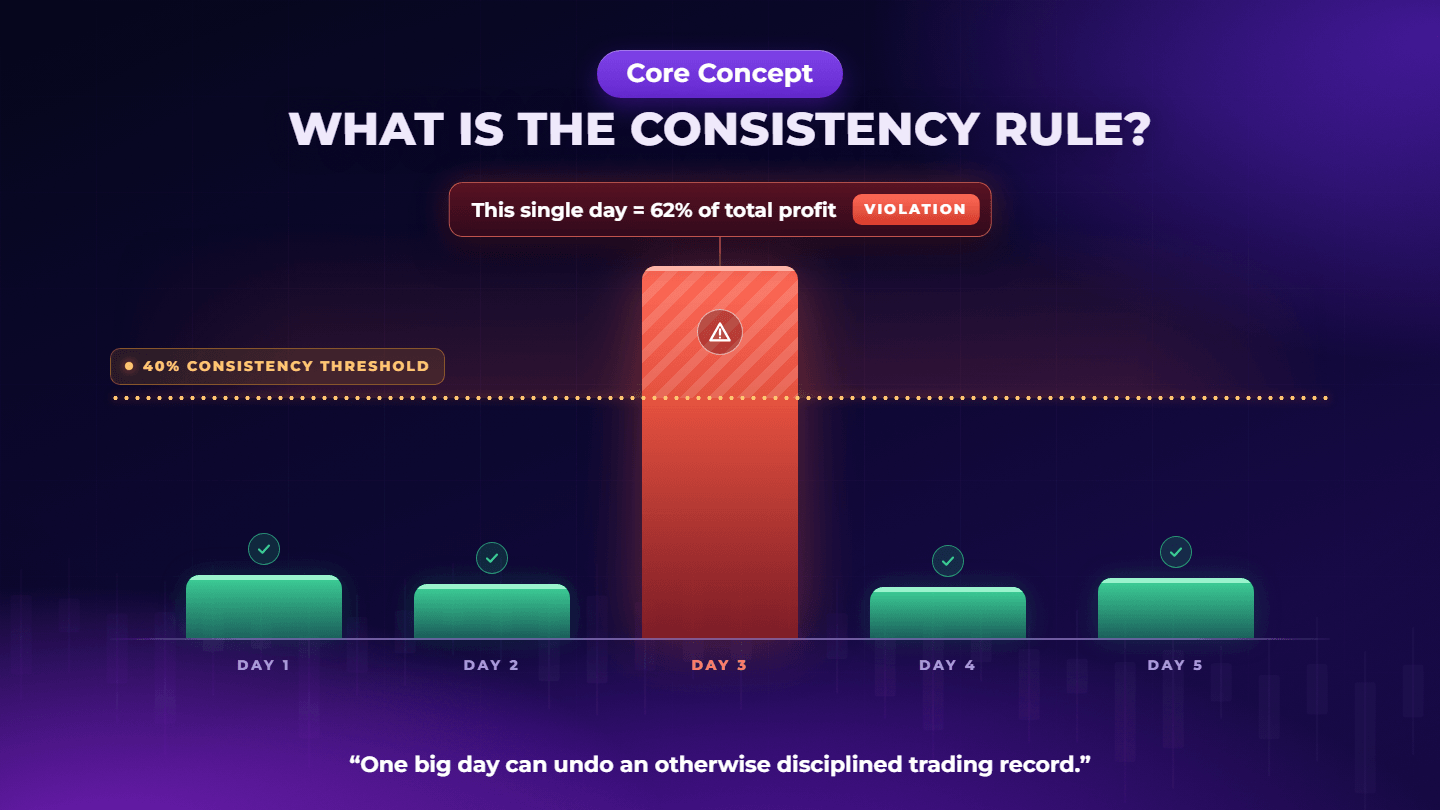
The consistency rule is a prop firm requirement that limits how much of a trader's total profit within a payout cycle can be attributed to a single trading day. In simple terms: the consistency rule requires that your best trading day must not exceed a defined percentage of your total profit before you are eligible to request a payout.
The specific consistency threshold varies by firm — some set the consistency limit at 30%, others at 40% or 50% — but the underlying consistency requirement is the same across the industry: no single day's profit should dominate the trader's overall performance.
Here is the consistency rule explained in its simplest form:
- Every prop firm tracks the net profit generated on each individual trading day
- At the end of a payout cycle, the firm calculates what percentage of total profit came from the single best trading day
- If that percentage exceeds the firm's consistency threshold, the payout request cannot be approved until the trader continues trading to bring the percentage back into compliance
- This applies regardless of how profitable the account is overall — a highly profitable account can still fail the consistency requirement
It's worth noting that consistency rules on funded accounts are not universal — some accounts have no consistency rule at all, particularly certain futures prop firms or account types designed for more aggressive trading styles. Always confirm whether a consistency rule applies to your specific funded account before planning your payout strategy around it. Understanding how the consistency rule on funded accounts actually rules work in practice — including how a losing day is treated in the total profit calculation — is just as important as knowing the threshold itself. A losing day simply reduces total profit; it does not carry a penalty of its own under the consistency rule, since the rule limits only the concentration of profit, not the presence of losses.
Why the Consistency Rule Exists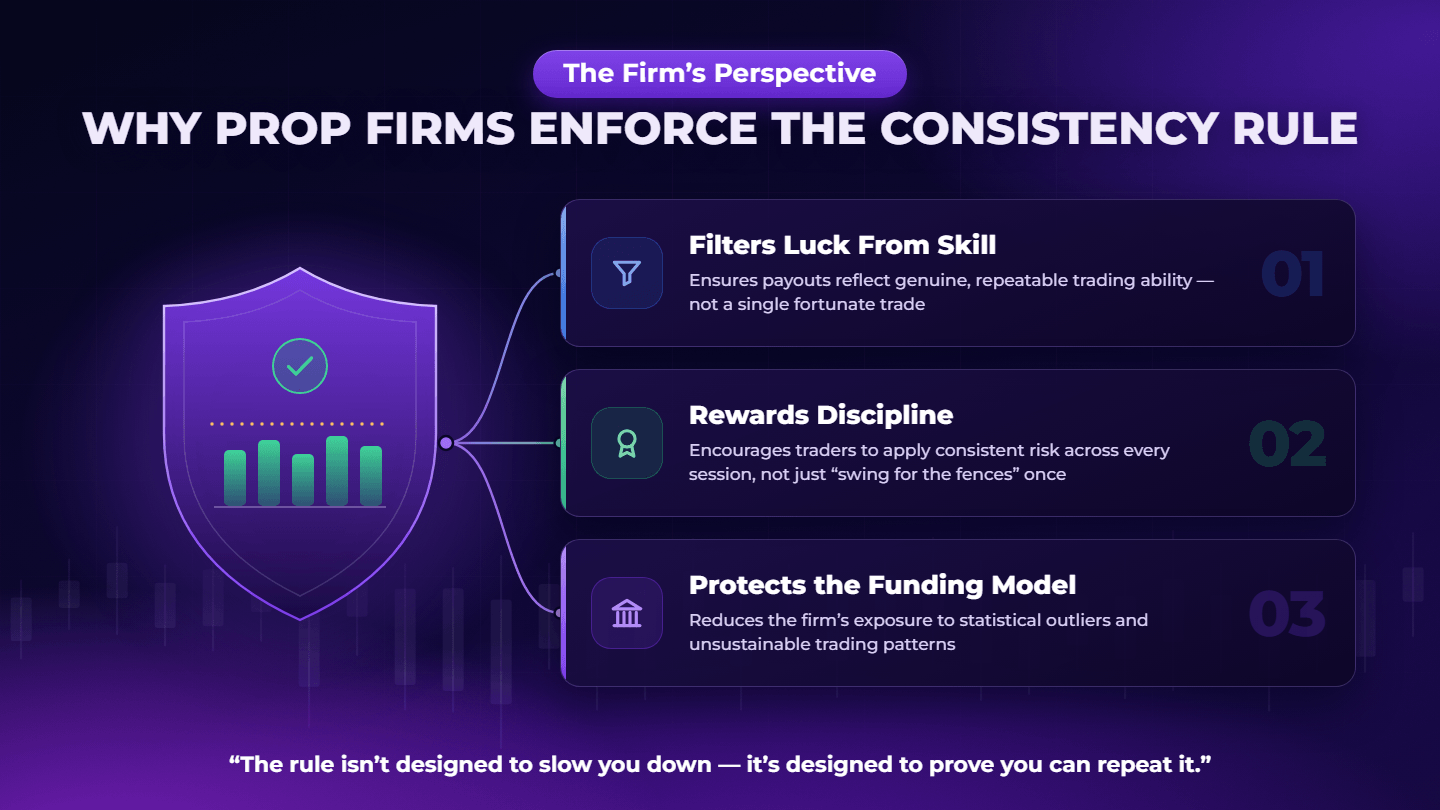
The consistency rule exists for a simple reason: prop firms need to prevent a trader from generating a payout-eligible profit through one oversized trade or one abnormal trading day, rather than through demonstrated, repeatable skill.
Consider why this matters from the firm's perspective. A funded account that generates $10,000 in profit sounds impressive. But if $8,000 of that came from a single trade taken with far more risk than the trader's normal risk per trade, the firm has no real evidence that the trader can repeat that result. The consistency rule forces the data to reveal the difference between skill and a single fortunate outcome.
The consistency rule serves several specific purposes:
- Rewards steady approach over gambling: A trader who applies consistent daily risk across multiple sessions demonstrates a repeatable process. The consistency rule financially rewards this trading behavior over one big winning day.
- Prevents overtrading and oversized risk: Because one oversized trade can push the best day's profit above the threshold, the consistency rule indirectly discourages traders from taking outsized risk per trade in pursuit of a single large win. In effect, it prevents traders from treating their trading account like a lottery ticket rather than a business.
- Protects the payout system: Every prop firm relies on statistically sound performance data before releasing capital. The consistency rule filters out results driven by variance rather than genuine trading skill.
- Creates a transparent rule that applies equally: Because the consistency rule is a percentage-based calculation rather than a subjective judgment, it applies the same way to every prop trader regardless of account size or trading style.
In short, the consistency rule exists to ensure that when a firm approves a payout, it is approving genuine, repeatable performance — not a single statistical outlier dressed up as skill.
How the Consistency Rule Is Calculated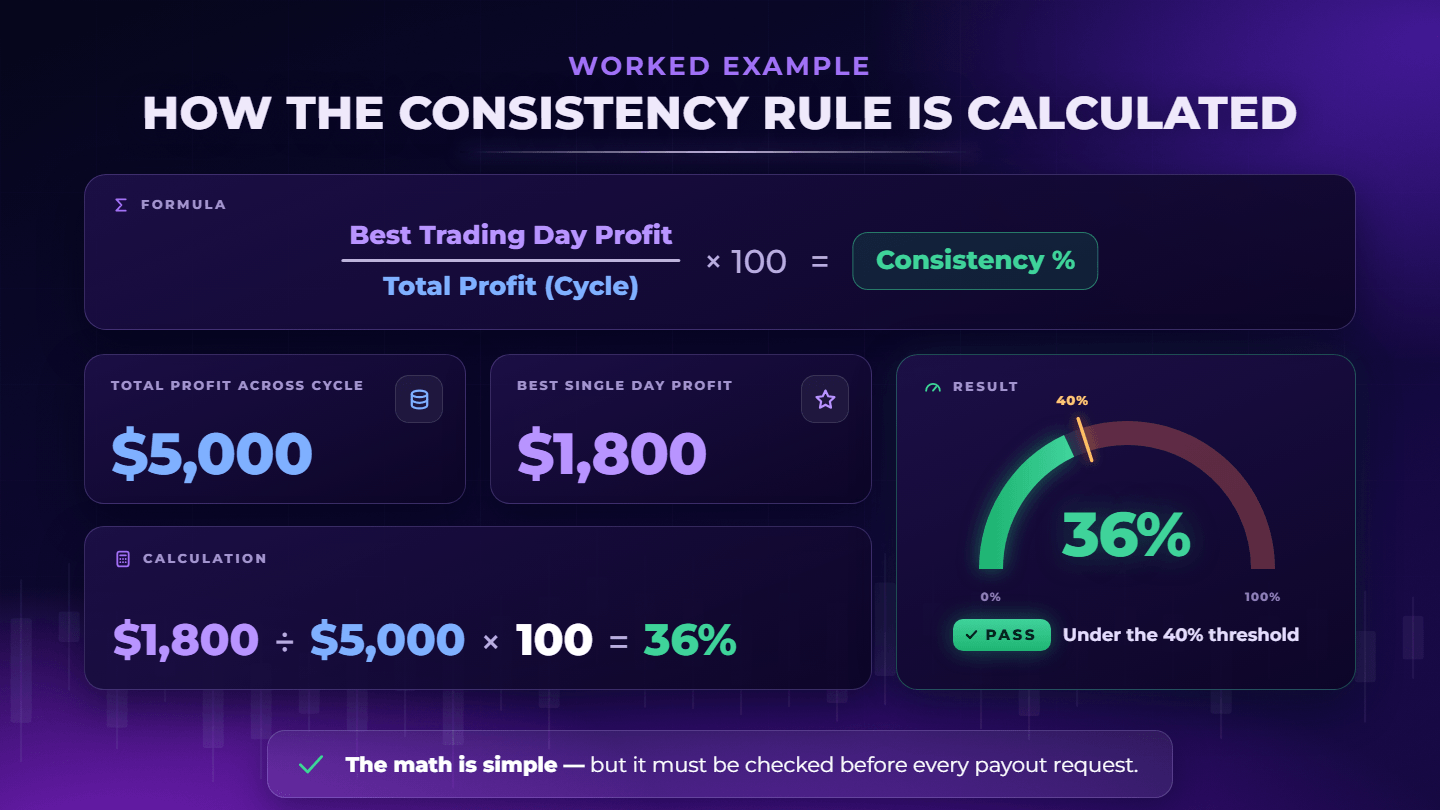
The calculation behind the consistency rule is straightforward once you see it laid out. The formula is:
CONSISTENCY RULE CALCULATION
Best Trading Day Profit / Total Profit (Payout Cycle) x 100
= Consistency Percentage
If Consistency Percentage <= Consistency Threshold: COMPLIANT
If Consistency Percentage > Consistency Threshold: NOT YET ELIGIBLE
To meet the consistency requirement, a trader's consistency percentage must fall at or below the firm's stated threshold — commonly 40%. Let's walk through several worked examples to see how this plays out in practice.
Example 1: A Compliant Trading Record
A trader has generated the following daily profit across five profitable trading days in the current payout cycle:
Day 1: $900
Day 2: $1,100
Day 3: $1,250 <- best day
Day 4: $950
Day 5: $800
Total profit: $5,000
Best day: $1,250
Calculation: $1,250 / $5,000 x 100 = 25%
Result: 25% is below the 40% threshold -> COMPLIANT
This trader can request a payout immediately, since no single trading day accounts for more than 25% of total profit — well within a 40% consistency limit. The profit was earned across multiple profitable sessions rather than concentrated in one.
Example 2: A Non-Compliant Trading Record
Now consider a trader with the same total profit, but a very different distribution across their trading days:
Day 1: $200
Day 2: $150
Day 3: $3,200 <- best day (one oversized trade)
Day 4: $250
Day 5: $1,200
Total profit: $5,000
Best day: $3,200
Calculation: $3,200 / $5,000 x 100 = 64%
Result: 64% exceeds the 40% threshold -> NOT YET ELIGIBLE
Both traders reached the same profit target and the same total profit. But the second trader's best trading day represents 64% of the total — far above the consistency threshold. Despite an equally profitable account, this trader cannot yet request a payout. They need to continue trading across additional sessions until their best day's profit represents 40% or less of the new total.
Example 3: Bringing a Non-Compliant Account Back Into Range
Using the same trader from Example 2, here is how additional profitable trading brings the account back into compliance:
Existing total profit: $5,000 (best day: $3,200 = 64%)
Trader continues trading and adds:
Day 6: $1,500
Day 7: $1,800
New total profit: $5,000 + $1,500 + $1,800 = $8,300
Best day remains: $3,200
New calculation: $3,200 / $8,300 x 100 = 38.5%
Result: 38.5% is below the 40% threshold -> COMPLIANT
By continuing to trade profitably across multiple additional sessions, the trader diluted the weight of the single oversized day relative to total profit. This is the practical mechanism behind meeting the consistency rule after an initial violation — keep trading, keep the risk per trade consistent, and let the best day's profit become a smaller percentage of your total profits over time.
How the Consistency Rule Varies by Firm
The consistency threshold varies by firm, and understanding this variation matters when comparing prop firms or funded account structures. Among the best prop firms and futures prop firms in the market, consistency rules explained on their websites typically fall into one of a few common structures:
- 40% threshold:
- One of the most common consistency limits used across the industry — no single trading day may account for more than 40% of total profit
- 30% threshold:
- A stricter consistency requirement used by some prop firms, demanding an even more evenly distributed trading record
- No consistency rule:
- Some accounts have no consistency rule at all — often reserved for specific account types or evaluation tiers where the firm relies more heavily on drawdown limits and daily loss limit rules to manage risk instead
It is also worth noting that consistency rules typically apply only to real trading on funded accounts — during the simulated trading phase of an evaluation, many prop firms do not enforce a consistency rule, focusing instead on the profit target and drawdown compliance. Always check the specific rules that apply to your account type, since prop trading firms are not standardised on this point. The consistency rule is separate from the profit split a firm offers, and separate from whether drawdown is measured on an EOD (end-of-day) basis or intraday — these are all distinct terms that govern how a firm manages its trading capital exposure across different financial products and account types.
Common Mistakes That Lead to Consistency Rule Violations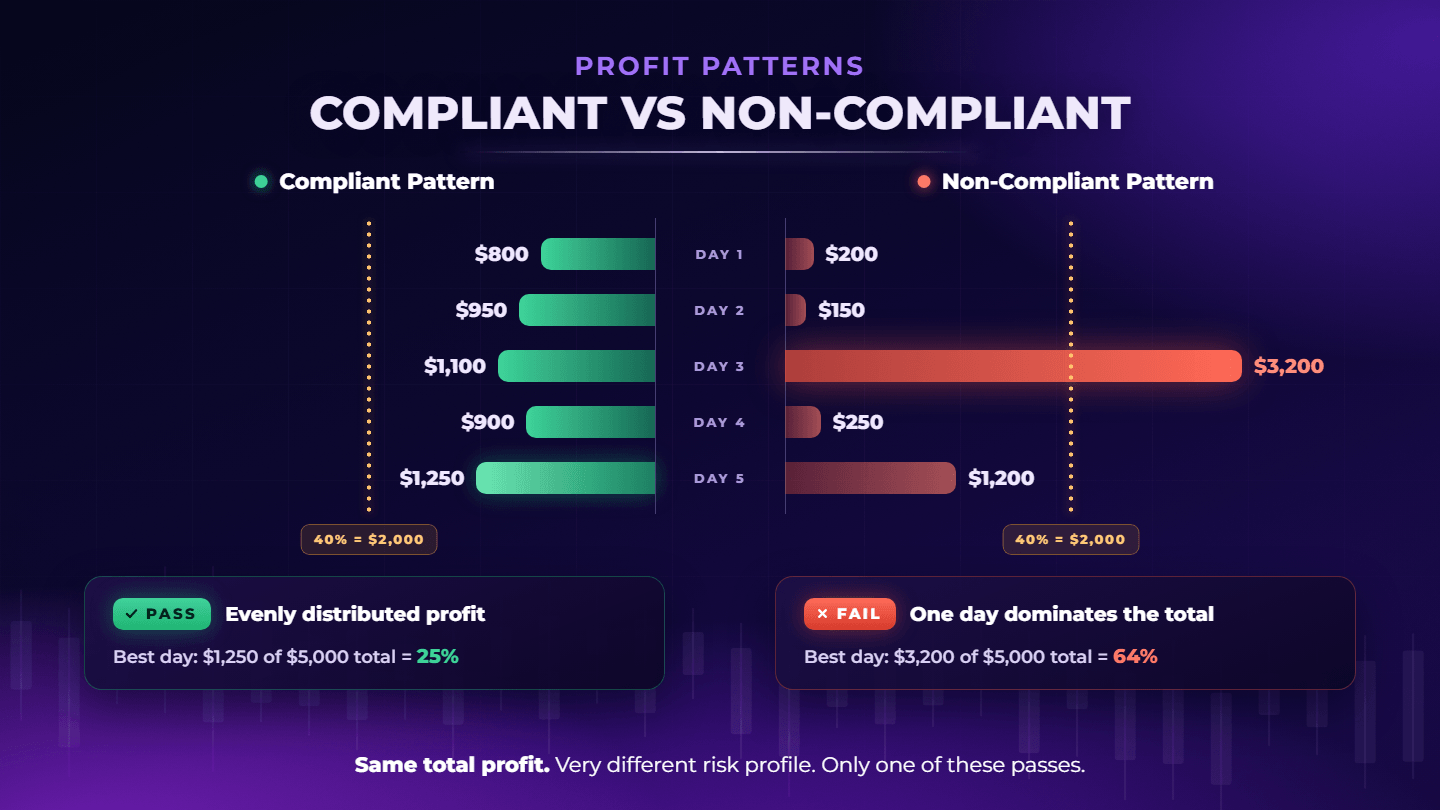
Most consistency rule violations are avoidable. They typically stem from a small number of recurring mistakes in trading behavior:
Taking One Oversized Trade
The single most common cause of a consistency rule violation is one oversized trade — a position sized well beyond the trader's normal risk per trade that happens to produce an outsized winning day. Even though the trade was profitable, it distorts the profit distribution across the payout cycle and can push the best day's profit well past the threshold.
Stopping Trading Too Early After a Big Day
A trader who has one exceptionally profitable day may be tempted to stop trading and request a payout immediately, assuming the profit target has been met. But if that single day represents a large percentage of total profit, the payout request will not be approved until the trader continues trading across additional profitable sessions to dilute the percentage.
Not Tracking the Consistency Percentage Proactively
Many traders only discover a consistency rule violation after attempting to make a payout — at which point they must go back and keep trading to fix it. Using a consistency calculator, or simply tracking daily profit against total profit manually after every trading day, allows a trader to spot a developing violation early and adjust their trading style before it becomes a problem.
How to Stay Compliant With the Consistency Rule
.png)
Meeting the consistency requirement consistently is less about avoiding profit and more about how that profit is distributed. The following practices help most prop traders remain compliant without changing their overall trading style:
- Keep risk per trade fixed: A consistent risk percentage per trade naturally limits how large any single day's profit can become relative to your overall total profit
- Recalculate your consistency percentage regularly: Don't wait until you're ready to request a payout — check your best trading day against your total profit after every trading day
- Avoid chasing one big winning day: A steady approach across multiple sessions is more valuable for payout eligibility than a single spectacular result
- Continue trading if you're close to the threshold: If your consistency percentage is above the limit, the fastest resolution is usually to keep trading profitably rather than stopping and waiting
- Use a consistency calculator if your platform offers one: Many funded account dashboards include a built-in consistency calculator that shows your current percentage in real time
None of these practices require sacrificing profitability. They simply require applying the same risk management discipline that good trading already demands — fixed risk per trade, respect for drawdown limits, and a steady approach across multiple sessions rather than relying on one big trade to hit a profit target.
Frequently Asked Questions
What is the consistency rule in prop trading?
The consistency rule in prop trading is a payout eligibility requirement stating that no single trading day's profit can exceed a defined percentage of total profit — commonly 40%. It exists to ensure that payouts reflect genuine, repeatable trading skill rather than one oversized trade or lucky session.
How is the consistency rule calculated?
The calculation divides your best trading day's profit by your total profit for the payout cycle, then multiplies by 100 to get a percentage. If that percentage is at or below the firm's consistency threshold, the account is compliant. If it exceeds the threshold, the trader must continue trading profitably across additional sessions to dilute the percentage before requesting a payout.
What happens if I violate the consistency rule?
A consistency rule violation does not close your funded account or trigger a drawdown breach. It simply means your payout request cannot yet be approved. You need to continue trading and generating profit across additional trading days until your best day's profit falls back within the required percentage of your new total profit.
Does the consistency rule apply to every prop firm?
No. The consistency threshold varies by firm, and some accounts have no consistency rule at all. Certain futures prop firms and specific account tiers rely more heavily on drawdown limits and daily loss limit rules instead. Always confirm the specific consistency requirement — if any — that applies to your funded account.
Can I avoid consistency rule violations without changing my trading style?
Yes. Most consistency rule violations come from one oversized trade rather than a fundamentally flawed trading style. Keeping your risk per trade consistent, avoiding the temptation to chase one big winning day, and tracking your consistency percentage regularly is usually enough to stay compliant while trading exactly as you normally would.
Final Thoughts
The consistency rule in prop trading is not designed to punish profitable traders — it is designed to confirm that profits are the result of a repeatable process rather than a single fortunate trade. Every prop trader working toward a payout should understand exactly how their firm calculates the consistency percentage, what the consistency threshold is, and how to structure their trading days to remain comfortably within it.
The calculation itself is simple: best trading day's profit divided by total profit. What matters is applying that awareness proactively — keeping risk per trade consistent, tracking your percentage after every session, and favouring a steady approach over a single oversized trade. Traders who build this habit rarely encounter a consistency rule violation at all, because their trading behavior was already structured around genuine, repeatable performance.
Understanding the consistency rule alongside the broader payout process covered in Article 27, and the full challenge rule set covered in Article 14, gives you a complete picture of what it takes to trade a funded account successfully from evaluation through to payout.
Disclaimer: This article is provided for informational purposes only and does not constitute investment advice. Trading involves risk, and profits or losses will vary based on individual performance. Consistency rules, thresholds, and other prop firm rules vary by provider and are subject to change — always confirm current terms directly with your prop firm before trading.
Trade within clear, fair rules — apply for a funded Futures or CFD account with 4PropTrader today