Quick Summary
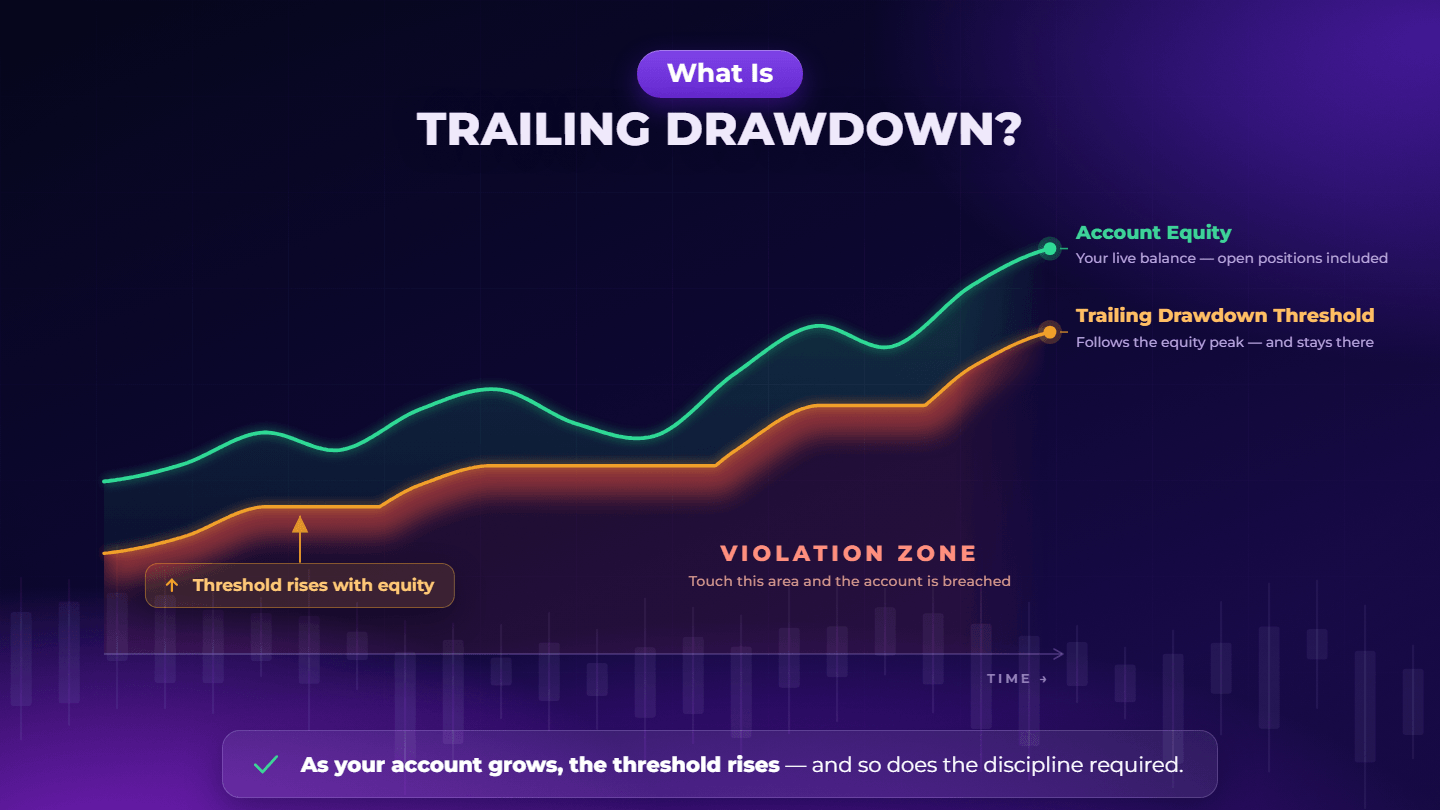
Trailing drawdown is a dynamic risk management rule used by many prop firms in which the maximum drawdown threshold moves upward as your account grows — following the highest balance your account has ever reached, including unrealized profits from open positions. Unlike a static drawdown limit, which stays fixed relative to your starting balance, trailing drawdown trails your peak equity in real time, meaning the trailing threshold rises with every dollar of profit your account achieves.
Understanding trailing drawdown is essential for every trader operating on a funded account or working through a prop firm challenge. This article explains trailing drawdown in full — how it is calculated, how it differs from EOD drawdown, the three types of trailing drawdown used by major prop firms, and exactly how to trade safely within its limits.
Introduction
Of all the drawdown rules used by prop firms, trailing drawdown is the one that catches the most traders off guard. It is not complicated once understood — but the way it behaves in practice is fundamentally different from what many traders expect, and misunderstanding it is one of the most common reasons funded accounts are lost.
The core challenge is this: trailing drawdown does not just measure how far your account has fallen from its starting balance. It measures how far your account has fallen from its highest point — including unrealized gains on open positions that have not yet been closed. This means the drawdown trailing threshold can move upward even while you are still in a trade, narrowing your available buffer before you have locked in a single dollar of profit.
Every trader who operates on a performance account with trailing drawdown rules needs to understand this mechanic before they place a single trade. The consequences of getting it wrong are immediate — a trailing drawdown violation ends the funded account or the prop firm challenge without warning, regardless of how profitable the account has been overall.
This article covers trailing drawdown in full — the calculation method, the different drawdown types, real worked examples, and the practical rules that keep traders safe. Whether you are new to prop firm trading or looking to understand trailing drawdown more deeply, this guide has everything you need.
What Is Trailing Drawdown?
Trailing drawdown is a drawdown rule in which the maximum loss threshold is not fixed — it moves upward as your account balance reaches new highs. The trailing threshold is always set at a fixed dollar amount or percentage below the highest balance your account has ever achieved, including the value of any open positions currently in profit.
Here is the core mechanic that defines trailing drawdown:
- The trailing threshold starts at a fixed trailing amount below your starting balance — this is the max drawdown or drawdown level from which the account is protected
- As your account grows and reaches a new high, the trailing threshold moves upward with it — the drawdown trails as the account grows, and the trailing drawdown moves upward in one direction only
- The trailing threshold never moves downward — it only moves upward as your account reaches each new high and moves in one direction: up
- Crucially, the trailing drawdown includes both realized and unrealized profits — meaning open positions that are currently in profit count toward the peak equity calculation
- If your account equity — including open positions — drops to the trailing threshold, the funded account is closed, and the challenge or funded trader status is lost
This is what makes trailing drawdown fundamentally different from a static drawdown rule. With static drawdown, the maximum drawdown amount is fixed from the start and never changes regardless of how your account performs. With trailing drawdown, every dollar of profit your account makes raises the trailing threshold, meaning the discipline required to protect the account grows as the account grows. In prop trading, understanding this distinction is one of the most important aspects of developing a sustainable trading strategy — because the loss limit is not fixed; it moves with you.
How Trailing Drawdown Is Calculated
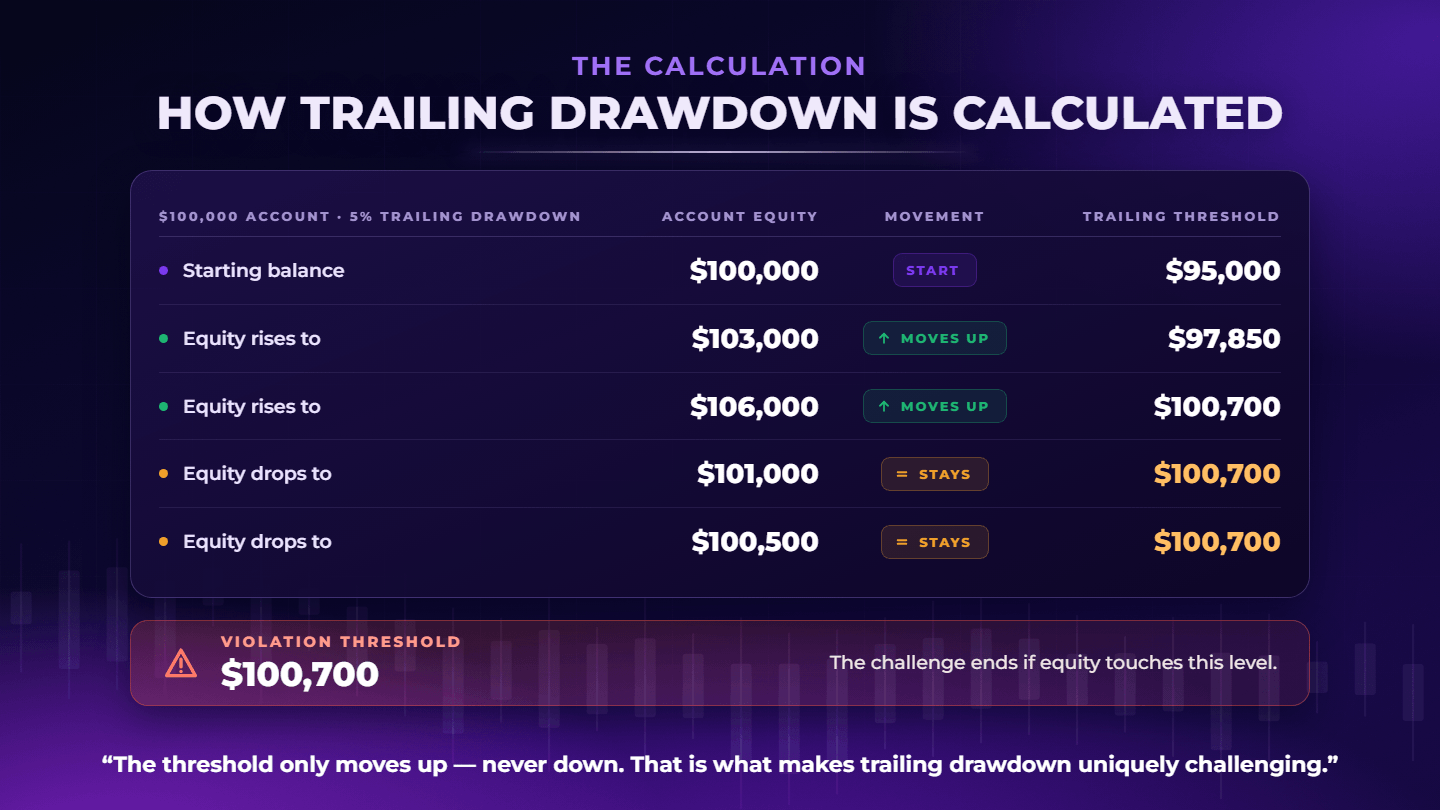
To understand trailing drawdown in practice, it helps to walk through a concrete example. The following worked example uses a 50k account with a $2,500 trailing drawdown amount — a structure commonly used in prop firm trading evaluations.
TRAILING DRAWDOWN WORKED EXAMPLE
Account size: $50,000 | Trailing drawdown amount: $2,500
Day 1 — Start:
Starting balance: $50,000
Trailing threshold: $47,500 ($50,000 - $2,500)
Day 2 — Account grows to a new high:
Account balance: $52,000
Trailing threshold: $49,500 ($52,000 - $2,500)
Threshold moves upward: YES
Day 3 — Open trade shows unrealized profit of $1,500:
Account balance: $52,000
Floating equity: $53,500 (balance + unrealized profit)
Trailing threshold: $51,000 ($53,500 - $2,500)
Threshold moves upward: YES (based on floating equity)
Day 3 — Trade reverses, position closed at breakeven:
Account balance: $52,000
Trailing threshold: $51,000 (does not move back down)
Available buffer: $1,000 (significantly narrowed)
VIOLATION: If equity drops to $51,000 — the funded account is closed.
This example shows the critical risk that trailing drawdown creates: the trailing threshold moved upward based on an unrealized profit that was never locked in. The trade reversed and closed at breakeven, but the trailing threshold remained at $51,000 — leaving the trader with only $1,000 of buffer where they had $4,500 at the start of the day. The drawdown trails the peak, not the realised result.
This is what traders mean when they say trailing drawdown punishes traders who let winning trades reverse. The drawdown trails every dollar of peak equity — realised or not. Importantly, this dynamic also affects how traders should think about their profit target: in a trailing drawdown account, the goal is not just to reach the profit target but to do so without allowing intraday drawdown to threaten the trailing threshold along the way. Market conditions can change quickly, and a trade that looks certain to contribute to the profit target can reverse sharply — particularly in volatile market conditions. Once the trailing drawdown threshold reaches the starting balance or beyond, the account is essentially trading without any buffer from the original deposit.
Three Types of Trailing Drawdown
Not all trailing drawdown rules work in the same way. Understanding the three types of trailing drawdown used across major prop firms is essential for knowing exactly how the rule applies to your specific account.
1. Intraday Trailing Drawdown
Intraday trailing drawdown — also referred to as an intraday trailing threshold — updates the trailing threshold in real time throughout the trading session, based on the highest equity your account reaches at any point during the trading day. This includes unrealized profits from open positions.
The intraday trailing drawdown is the most dynamic and demanding form of trailing drawdown because the trailing threshold can move multiple times upward within a single trading session. Platforms using Rithmic and WealthCharts evaluations commonly apply intraday trailing drawdown to their performance account structures, making real-time monitoring of the trailing threshold a non-negotiable habit for traders on these platforms.
The key risk with intraday trailing drawdown: if you open a trade that moves significantly into profit during the trading day — even for a short time — the intraday trailing threshold rises to reflect that peak equity. If the trade then reverses, you are trading against a higher trailing threshold than when you entered, with less buffer available than your account balance alone would suggest.
2. End of Day Trailing Drawdown
Some prop firms apply a trailing drawdown that updates only at the end of the trading day, based on your closing balance. This means the trailing threshold moves upward only when the trading day closes with a higher balance than the previous peak — and importantly, unrealized profits from open positions do not affect the trailing threshold during the session itself.
This is closer to EOD drawdown in its mechanics — the trailing threshold is based on your closing balance at the end of each trading day rather than on intraday equity peaks. For traders familiar with End of Day Drawdown (covered in detail in Article 6), this type of trailing drawdown will feel more predictable and manageable, as open trade performance does not affect the trailing threshold until the session closes.
3. Static Drawdown (for comparison)
Static drawdown — sometimes called a fixed drawdown or maximum drawdown rule — does not trail at all. The maximum drawdown amount is set at the beginning of the evaluation and never moves, regardless of how the account performs. The drawdown limit is always calculated from the original starting balance.
The key difference between static drawdown and trailing drawdown: with static drawdown, profitable trading does not reduce your buffer — it actually increases the distance between your current balance and the fixed drawdown threshold. With trailing drawdown, every new account high raises the trailing threshold, meaning the buffer remains fixed in dollar terms but requires consistent discipline to maintain as the account grows.
Understanding these different drawdown types — and specifically which one applies to your funded account — is one of the first things every trader should confirm before beginning a prop firm challenge or trading a performance account.
Trailing Drawdown vs End of Day Drawdown
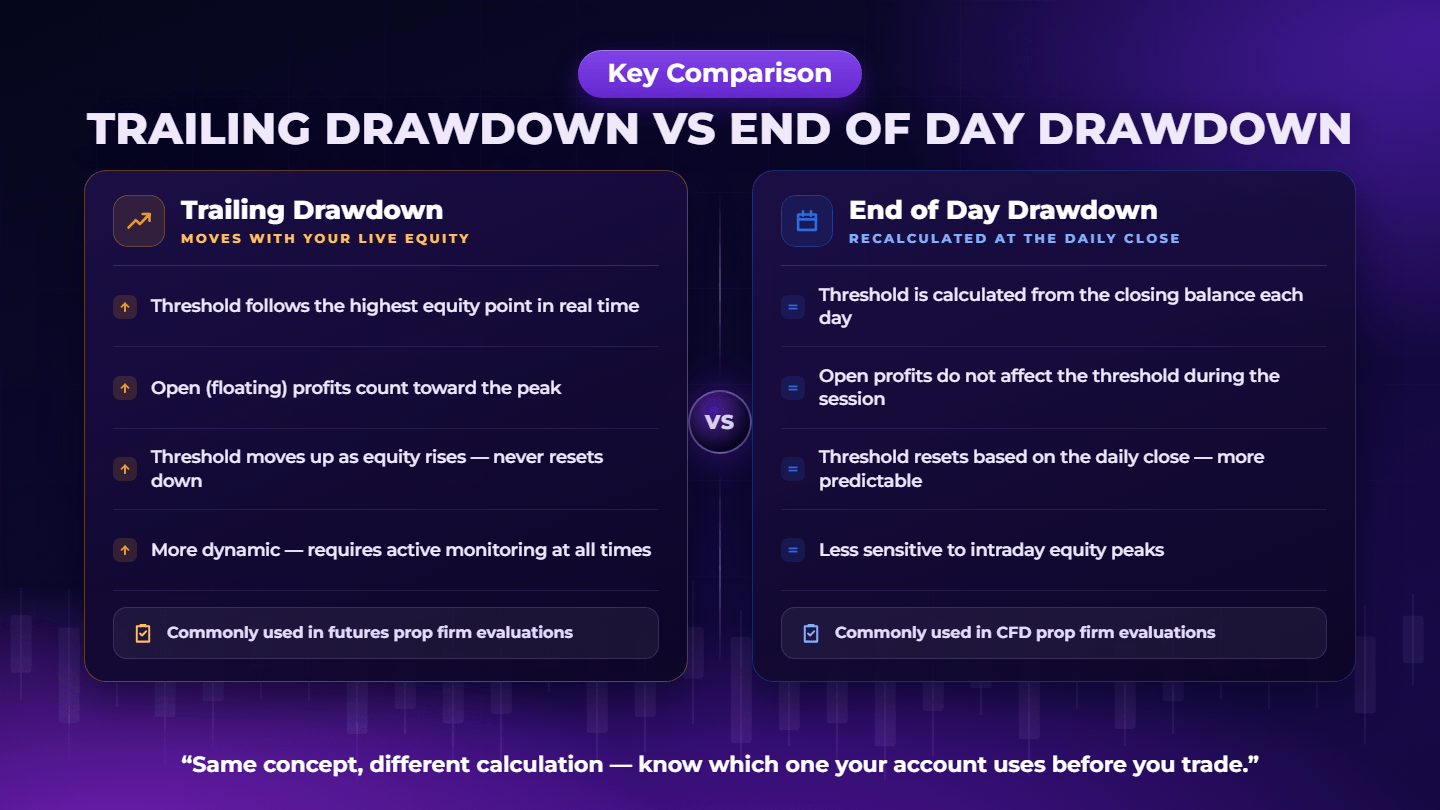
The most important distinction for traders moving between different prop firm structures is the difference between trailing drawdown and End of Day (EOD) drawdown. A full explanation of EOD drawdown is available in Article 6 of this series — here, the focus is on the single most important difference between the two methods.
The defining difference is this:
- EOD drawdown is based on your closing balance at the end of the trading day. Open positions and unrealized profits do not affect the drawdown threshold during the session. The drawdown threshold updates only when the trading day closes.
- Trailing drawdown — specifically intraday trailing drawdown — updates in real time based on the highest equity your account reaches at any point during the trading session, including unrealized profits from open positions. The threshold moves upward as your account reaches each new high during the day, not just at the end of the trading day.
In practical terms: a trader holding a profitable open trade during a session with EOD drawdown rules faces no immediate risk from that trade's peak equity — the drawdown threshold will only update based on the closing balance. The same trader, on an intraday trailing drawdown account, will see the trailing threshold rise in real time as the trade moves into profit — even before the position is closed.
This is why traders who switch from EOD drawdown accounts to intraday trailing drawdown accounts — or vice versa — must adjust their approach to risk management, position sizing, and trade management. The drawdown rule governs how much buffer you actually have available at any point during the trading session, and that buffer behaves very differently under each drawdown rule.
How Trailing Drawdown Affects Your Trading Behaviour
Understanding trailing drawdown is not just an academic exercise — it directly shapes how a trader should approach every trade on a funded account or performance account with this drawdown rule in place.
Here are the key ways in which trailing drawdown changes the practical reality of trading:
Open Positions Are Not Safe Until Closed
With trailing drawdown, an open trade that is currently showing unrealized profit has already raised the trailing threshold. The unrealized profit is counted toward the peak equity that the trailing threshold follows. If the market reverses and the trade closes at a loss — or even at breakeven — the trailing threshold does not fall back down. It remains at the higher level set by the peak unrealized equity.
This means that every open trade on a trailing drawdown account carries an invisible secondary risk: the risk that the trade reverses after raising the trailing threshold, leaving the account with less buffer than before the trade was opened. Managing this risk requires active use of trailing stops and disciplined profit protection on every open position.
The Account Grows, the Pressure Grows
As the account grows and reaches new highs, the trailing threshold moves upward with it. Each time the account grows and the account reaches a new high — bringing the account to a new high watermark — the trailing threshold rises to match. In dollar terms, the drawdown amount stays the same. But in terms of the discipline required to stay safe, the pressure increases as the account grows — because any drawdown that reaches the trailing threshold ends the account, regardless of how much profit has been accumulated above it.
This is one of the most psychologically challenging aspects of trading a trailing drawdown account. The more successful the account has been, the higher the trailing threshold sits — and the more carefully each trade must be managed to avoid a violation that erases all progress.
The Current Drawdown Must Be Monitored in Real Time
On a trailing drawdown account, the current drawdown — the live distance between your floating equity and the trailing threshold — must be monitored throughout every trading session. Unlike a static drawdown where the threshold is fixed and can be checked once at the start of the day, the trailing drawdown threshold can move multiple times during a single trading session on an intraday trailing drawdown account.
Every trader on a trailing drawdown account should know their trailing threshold at all times. Most prop firm trading platforms display this information directly, but traders should also calculate it manually as a check — particularly when multiple open positions are running simultaneously.
Common Trailing Drawdown Violations and How to Avoid Them
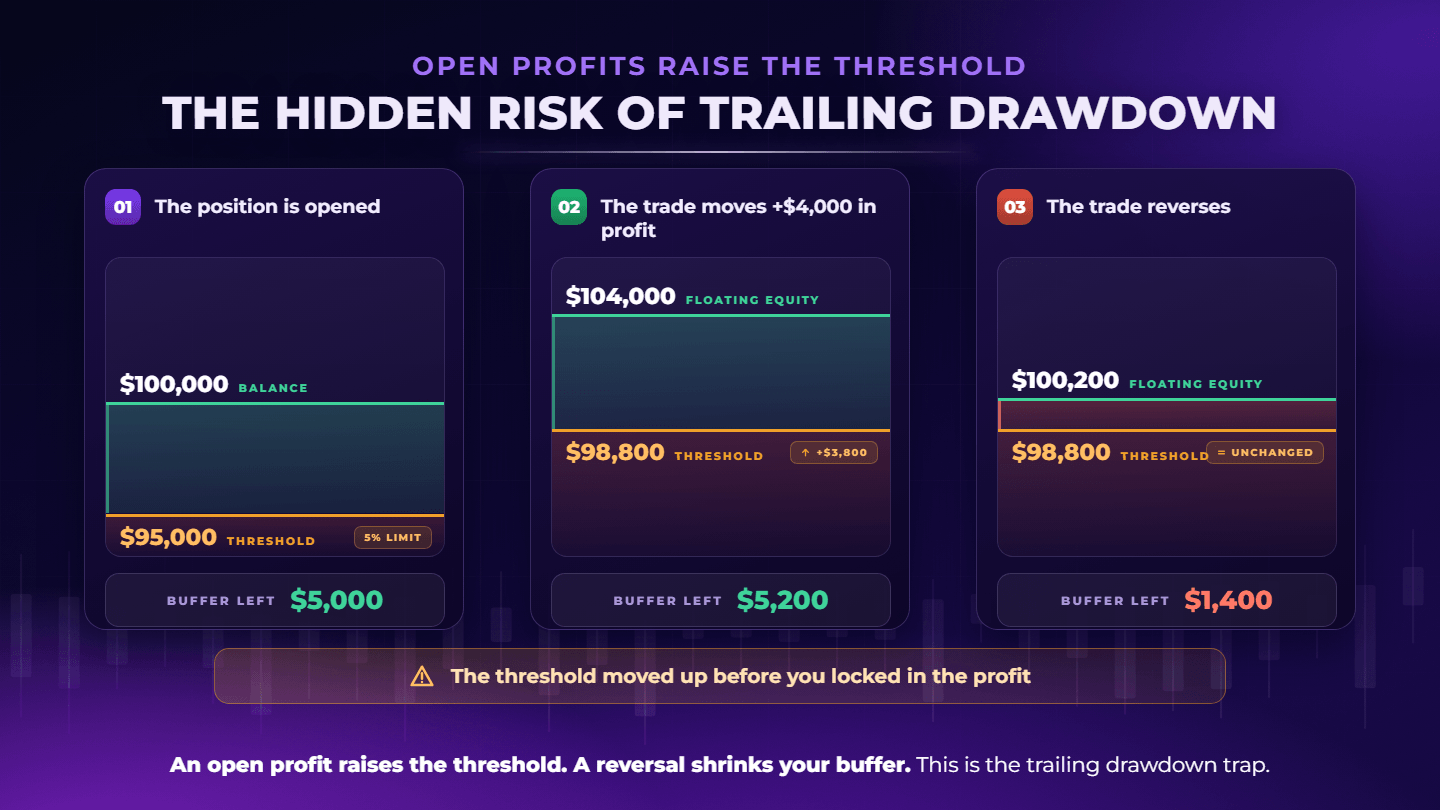 The majority of trailing drawdown violations are not caused by catastrophic single trades. They are caused by a series of smaller mistakes that compound over the course of a trading session or trading day. Here are the most common trailing drawdown mistakes and how to avoid them:
Letting Winners Reverse Without Protection
This is the most frequent cause of trailing drawdown violations. A trader opens a position, the trade moves significantly into profit — raising the trailing threshold — and then the market reverses. The trader, hoping the trade will recover, holds the open trade as it moves toward the trailing threshold. By the time the decision is made to close, the account equity has reached or breached the trailing threshold.
The solution is simple but requires discipline: use a trailing stop on every significant winning trade. When a trade moves meaningfully in your favour, lock in a portion of that profit by moving your stop to breakeven or using a trailing stop that follows price. Do not allow an unrealized profit to reverse into a trailing drawdown stop violation.
Trading Too Large
Large position sizes amplify both profits and losses — and on a trailing drawdown account, they also amplify the speed at which the trailing threshold moves. A single large trade that peaks at a significant unrealized profit before reversing can raise the trailing threshold dramatically and leave the account dangerously close to a violation. Risk management discipline — keeping position sizes conservative relative to the drawdown amount — is the primary defence against this risk.
On a 50k account with a $2,500 trailing drawdown, risking 1% per trade means a maximum loss of $500 per trade. That gives you five consecutive losing trades before you approach the original trailing threshold — and even that buffer shrinks if any of those trades first moved into profit before reversing. Sizing conservatively is not optional on a trailing drawdown account; it is the foundation of the entire risk management approach.
Ignoring Unrealized Gains in the Drawdown Calculation
Many traders who are new to trailing drawdown accounts make the mistake of monitoring only their account balance, not their floating equity. Because the trailing drawdown includes both realized and unrealized gains, the trailing threshold is always calculated on the highest floating equity — not just the highest closed balance.
A trader with a $52,000 account balance who has an open trade showing $2,000 of unrealized profit has a floating equity of $54,000. If the trailing drawdown amount is $2,500, the trailing threshold is currently at $51,500 — not $49,500. Ignoring this distinction and monitoring only the account balance gives a completely inaccurate picture of how much buffer is actually available.
5 Rules for Trading Safely Within Trailing Drawdown Limits
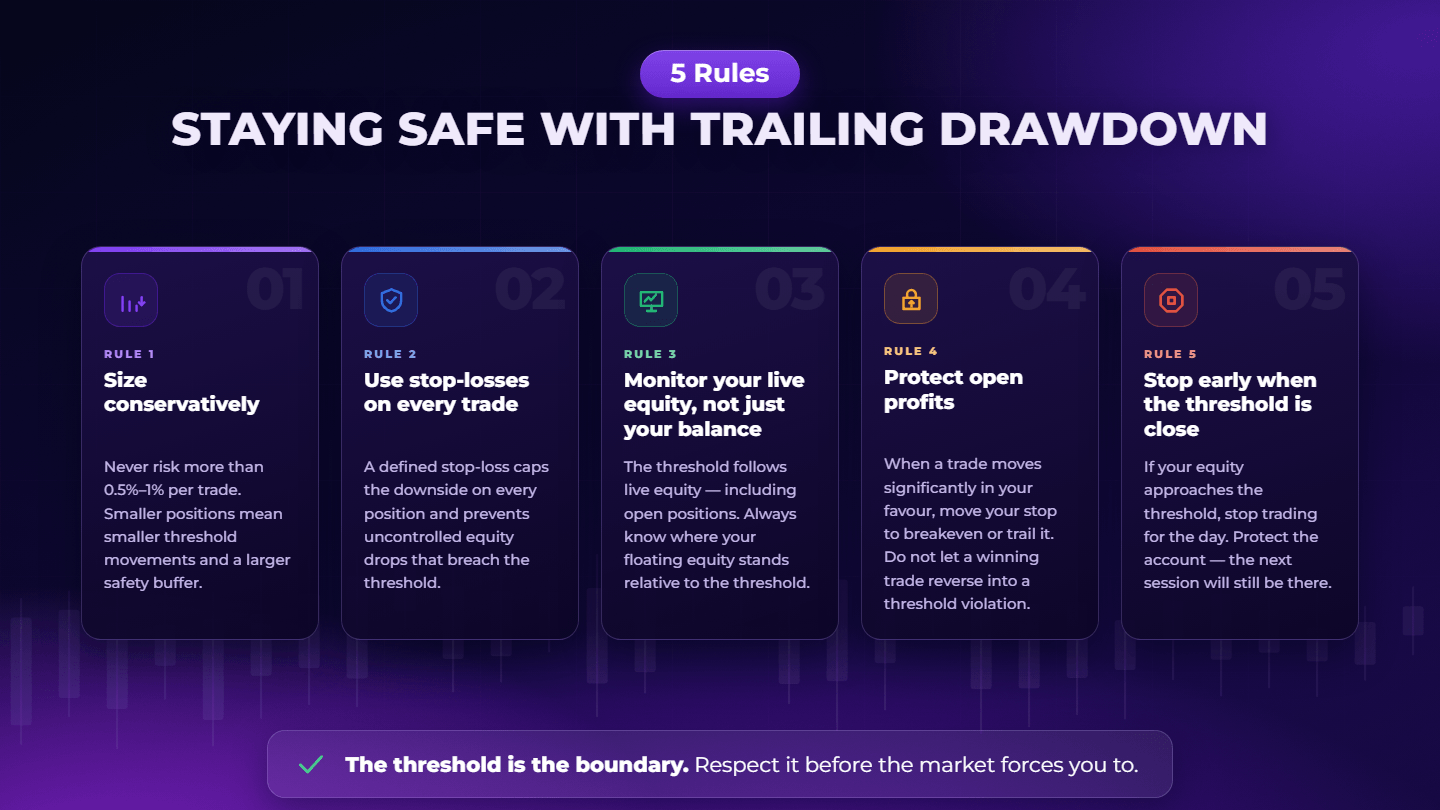 The following rules apply to every trader on a trailing drawdown account, whether they are working through a prop firm challenge or managing an active funded account. These rules are designed to keep the current drawdown well within safe limits at all times.
-
Rule 1 — Size conservatively:
Never risk more than 0.5%–1% of the account size per trade. Smaller position sizes produce smaller unrealized peaks, which means smaller movements in the trailing threshold per trade. This gives the account more room to absorb a series of losses without approaching the trailing threshold.
-
Rule 2 — Use stop-losses on every open trade:
A defined stop-loss on every open trade caps the downside on each position and prevents an uncontrolled reversal from running all the way to the trailing threshold. The stop-loss is the primary risk management tool on a trailing drawdown account.
-
Rule 3 — Protect unrealized profit actively:
When a trade moves significantly in your favour, move your stop to breakeven or deploy a trailing stop that follows price. Protecting unrealized profit prevents the scenario where a large winning trade raises the trailing threshold and then reverses into a violation.
-
Rule 4 — Monitor the trailing threshold in real time:
Know your trailing threshold at all times during a trading session — not just your account balance. Track your floating equity, including open positions, and maintain awareness of how close your current equity is to the trailing threshold at all times.
-
Rule 5 — Stop trading when the buffer is thin:
If your floating equity is close to the trailing threshold, stop trading for the trading session. The risk of a further loss — or even a brief market spike that triggers the trailing drawdown stops — is not worth the potential benefit of one more trade. Protect the account first.
Frequently Asked Questions
What is trailing drawdown?
Trailing drawdown is a drawdown rule used by many prop firms in which the maximum loss threshold — the trailing threshold — moves upward as your account reaches new highs. The trailing drawdown includes both realized and unrealized profits, meaning the trailing threshold updates based on the highest floating equity your account achieves, including unrealized gains from open positions. The trailing threshold never moves back down — it only moves upward as the account grows.
How is trailing drawdown different from static drawdown?
Static drawdown sets a fixed maximum drawdown amount from the starting balance that never changes. With static drawdown, profitable trading increases your buffer — the distance between your balance and the fixed threshold grows as the account grows. With trailing drawdown, the trailing threshold follows the peak equity, meaning the dollar buffer stays the same, but the threshold moves upward with every new high. There are three types of trailing drawdown used by major prop firms: intraday trailing drawdown, end-of-day trailing drawdown, and fixed-period trailing drawdown.
Does trailing drawdown include unrealized profits?
Yes — intraday trailing drawdown includes both realized and unrealized profits. The trailing threshold is calculated based on the highest floating equity your account reaches, which includes the unrealized profit of any open positions. This means an open trade that moves significantly into profit raises the trailing threshold before the profit is locked in — creating risk if the market reverses.
What is the difference between trailing drawdown and EOD drawdown?
EOD drawdown updates the drawdown threshold based on your closing balance at the end of the trading day — unrealized profits from open positions do not affect the threshold during the trading session. Trailing drawdown — specifically intraday trailing drawdown — updates in real time throughout the trading day based on the highest floating equity, including unrealized profits. EOD drawdown is covered in full in Article 6 of this series.
What happens when you breach trailing drawdown?
If your account equity — including the value of any open positions — drops to the trailing threshold, the funded account or prop firm challenge is immediately terminated. This is the maximum drawdown rule in absolute terms — there is no grace period and no partial breach. Trailing drawdown violations are one of the most common reasons prop firm challenges fail, and funded accounts are closed.
What is the trailing drawdown on a 50k account?
This varies by prop firm, but a common structure for a 50k account is a trailing drawdown amount of $2,000–$2,500. This means the trailing threshold starts at $47,500–$48,000 and moves upward as the account grows. The exact trailing drawdown amount and trailing drawdown rules for your specific account should always be confirmed with your prop firm before you begin trading. Trading involves substantial risk of loss — always understand the specific drawdown rule that applies to your account.
What is Apex Trader Funding's trailing drawdown structure?
Apex Trader Funding is one of the major prop firms that uses intraday trailing drawdown on their performance account evaluations. Their trailing drawdown accounts use an intraday trailing threshold that updates in real time based on the highest equity achieved during each trading session, including unrealized profits. Traders on Apex Trader Funding evaluations should be particularly aware of how the intraday trailing drawdown behaves with open positions, as the trailing threshold can move multiple times within a single trading session.
Final Thoughts
Trailing drawdown is the most dynamic and demanding drawdown rule in prop firm trading. Unlike a static drawdown that sits fixed from the starting balance, trailing drawdown moves upward with every dollar of profit — including unrealized gains — that your account achieves. The trailing threshold never moves backward. It only moves upward as your account grows.
Understanding trailing drawdown is not optional for traders on performance accounts or prop firm challenge evaluations that use this rule. The intraday trailing drawdown in particular requires real-time monitoring, disciplined position sizing, and active protection of open profits — because the market reverses without warning, and when it does, the trailing threshold is already higher than it was when the trade was opened.
The traders who manage trailing drawdown accounts successfully are those who treat the trailing threshold not as a distant safety net but as an active constraint that shapes every trading decision. Size conservatively. Protect your profits. Monitor your current drawdown at all times. And when the buffer is thin — stop trading and protect the account. The next trading session will still be there. The funded account may not be if a trailing drawdown violation occurs.
There are different drawdown types across the prop firm industry — static drawdown, EOD drawdown, and trailing drawdown — and understanding which one governs your account is the single most important piece of prop firm rule knowledge a trader can have. Different drawdown types require different approaches to risk management, trade sizing, and profit protection. Know your drawdown rule before you place your first trade.
Risk Warning: Futures and CFD trading involves substantial risk of loss. Prop firm trading and funded account evaluations carry substantial risk — past performance does not guarantee future results. Always understand the specific trailing drawdown rules that apply to your account before you begin trading.
Trade confidently within trailing drawdown limits — apply for a funded Futures or CFD account with 4PropTrader and trade under transparent risk rules.