Disclaimer:
This article is for general informational purposes only and does not constitute tax, legal, or financial advice. Always consult a qualified tax advisor for guidance specific to your situation.
Quick Summary
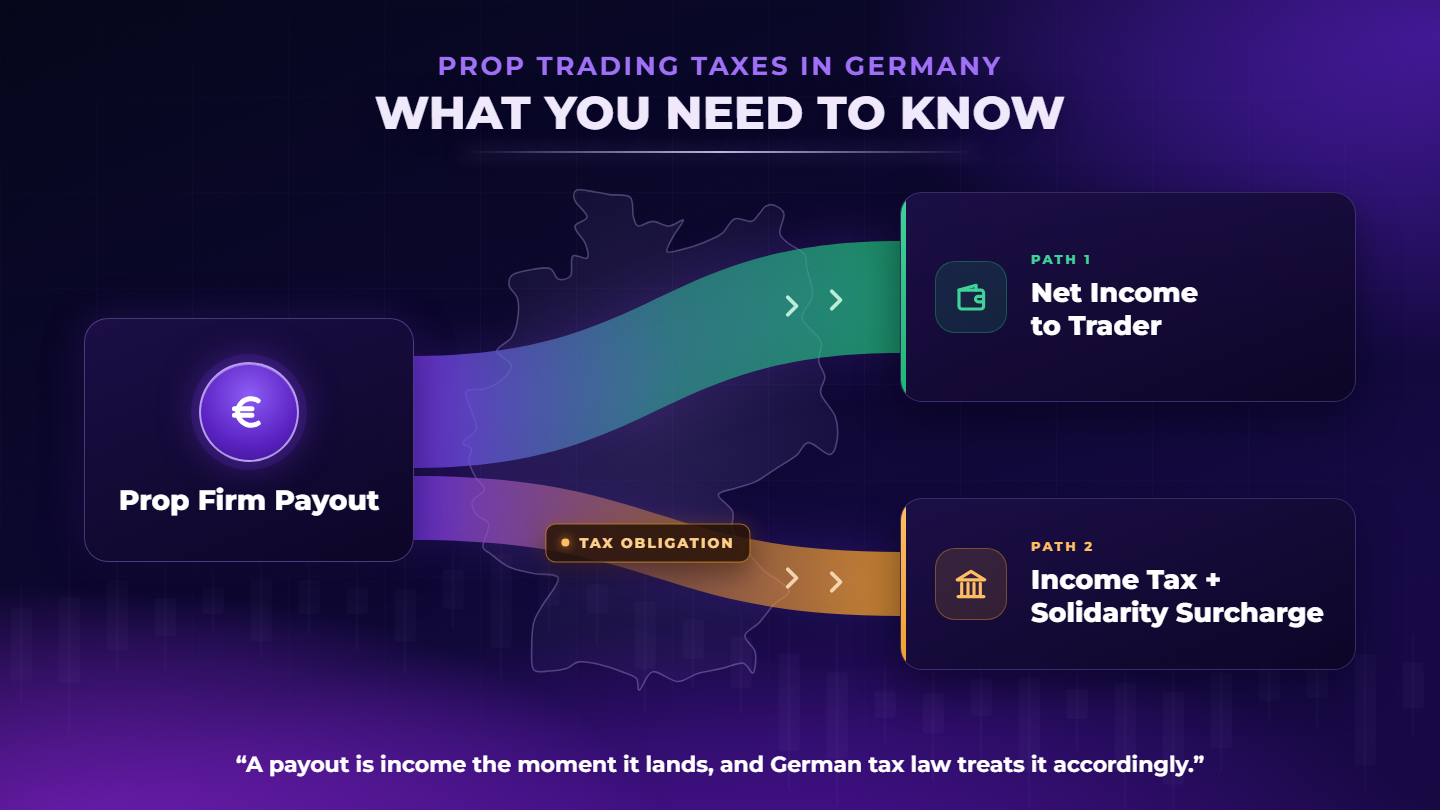
Prop firm payouts in Germany are treated as taxable income, not as tax-free winnings and not as capital gains — the payout is taxed at your personal income tax rate, with a solidarity surcharge potentially applying on top. Whether you also need to register a business, including a possible Trading GmbH formally, depends on how frequently and seriously you trade rather than on a single fixed rule.
This article goes deep into how prop trading taxes in Germany actually work, the tax treatment of payouts, the documentation you should be keeping year-round, and why every prop trader should confirm their specific obligations with a qualified local tax advisor before relying on general guidance like this.
Introduction
Prop trading has given traders across Europe a way into real trading without needing a large pool of personal trading capital. For German traders, this shift has been especially significant, funded accounts from prop trading firms now offer a legitimate route into futures and forex markets that would otherwise require substantial upfront capital. But once a payout actually lands in your account, a different question takes over: how are prop firm payouts taxed in Germany, and what do you actually need to do about it?
This guide breaks down how prop trading taxes in Germany actually work, how payouts are classified, what income tax rate applies, whether a business registration is required, and what documentation you should be keeping as trading taxes in Germany becomes a bigger part of the conversation for traders in 2026.
Why This Matters for German Traders
Germany's trading culture has always leaned toward disciplined, rules-based approaches, and that mindset has translated well into prop trading. Among the best prop firms operating internationally, several now offer a prop firm for German traders specifically, with EUR-denominated evaluations, SEPA payout rails, and support for traders based in Germany who want to keep the entire process local and straightforward.
Firms like FTMO are frequently the first prop trading firms German traders encounter, and it's easy to see why: the appeal of trading in Germany through a funded account, without needing to deposit large amounts of trading capital, has never been stronger. But growing adoption also means growing scrutiny. As more prop traders in Germany start requesting payouts, tax authorities and traders alike are paying closer attention to how this income should be reported.
Is Prop Trading Even Legal in Germany?
One of the first questions many newcomers ask is whether prop trading is legal in Germany at all. The short answer is yes. Proprietary trading firms that offer funded evaluation accounts run those evaluations as simulated trading environments, and most prop firms operate outside BaFin's direct licensing requirements because they are not offering regulated financial products or financial services directly to the trader, they are providing capital and a profit split arrangement instead.
This matters because it shapes how income is taxed later. Since the firm typically isn't classified as a financial services provider, the relationship falls outside the strict framework of Germany's Securities Trading Act (Wertpapierhandelsgesetz), and payouts are treated differently than income from regulated investment advice or brokered financial products.
Payouts Are Not Capital Gains: Why That Distinction Matters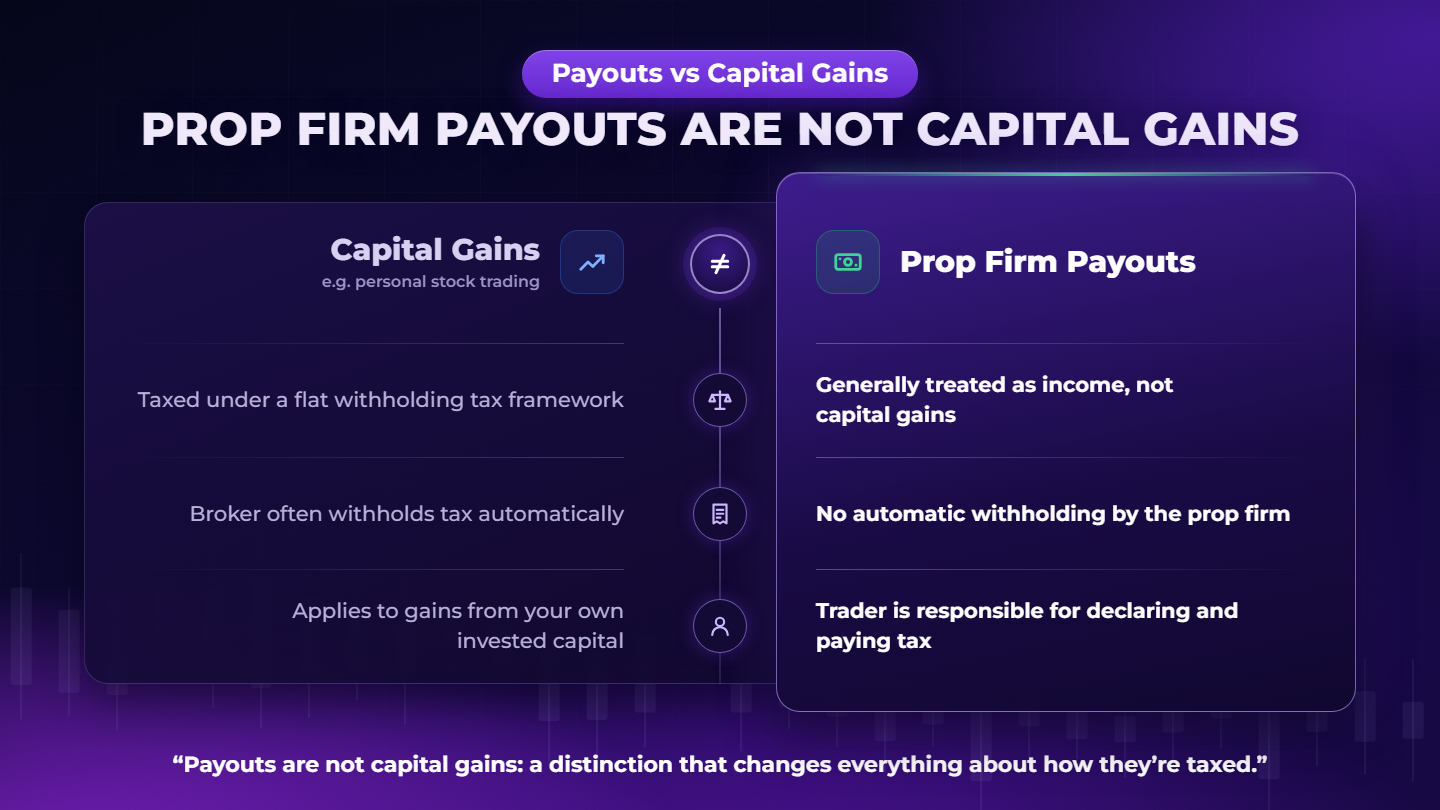
A common misconception is that prop firm payouts should be taxed like capital gains from personal stock or ETF investing, where a flat withholding tax is deducted automatically by the broker. That's not how it works here. Payouts are not capital gains — they are treated as income, similar to freelance or self-employment earnings, and no automatic withholding tax is applied by most prop trading firms.
This means prop trading payouts land in your account in full, and the responsibility to declare and pay tax on them sits entirely with you. Unlike the U.S., where some traders benefit from separate short-term and long-term capital gains treatment, German traders generally cannot rely on that framework for funded-account income.
Income Tax Rate, Solidarity Surcharge, and Your Tax Burden
Because payouts are classified as income, they're added to your total taxable income for the year and taxed at your personal income tax rate — Germany's progressive income tax rate structure, which can reach a top marginal tax rate of 25 percent and higher for higher income brackets depending on your total earnings for the year. On top of that, a solidarity surcharge (Solidaritätszuschlag) may apply, adding a further percentage on top of your income tax liability for higher earners — though many individual traders will fall under current solidarity surcharge exemption thresholds.
Together, these can meaningfully affect your total tax burden, especially once your profits or losses from prop trading are combined with income from other sources. German tax law does not treat trading payouts as a special, lightly-taxed category — every prop trader who earns a payout is expected to declare it like any other form of income.
Can You Deduct Expenses? Income-Related Expenses Explained
Germany's tax system does allow for income-related expenses (Werbungskosten) to be deducted against income in many cases, and this is worth discussing directly with a professional, since the deductibility of costs tied to prop trading — evaluation fees, data subscriptions, platform costs — depends heavily on how your specific income is classified. This is another reason prop trading taxes in Germany isn't a one-size-fits-all answer, and why generic guidance, including this article, is not a substitute for individual advice.
Do You Need to Register a Business?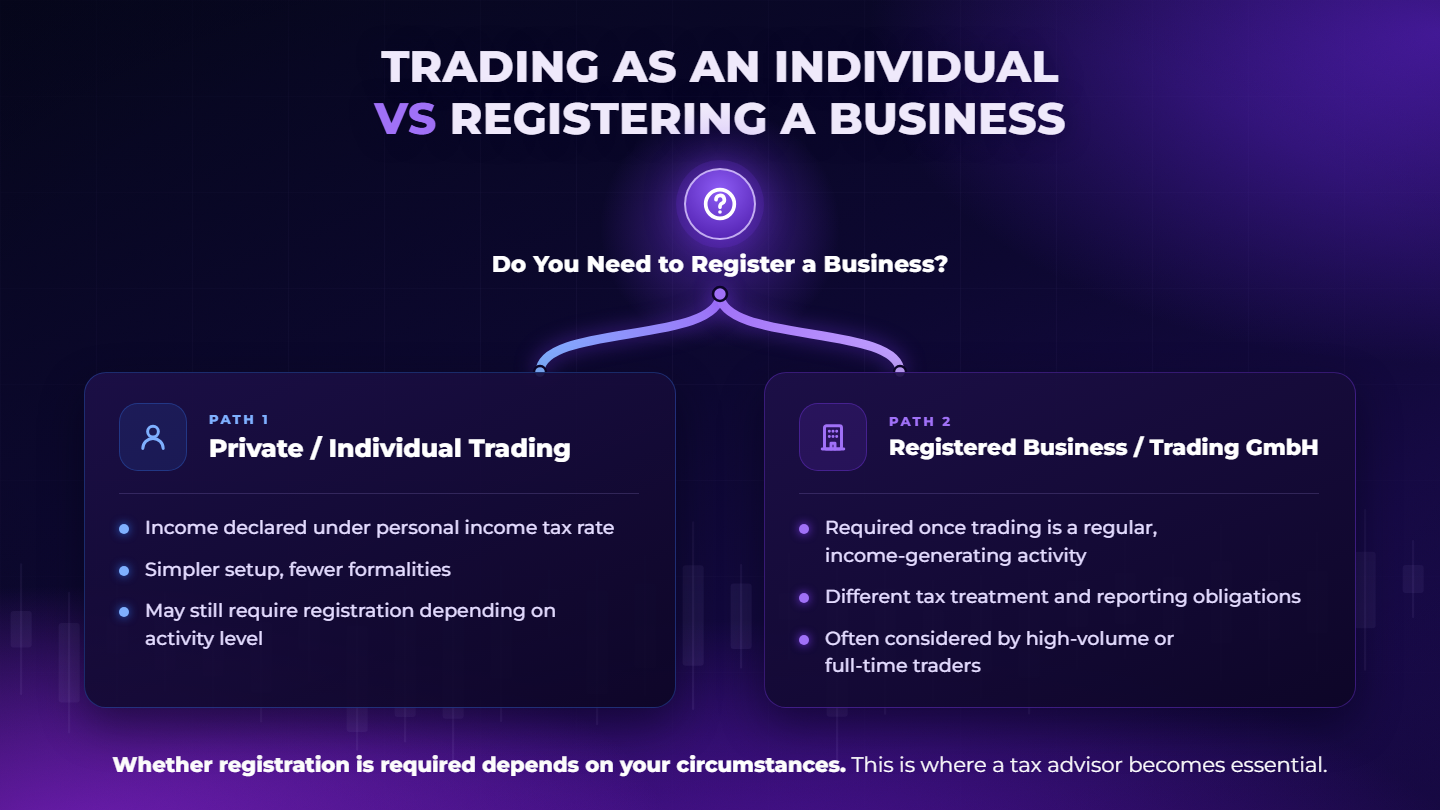
Whether you need to formally register a business — or even set up a Trading GmbH — depends on how frequently and seriously you trade. Casual, occasional prop trading conducted alongside a full-time job is often treated as private income. But once trading becomes a regular, income-generating activity — multiple funded accounts, consistent monthly payouts, high trading volume — registration requirements typically apply, and some traders based in Germany choose to formalize their activity to protect personal liability and personal assets, which is where the trading GmbH structure comes in.
There's no single rule that fits every prop trader here, and this is exactly the kind of decision that should never be made without speaking to a local tax advisor first.
Documentation to Keep Heading Into Germany 2026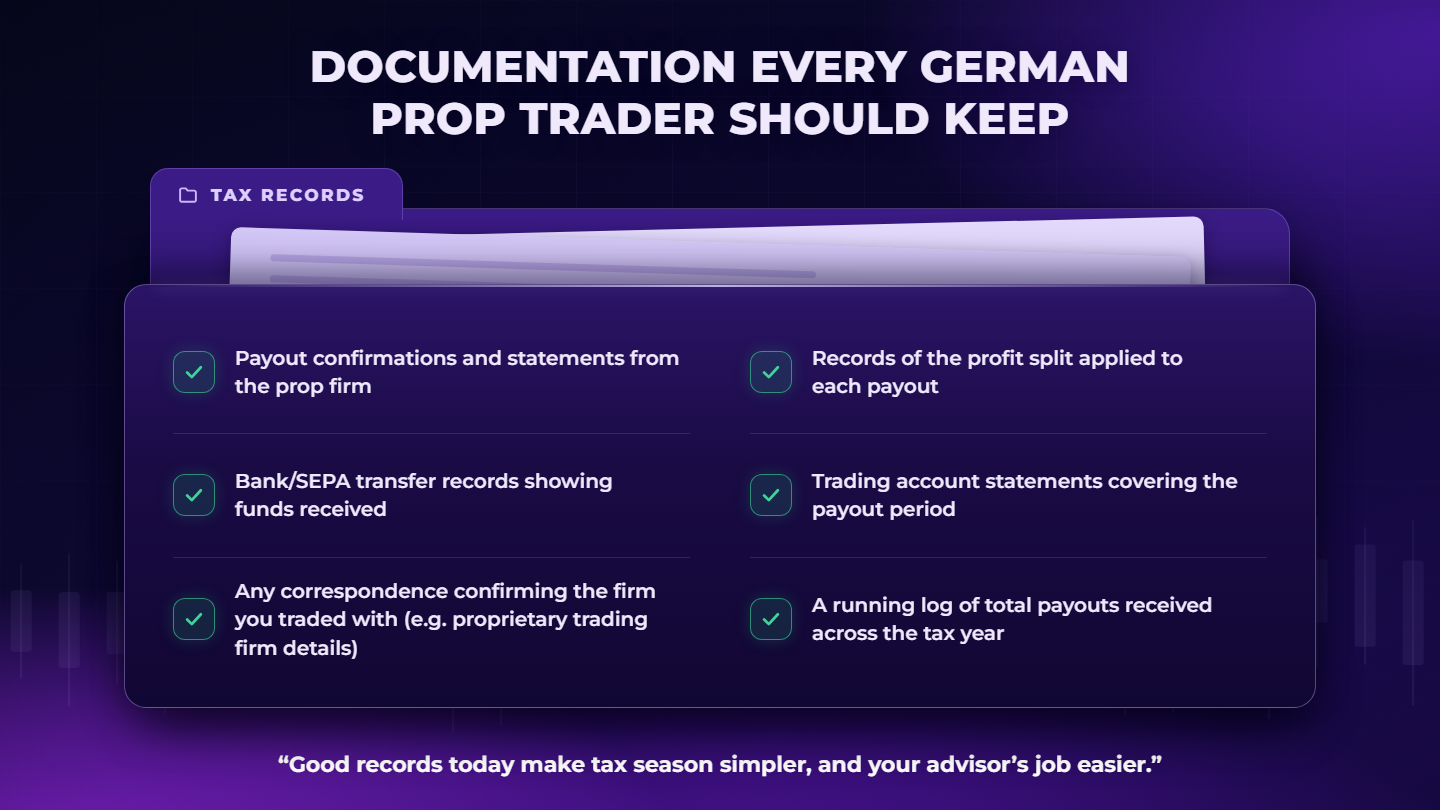
Whatever path you take, good recordkeeping makes everything simpler. At a minimum, keep:
- Payout confirmations and statements from the prop firm
- A running log of every payout received across the tax year
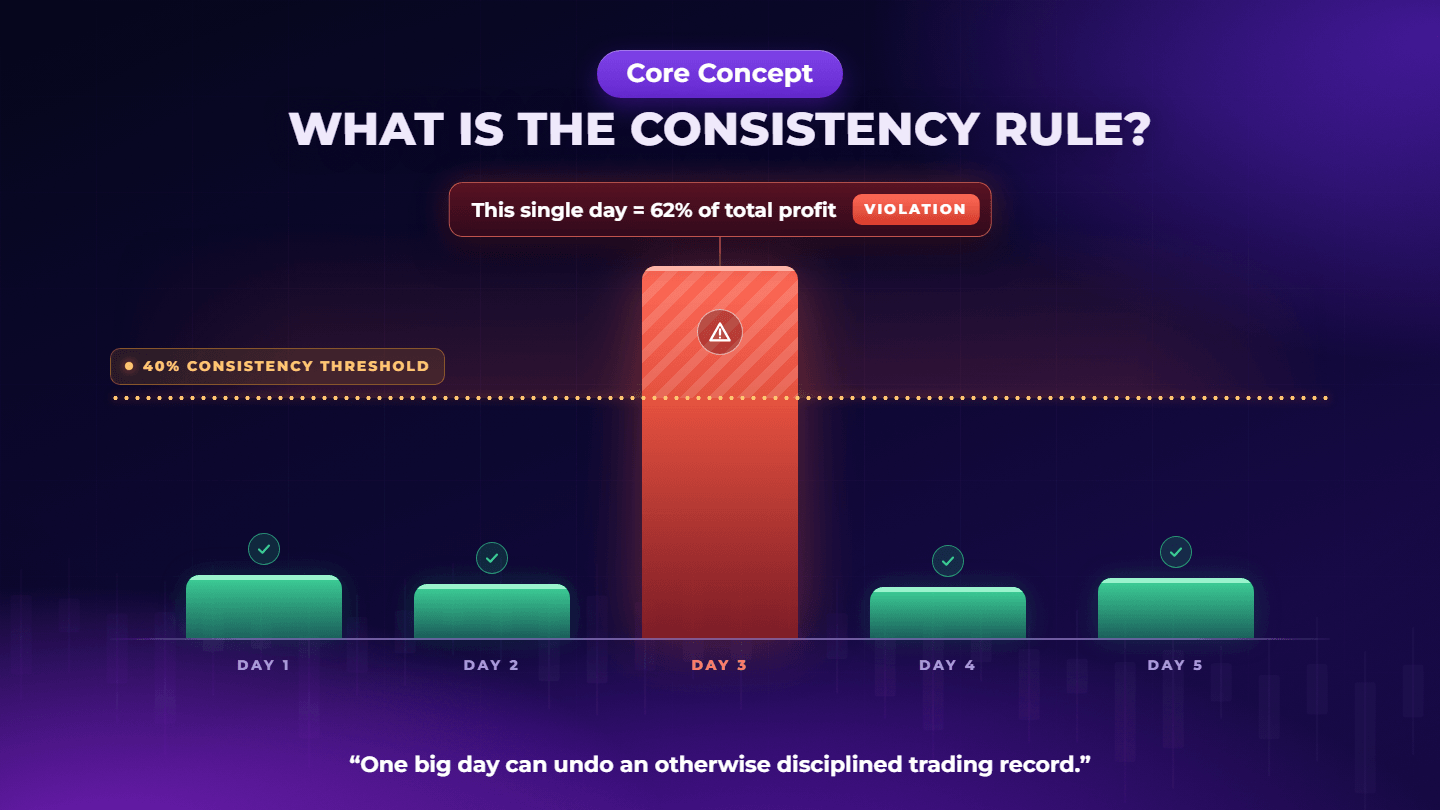
- Account statements showing your daily loss limit, drawdown, and consistency rules performance for each evaluation and funded account
- SEPA transfer confirmations tying each payout to your bank account
Many funded programs also apply firm-specific consistency rules and an EOD (end-of-day) drawdown calculation rather than an intraday one — details that don't affect your tax filing directly, but are useful to document alongside your payout history in case a tax advisor asks how your account was structured. Heading into Germany 2026, having this documentation organized from the start will save considerable time when tax season arrives.
Working With a Tax Advisor
Nothing in this guide should be treated as personalized tax advice. Prop trading taxes in Germany involve enough individual variation — business structure, total income, other earnings, evaluation costs — that only a qualified professional can give you an accurate answer for your situation. Before you file, take the time to consult a qualified tax advisor who is familiar with proprietary trading income, and bring your full payout history, account statements, and any correspondence from your prop firm to that conversation.
Frequently Asked Questions
Are prop firm payouts taxable in Germany?
Yes. Prop firm payouts are treated as income for German traders, not as tax-free winnings or capital gains, and must be declared according to your personal income tax rate.
Do I need to register a business to trade with a prop firm?
Not always. It depends on the frequency and scale of your activity. Casual traders may not need to, while consistent, income-generating trading often requires registration — sometimes structured through a trading GmbH. A local tax advisor can confirm what applies to your situation.
Is prop trading legal in Germany?
Yes, prop trading is legal in Germany. Most prop firms operate outside BaFin's licensing requirements because they aren't offering regulated financial services directly, but this doesn't change your personal tax obligations on any payout received.
What documentation should I keep for tax season?
Payout confirmations, SEPA transfer records, account statements showing consistency rules and daily loss limit compliance, and a running log of total payouts for the year.
Final Thoughts
Prop trading taxes in Germany are not a topic with one universal answer — it depends on how much you're earning, how often you trade, and how your specific prop firm structures its payouts. What stays constant is the underlying principle: a payout is income the moment it lands; German traders are responsible for declaring it, and the personal income tax rate, solidarity surcharge, and business registration question all deserve real attention rather than guesswork.
The practical habit that makes this easiest is documentation — keeping payout confirmations, SEPA records, and account statements organized as you go, rather than reconstructing your payout history at tax time. Traders who treat recordkeeping as part of their trading routine, not an afterthought, consistently have a smoother, less stressful filing process.
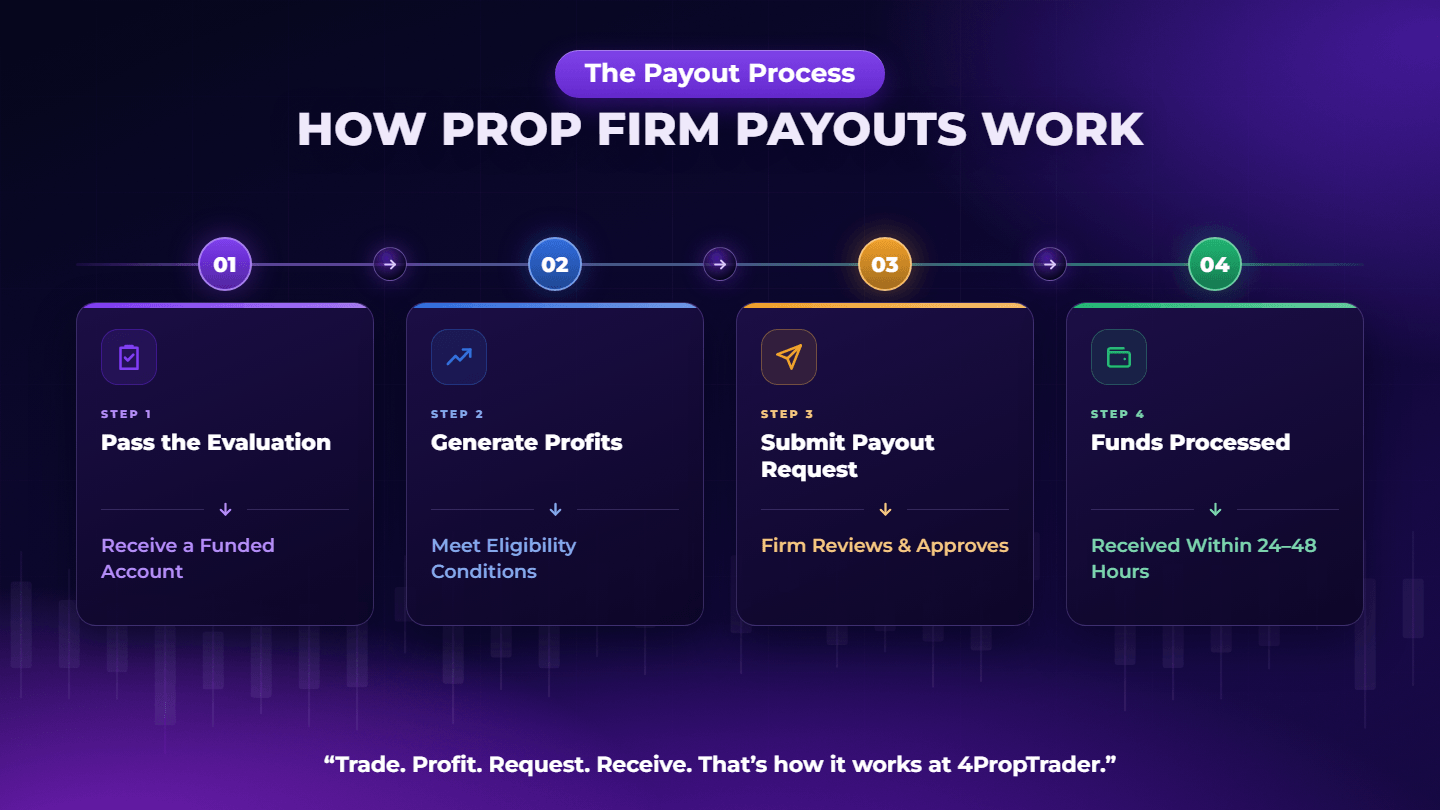
Understanding how prop firm payouts are taxed alongside the broader payout process covered in Article 27 gives you a complete picture of what it takes to trade a funded account successfully from evaluation through to payout — and ultimately, through to tax season.
Disclaimer: This article is provided for informational purposes only and does not constitute tax, legal, or investment advice. Tax treatment of prop firm payouts depends on individual circumstances and is subject to change — always confirm your specific obligations with a qualified local tax advisor before filing.
Understand your payout process before you start — apply for a funded account with 4PropTrader today.