Quick Summary
Smaller-scale versions of popular index, metals, and energy products track the same underlying benchmarks as the standard mini, but at one-tenth the size. Because each tick is worth a fraction of the mini's, a loss on a single position uses up far less of a drawdown allowance, which is why the smaller instruments suit funded accounts.
This guide compares MES, MNQ, and the other approved symbols with their minis side by side: contract specs, tick value tables, margin and commissions. By the end, you will see exactly how the smaller scale changes your risk before you apply.
Introduction
Every funded account comes with rules, and the one that matters most for almost everybody is the drawdown limit. A single large position can eat up a big share of that allowance in a few minutes, which is why many people look at smaller instruments before they place a first order.
That is the problem micro products were built to solve. They follow the same benchmarks as their mini counterparts, but each one is a fraction of the scale, so a swing that would hurt on the mini becomes manageable.
This article focuses on the instruments themselves: the specifications, how tick values compare, how margin and commissions differ, and why the smaller scale makes it easier to stay inside your drawdown limits. It assumes you already know the basics, which are covered in our guide to futures trading, and it does not repeat the position sizing formulas from our position sizing guide.
What Are Micro Futures?
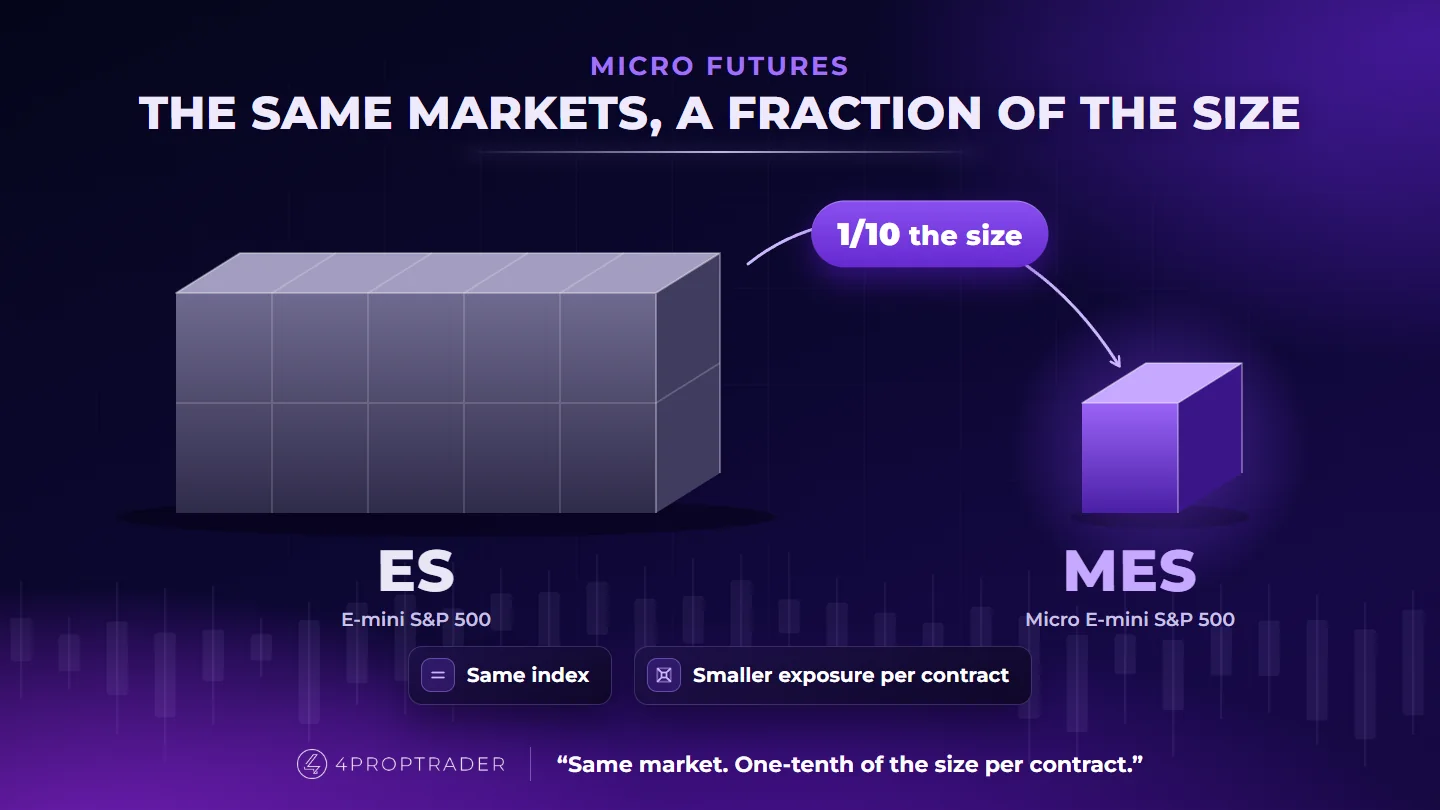
Micro futures are exchange-traded derivatives listed by CME Group as smaller-scale versions of widely followed products. The term micro e-mini usually refers to the equity index versions, such as MES (S&P 500) and MNQ (Nasdaq-100), but the idea now extends to metals, energy and other benchmarks. Each one is designed to track the same underlying as its standard mini at one-tenth of the scale.
The result is a product with the same behaviour but a much smaller dollar swing per tick. That is the whole point: the instrument is familiar, the exposure is lighter, and the cost of a mistake is lower.
Specifications and Tick Values: Micro vs Mini
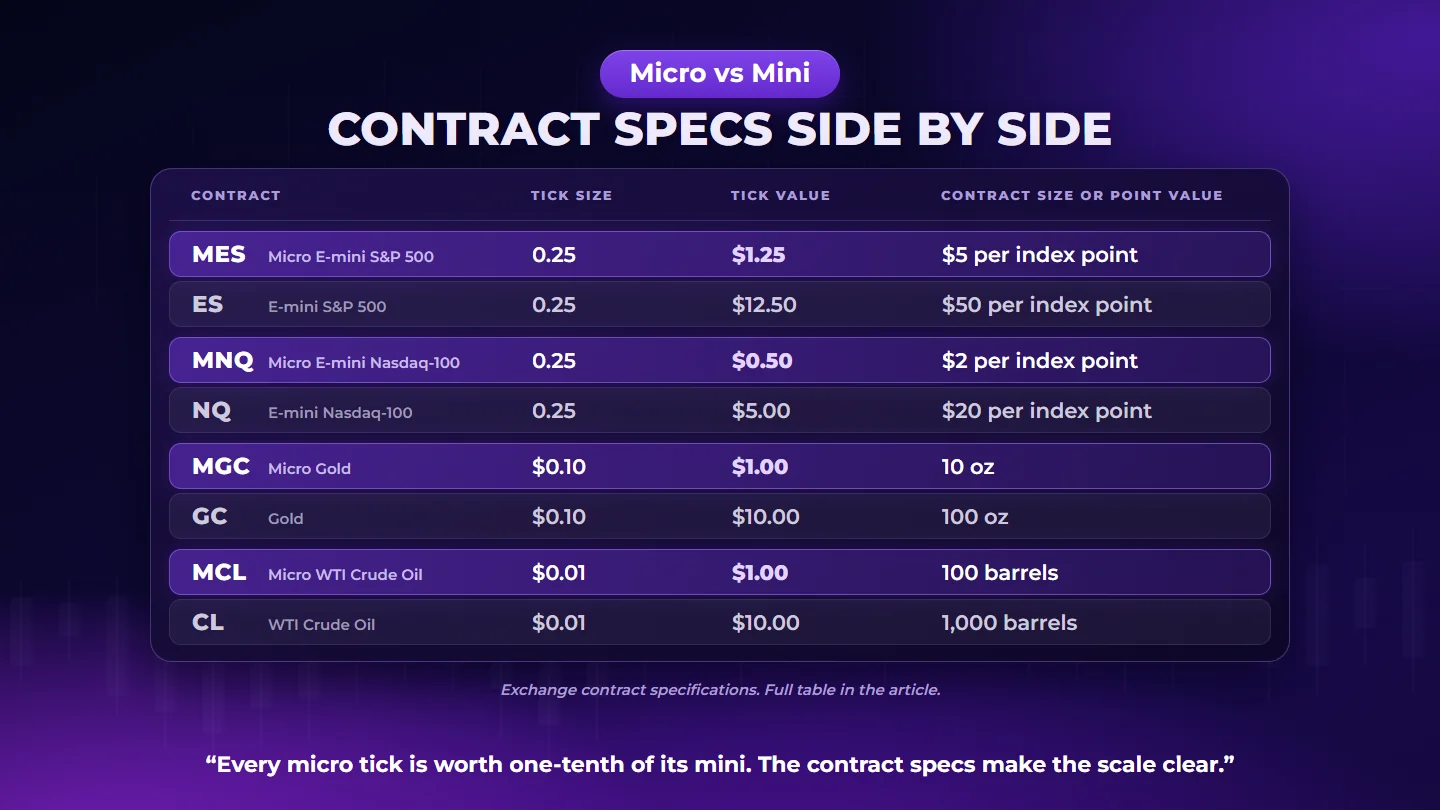
Every futures contract has fixed terms: what it tracks, how much each point or unit is worth, and the minimum increment, called the tick. The contract size is where the one-tenth ratio shows up; it holds across nearly every pair in the tables below, and the specs, including contract multipliers, make it easy to verify.
Equity index pairs
| Symbol | Tracks | Tick size | Tick value | Value per point | Scale vs mini |
|---|---|---|---|---|---|
| MES | S&P 500 | 0.25 | $1.25 | $5 | 1/10 |
| ES | S&P 500 | 0.25 | $12.50 | $50 | Standard |
| MNQ | Nasdaq-100 | 0.25 | $0.50 | $2 | 1/10 |
| NQ | Nasdaq-100 | 0.25 | $5.00 | $20 | Standard |
| MYM | Dow Jones | 1.00 | $0.50 | $0.50 | 1/10 |
| YM | Dow Jones | 1.00 | $5.00 | $5 | Standard |
Metals and energy pairs
| Symbol | Tracks | Tick size | Tick value | Underlying amount | Scale vs mini |
|---|---|---|---|---|---|
| MGC | Gold | 0.10 | $1.00 | 10 troy oz | 1/10 |
| GC | Gold | 0.10 | $10.00 | 100 troy oz | Standard |
| MCL | Crude oil | 0.01 | $1.00 | 100 barrels | 1/10 |
| CL | Crude oil | 0.01 | $10.00 | 1,000 barrels | Standard |
| MHG | Copper | 0.0005 | $1.25 | 2,500 lbs | 1/10 |
| HG | Copper | 0.0005 | $12.50 | 25,000 lbs | Standard |
Read the tables in pairs. One tick on MES is worth $1.25, while one tick on ES is worth $12.50. A one-point move, which is four ticks, changes an ES position by $50 and an MES position by $5. Micro gold works the same way: a single tick on MGC is $1.00, against $10.00 on the standard gold product.
These are exchange specifications, so they do not change with the broker or the firm. What the pairs also share is the benchmark: their daily settlement prices follow the same underlying, which is why the smaller product behaves like its mini and differs only in scale.
A Worked Comparison: Same Move, Different Swing
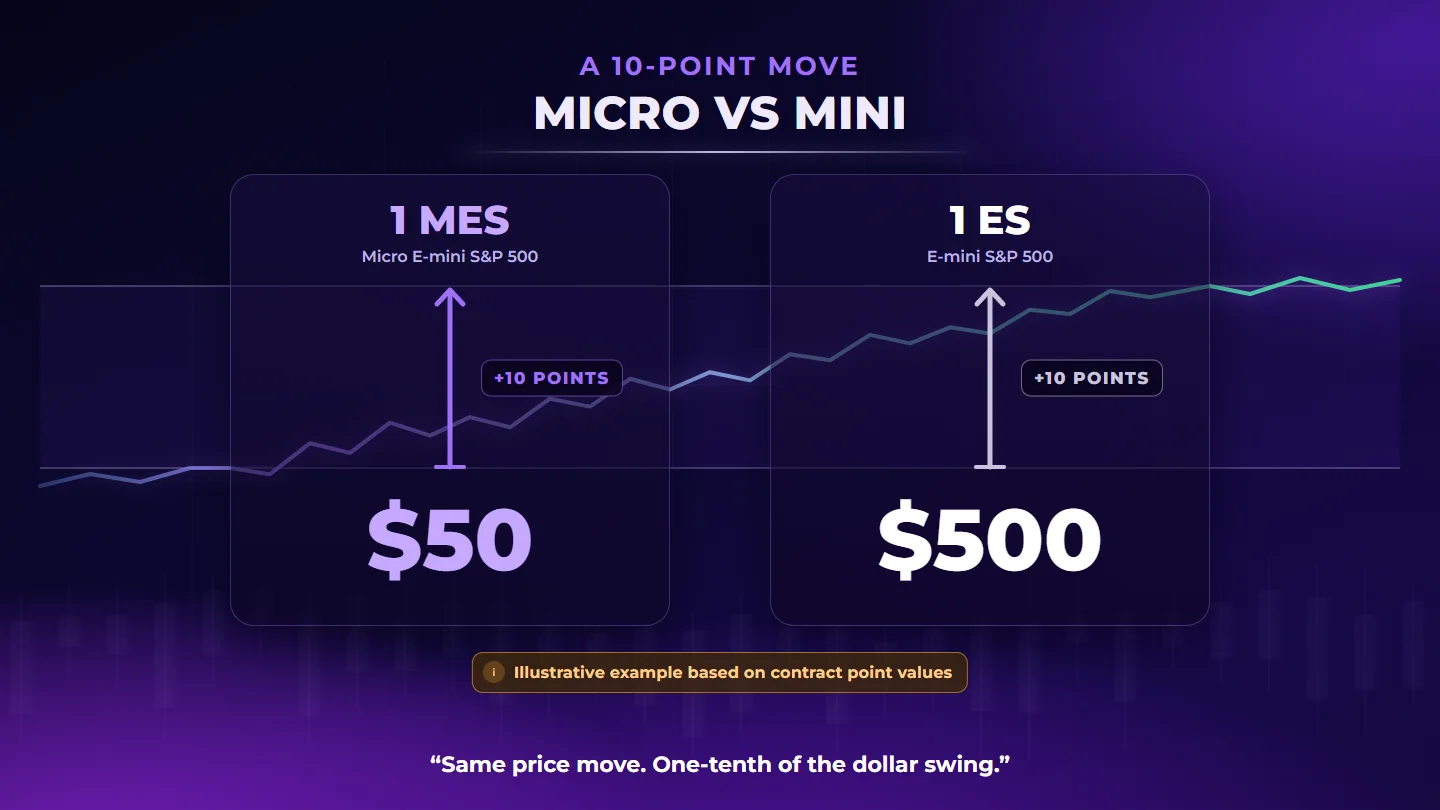
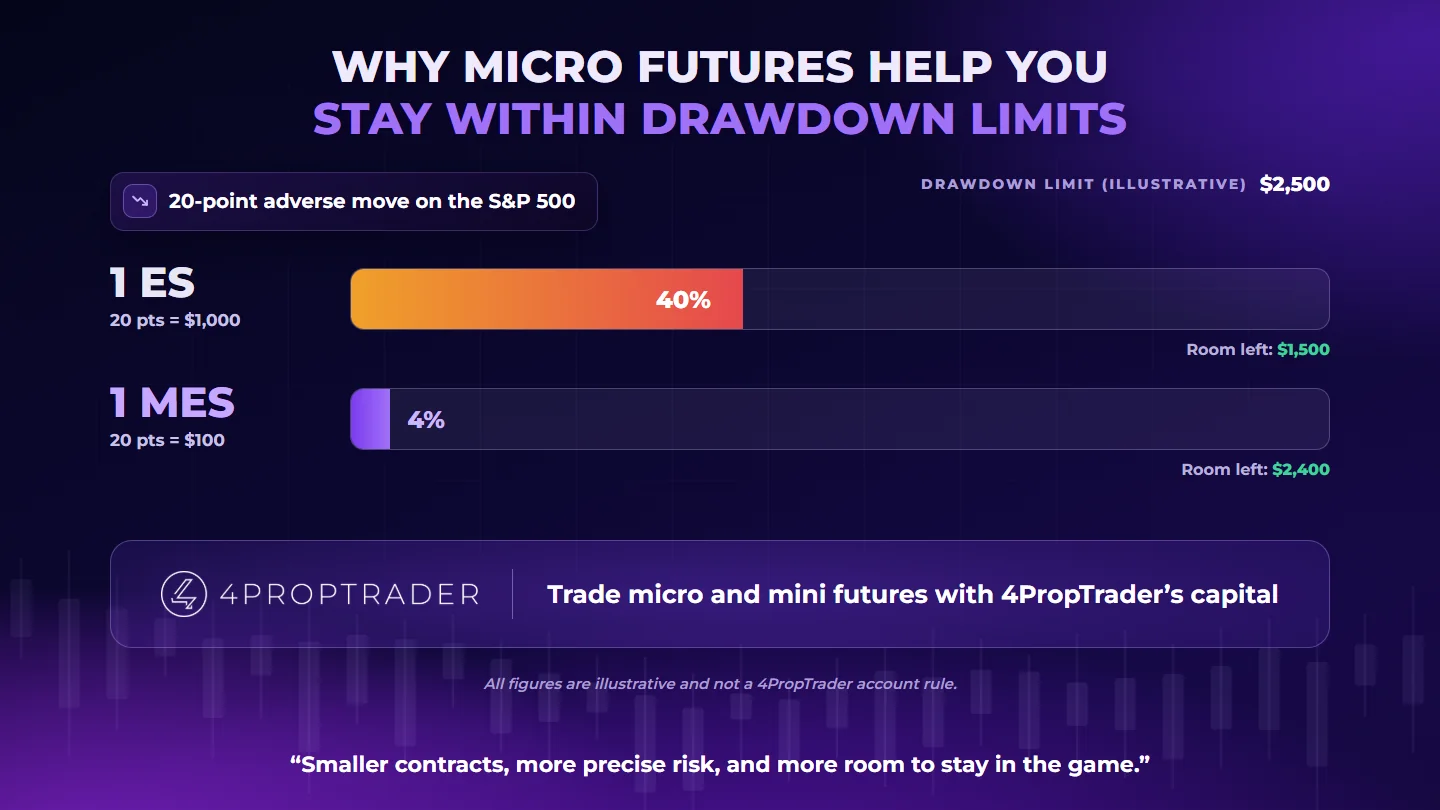
Suppose the S&P 500 falls 20 points against a long position. On one ES, that is a $1,000 loss (20 points × $50). On MES, it is $100 (20 × $5). The Nasdaq-100 gives the same picture: a 50-point drop costs $1,000 on NQ (50 × $20) and $100 on MNQ (50 × $2). The price movements are identical, and the dollar impact is one-tenth.
Now put that against a drawdown allowance. For illustration only, and not as a 4PropTrader account rule, imagine a $2,500 drawdown limit. A 20-point adverse move on one ES uses $1,000, which is 40% of the allowance. The same move on one MES uses $100, or 4%. The first position leaves room for a couple more bad moves before the account is in trouble; the second leaves room for many.
Margin: What Changes and What Does Not
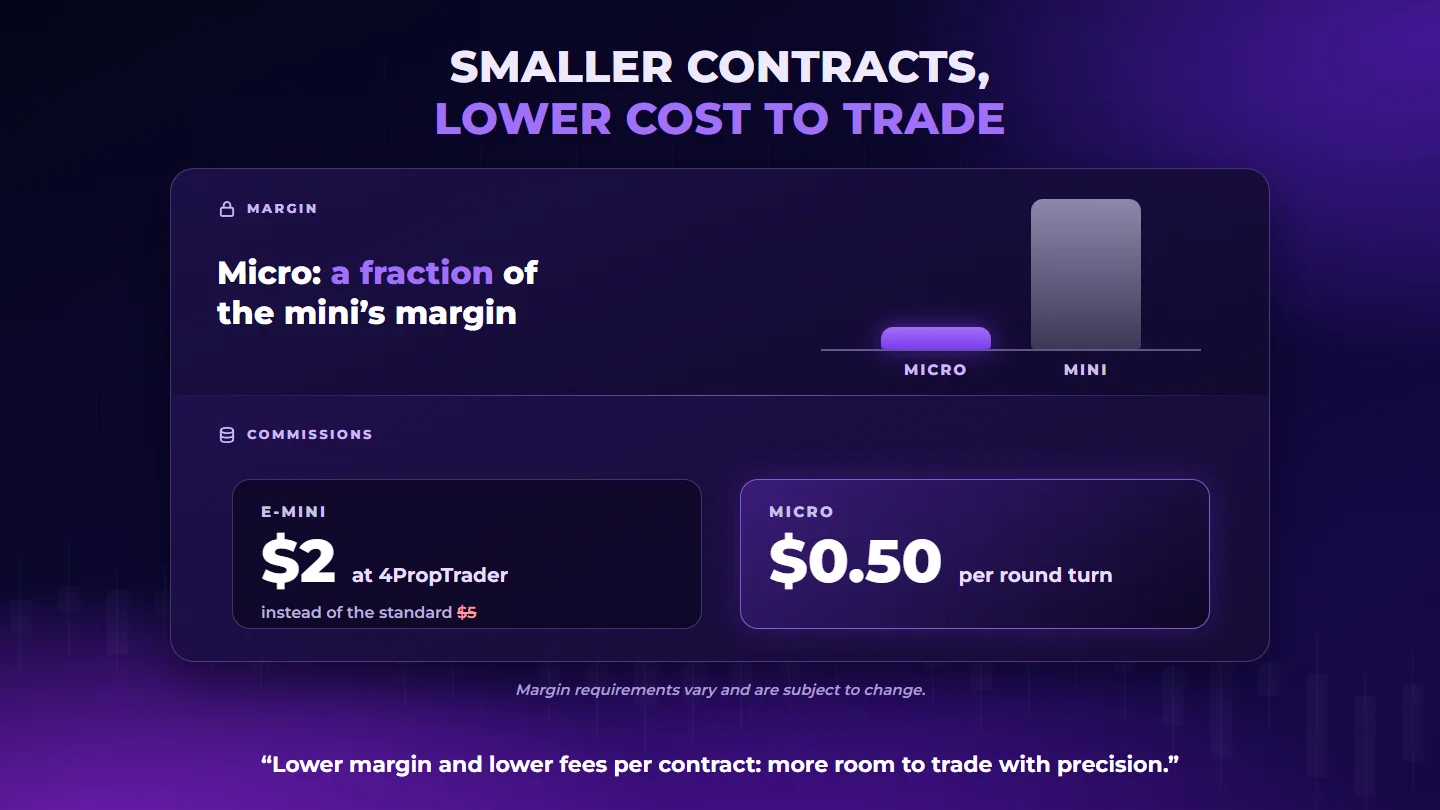
Margin is the deposit required to hold a position, and for the smaller instruments it is typically a fraction of the mini's, broadly in line with the difference in scale. The exact figures are set by the exchange and adjusted when volatility rises, so check the current requirement with your broker or in the firm's rules rather than relying on a number in an article. A brokerage statement shows what is actually being held.
The practical effect is that the smaller instruments let you hold a position without committing a large block of capital to it. In fast markets, that matters, because margin demands tend to rise just when moves get larger.
Commissions and Fees at 4PropTrader
Commission is the other cost to compare. At 4PropTrader, the commission is $2 round turn for mini instruments instead of the standard $5, and $0.50 round turn for the smaller ones. A round turn covers the entry and the exit.
Here is an honest way to read those levels. A $0.50 round turn on a $1.25 MES tick means the commission is 0.4 of a tick, while $2 on a $12.50 ES tick is 0.16 of a tick. So per tick, the smaller instrument carries a proportionally higher cost, even though the dollar amount per position is lower. And if you scale up to match one ES, ten MES cost $5 round-trip against $2 for one ES. What the smaller instrument offers is precision, not cheaper equal exposure.
Why Smaller Instruments Fit Funded Accounts
These products were originally aimed at small traders and individual investors who found the standard sizes too large, and the same logic applies to anyone working inside a drawdown limit. The main benefit is flexibility: you can enter a position in stages, add or reduce it in small steps, and adjust as the situation develops, instead of making an all-or-nothing decision.
If you want to trade through volatile releases, a smaller swing per tick gives you room to be wrong without ending the account, and that is the core idea behind trading micro futures. It also helps when you are testing a new strategy, because a slip in execution costs a fraction of what it would on the mini. Many people combine both: they use the standard instrument for conviction setups and the smaller one to fine-tune an entry, which is a sensible option when you want tighter drawdown management and a real opportunity to refine your approach.
Experienced futures traders use them for the same reason. Liquidity in the most popular products is deep, and trading volume is high, so getting in and out is rarely a problem, and the instant feedback of a small position helps you learn how your approach behaves under real conditions.
Practical Points Before You Start
A few details are worth checking before you place a first order. Futures expire, so positions held across the expiry date are rolled to the next month, and it helps to know how your platform handles that. Your trading platforms should show a real-time quote and a clear chart, and the order entry should show the tick value of the symbol you are about to use so that there are no surprises.
Based on market conditions, spreads and fills can differ between instruments, so it is sensible to start with small positions on the product you plan to use. CME Group also lists micro products on cryptocurrency and FX benchmarks, but those fall outside the instruments approved at 4PropTrader, which include listed futures including equity indices, metals and energy, plus commodity products such as copper.
Getting Started With Micro and Mini Instruments at 4PropTrader
The approved list at 4PropTrader includes the pairs shown in the tables above: MES and ES, MNQ and NQ, MYM and YM, MGC and GC, MCL and CL, and MHG and HG, among others. You can choose the standard or the smaller version of each, so one contract of MES can sit alongside a mini position in the same account if that suits your plan.
Once you explore micro and mini side by side, the choice comes down to how much dollar swing per tick you want to carry. A smaller contract commits less of your drawdown limit to any single idea, while the mini carries more weight per tick.
Frequently Asked Questions
What are MES and MNQ?
They are the smaller-scale versions of the S&P 500 and Nasdaq-100 mini products, each one-tenth of the standard scale. A tick on MES is $1.25 and a tick on MNQ is $0.50.
Are tick values proportional between micro and mini?
Yes. Across the pairs in the tables, the smaller instrument has a tick value one-tenth of its mini's, for example $1.25 against $12.50 on the S&P 500.
Do the smaller instruments need less margin?
Typically yes, broadly in line with the difference in scale, but requirements are set by the exchange and change with market conditions, so check the current figure.
Are commissions lower?
In dollar terms per position, yes. At 4PropTrader, the commission is $0.50 round turn on the smaller instruments and $2 round turn on the minis, against a standard $5. Per tick, though, the smaller instruments carry a proportionally higher cost.
Which instruments can I trade with 4PropTrader?
The approved list includes MES, ES, MNQ, NQ, MYM, YM, MGC, GC, MCL, CL, MHG and HG, among others.
Final Thoughts
The smaller instruments are the same products at one-tenth of the scale. That gives you the same benchmark with a lighter dollar swing per tick, which makes it far easier to keep a single bad move from using up your drawdown. They also give you finer control over entries, exits, and exposure, which is exactly what a funded account rewards.
If you are new to the basics, start with What Is Futures Trading? A Complete Beginner's Guide to the Market of Tomorrow. For the formulas that decide how many to hold, read What Is Position Sizing in Trading? The Key to Long-Term Consistency and Risk Control. Together with this guide, they give you the full picture before you place a first order.
Disclaimer: Trading futures involves substantial risk of loss and is not suitable for everyone. Tick values are fixed by the exchange, while margin requirements, commissions, and approved instruments are subject to change. Examples are illustrative and are not rules. Always confirm current terms directly before trading.
Trade micro and mini futures with 4PropTrader's capital — apply for a funded Futures account and manage risk with precision.