Quick Summary
A prop firm scaling plan is a structured path that lets a funded trader move up to a larger account size after hitting defined performance targets, instead of paying for a bigger account upfront. In most programs, a trader must reach a specific profit, stay within drawdown limits, and trade a minimum number of days before the firm increases the capital behind the account.
This guide to prop firm scaling explains how a scaling plan works, which scaling milestones usually trigger an increase, how to qualify for bigger accounts, and how 4PropTrader approaches growing your capital without a scaling plan of its own — so you know exactly what to look for before you apply.
Introduction
Anyone who passes an evaluation eventually asks the same question: how do I trade with more capital? For many funded traders, the answer is a scaling plan. Rather than paying challenge fees for a larger challenge, a trader can grow their capital by proving results on the account they already have. The idea is simple, but the details differ widely from one prop firm to the next, which is why understanding how prop firm scaling plans work matters before you commit to any program.
Scaling is also one of the most misunderstood parts of prop trading. Some traders assume every one of the proprietary trading firms they compare offers it, while others assume it guarantees a bigger account if they simply keep trading. In reality, firms that offer scaling attach specific rules to it, and some firms offer no scaling at all. This article walks through how the mechanics generally work, shows calculation examples using illustrative numbers, and explains what to check when you compare scaling structures between programs.
What Is a Scaling Program?
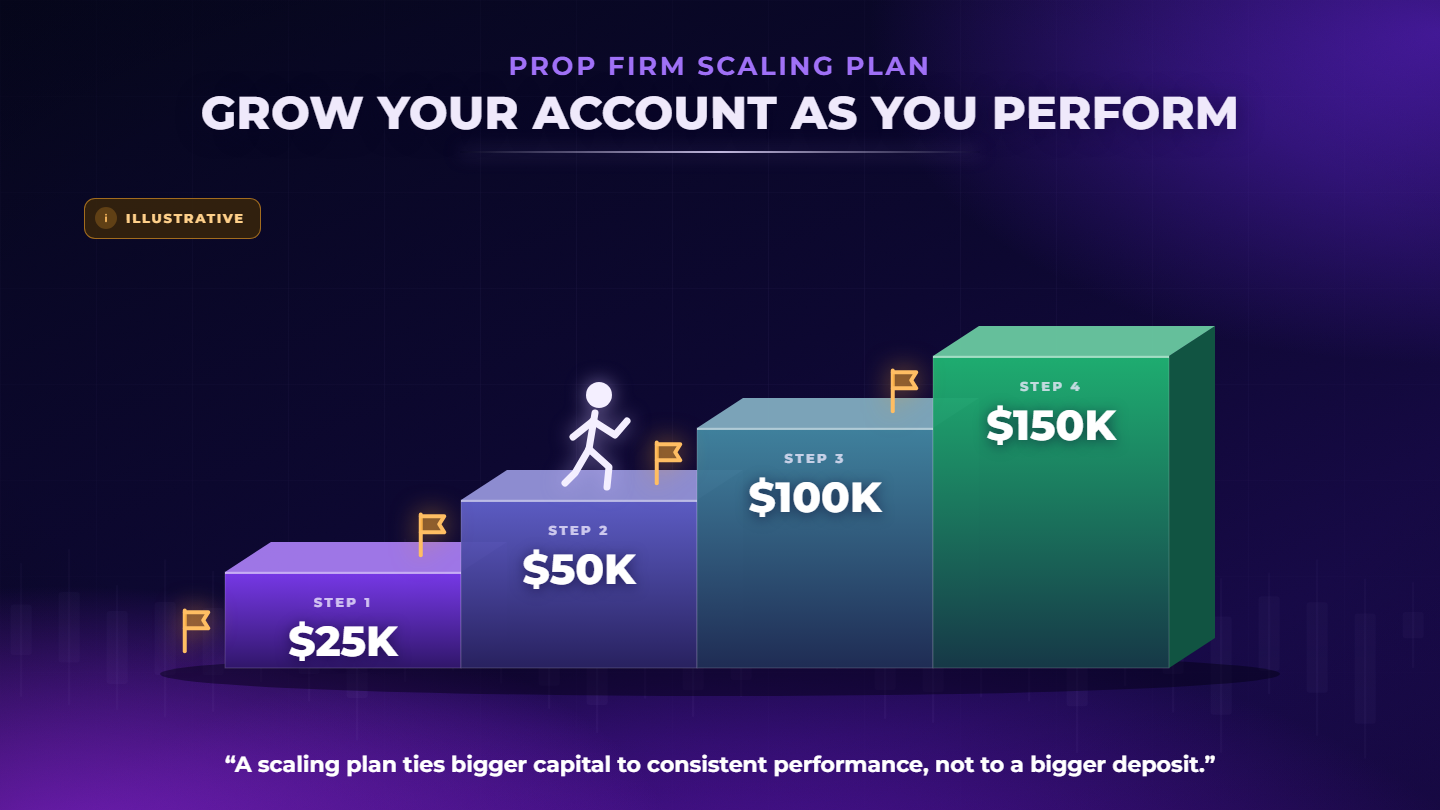
A scaling program is a set of rules that lets a trader increase their account when they reach agreed performance levels. Think of it as a staircase: each step is a larger account, and each step is unlocked by results on the one below it. As the firm's capital behind the account grows, they get more room to work with, and the firm gets evidence that they can handle more responsibility.
Scaling exists because it aligns incentives. A trading firm that lets a proven trader manage more capital stands to earn more from those results, and the trader earns more in dollar terms from the same percentage return. A good scaling plan makes that alignment explicit, so both sides know what has to happen for the next step to unlock.
How Scaling Plans Work
Although the details vary, most plans follow the same basic pattern. A trader starts with funded capital, trades under the program's trading rules, and is reviewed at set intervals. If the requirements are met, the firm raises the account, and the process repeats from the new level.
Understanding how a plan works in practice comes down to three questions: what triggers a review, what you have to achieve to pass it, and what changes about your account rules after an increase. A plan that answers all three clearly is far easier to plan around than one that leaves them vague.
Common Scaling Requirements and Targets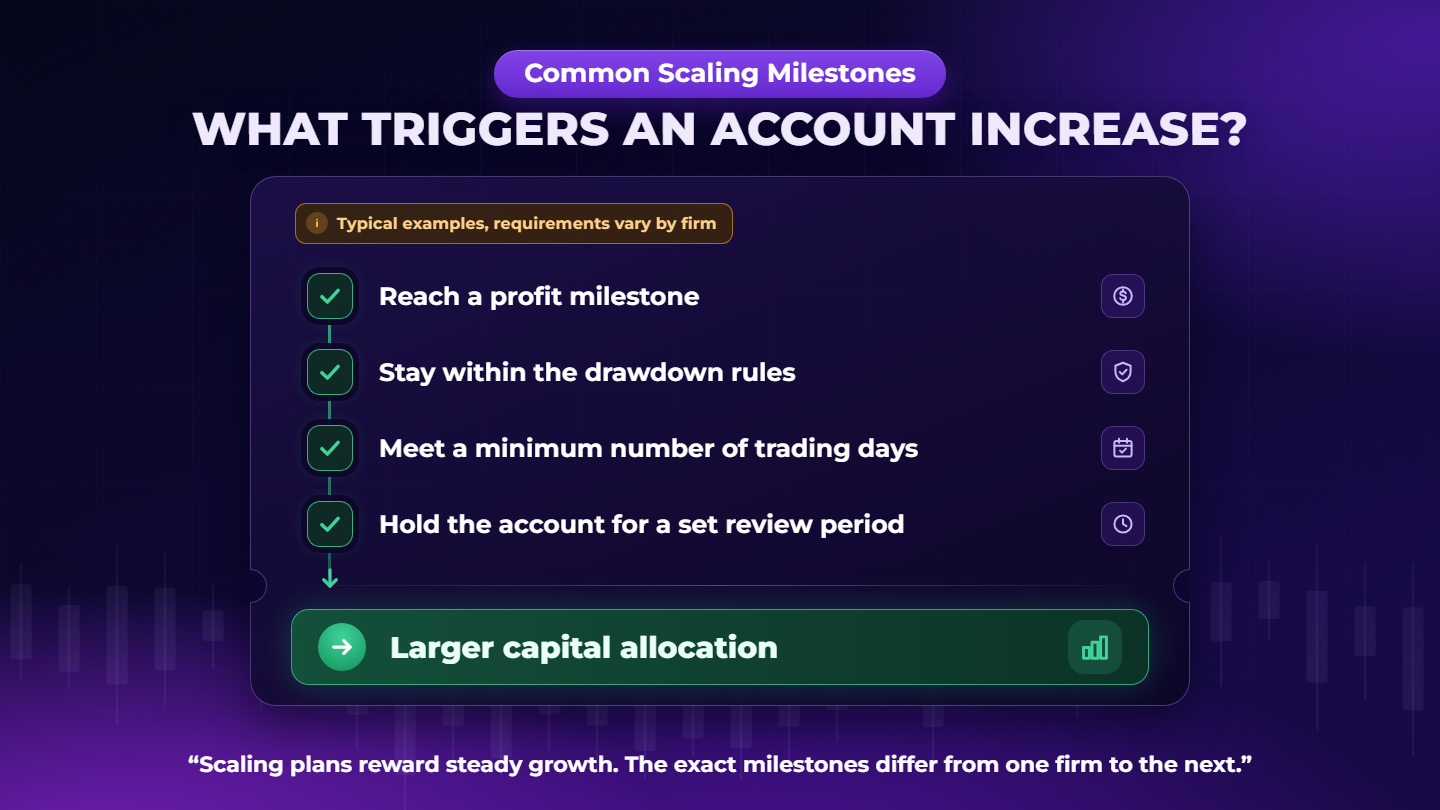
Most plans combine several requirements rather than relying on one number. The most common include:
- A profit milestone: reaching a set percentage or dollar gain on the current account, which acts as the profit target for that step.
- A minimum number of trading days, because the firm wants to see results over time rather than one lucky session.
- Staying inside the drawdown limits and the daily loss rules for the whole review period.
- A review period, or a minimum number of payout cycles, before the next level unlocks.
- Regular account activity, rather than leaving the account idle between reviews.
Some firms require traders to demonstrate discipline and consistency across the entire review period, while others only check the numbers at the end. Because requirements differ so much, always read the full scaling rules before you start trading under any program.
Calculation Examples: From Targets to Bigger Accounts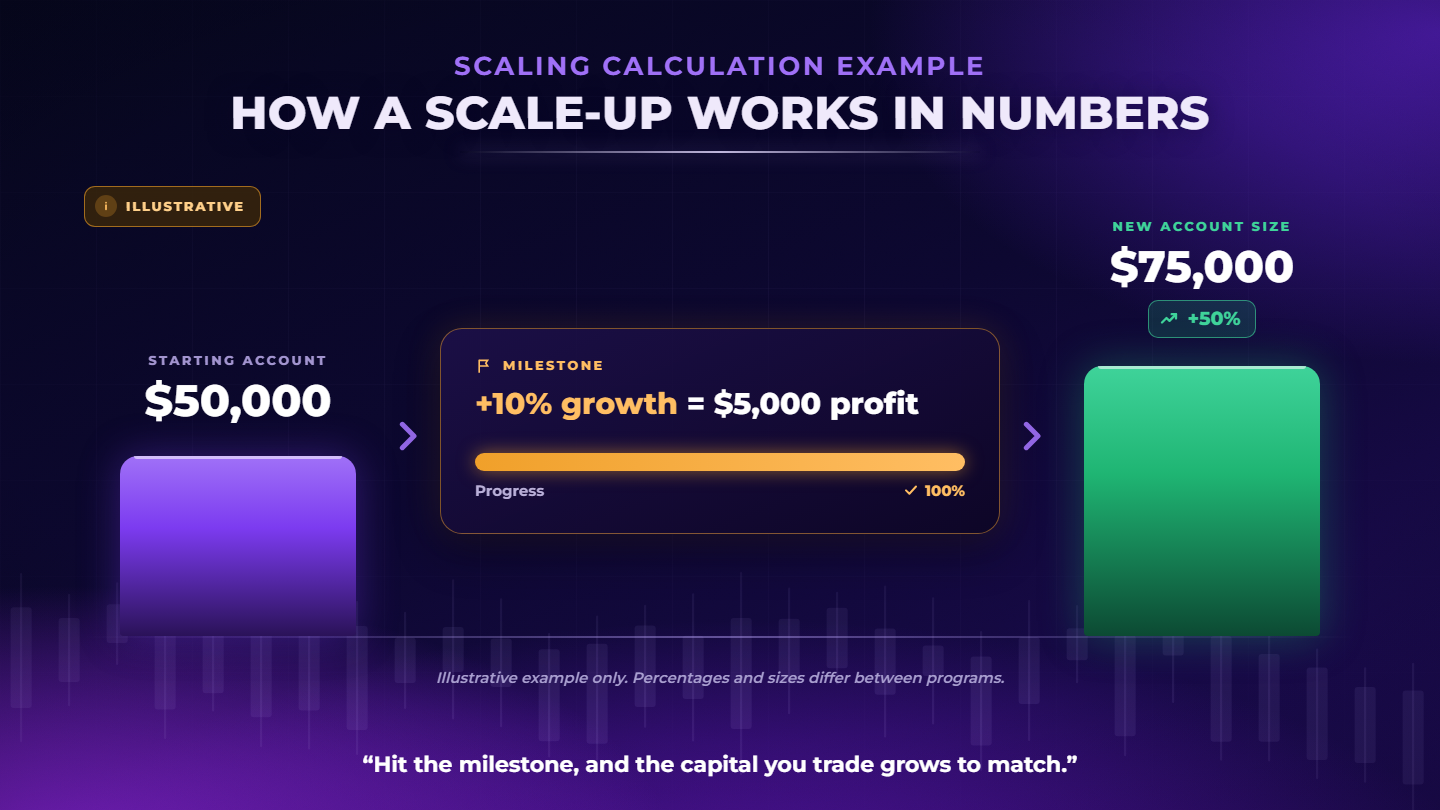
The examples below use illustrative numbers only. They are not 4PropTrader figures, and real programs set their own percentages and balances.
Example 1: A four-step ladder
Suppose a program starts you at $25,000 and increases the account by $25,000 at each step once you reach a 10% gain on the current balance, within the drawdown limits and the minimum number of trading days. Each step has a specific profit target:
- Step 1: $25,000 account. Target: 10% = $2,500 profit. Moves up to: $50,000.
- Step 2: $50,000 account. Target: 10% = $5,000 profit. Moves up to: $75,000.
- Step 3: $75,000 account. Target: 10% = $7,500 profit. Moves up to: $100,000.
Notice what happens to the profit needed at each step: the dollar amount rises because 10% of a bigger account is a bigger number, even though the percentage stays the same. A trader who scales through this ladder has to earn $2,500 + $5,000 + $7,500 = $15,000 in total to reach the $100,000 level.
Example 2: Why a bigger account changes the numbers
Consider a trader who earns a 5% return in a month. On a $50,000 account, that is $2,500. On a $100,000 account, the same 5% is $5,000. They have not become twice as skilled; they have simply been given twice the trading capital. That is the appeal of scaling: it multiplies the dollar value of a repeatable edge. It also multiplies the dollar value of mistakes, which is why risk matters more, not less, as the account grows.
These figures are gross, before any profit split. The profit split a firm applies to your gains is one of the factors worth comparing between programs, but it is a separate question from how the account grows.
Example 3: Reading a plan critically
Two programs may both advertise a $200,000 maximum. Program A increases the account after every 10% gain with a 30-day review. Program B asks for a 15% gain and three payout cycles before each increase. Program A reaches the top faster on paper, but if its drawdown rules are tighter, the faster path may carry a higher chance of breaching the account along the way. Comparing the full set of requirements, not just the headline size, is what separates a useful plan from a marketing line.
What Makes a Good Scaling Plan
A few qualities separate a plan worth planning around from one that only looks good on a landing page:
- Transparent scaling: the requirements, review dates, and account levels are published in plain terms, so you can calculate your path in advance.
- Flexible scaling: the plan allows for a reasonable range of approaches instead of rewarding only one narrow style.
- Sensible risk rules: the drawdown and daily loss limits still make sense at larger sizes, rather than being so tight that a normal losing streak ends the account.
- A clear definition of when a trader is eligible for scaling, including what resets the process if the account is breached.
How to Qualify for Larger Capital Allocations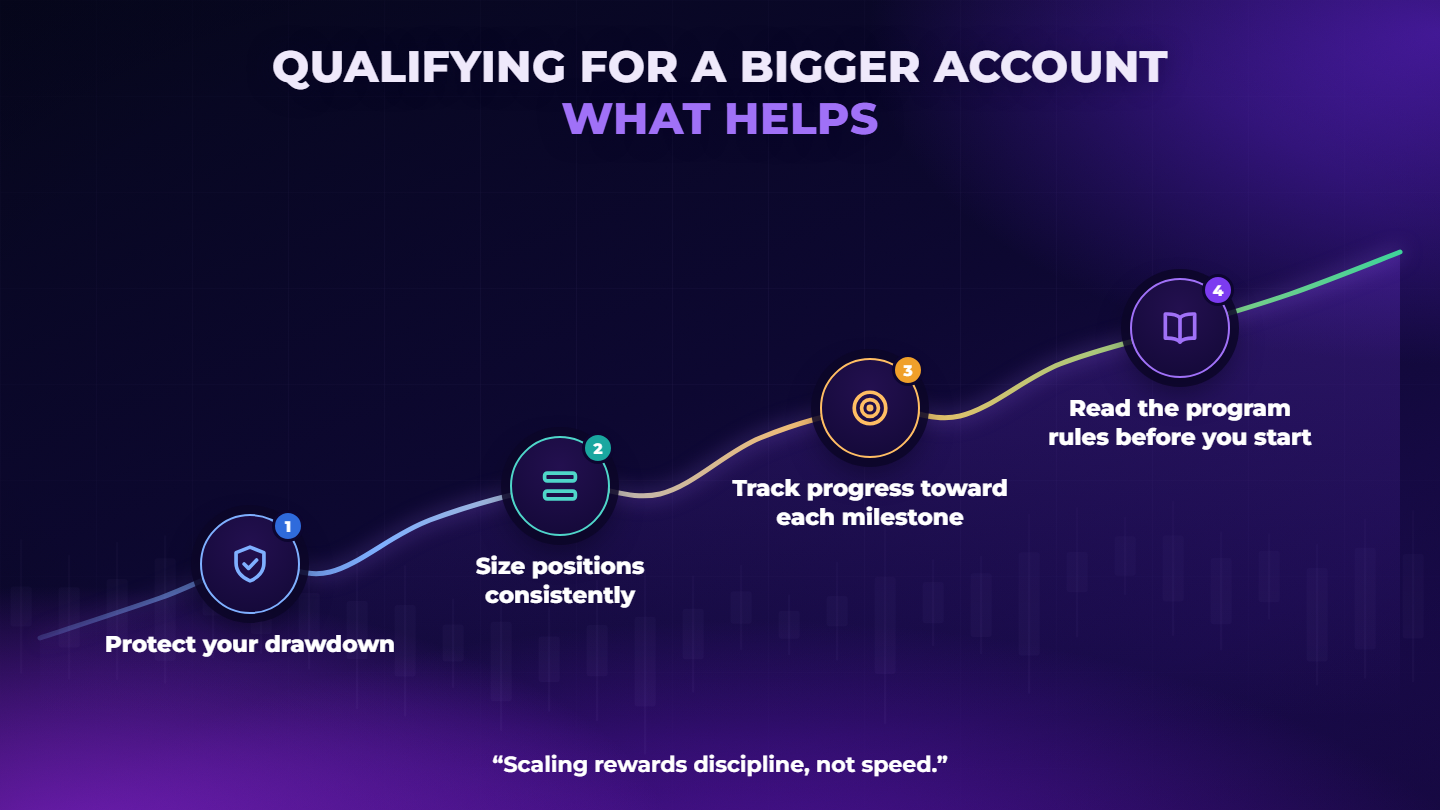
Qualifying is mostly about behaviour, because scaling decisions are based on performance over time rather than on one big result. Successful traders tend to share a few habits. They keep a trading style they can repeat, they size positions the same way from one session to the next, and they track their progress toward each target instead of guessing.
Strong risk management is the habit that matters most. A plan can only reward someone who stays inside the rules long enough to reach the next step, so protecting the account matters more than chasing the target quickly. In practice, traders scale most reliably when they treat every step as a fresh account to protect, not as a prize that has already been won. Before you try to grow your funded account, ask what the plan will realistically demand of your time and your risk.
Scaling, Instant Funding, and New Challenges
Not every route to a bigger account involves scaling. Some programs offer instant funding, where a trader skips the evaluation and starts on a live account straight away; these often come with different rules and may not include a scaling path at all. Other traders skip scaling altogether and buy a new challenge at a larger size.
That route means paying challenge fees again, passing the challenge rules again, and starting a new account from zero. Prop firm challenges are priced and structured differently from one firm to the next, so it is worth checking whether a rule applies to the challenge or funded account before you rely on it. Someone whose funded runs are consistently profitable is exactly who scaling is designed for, and for them scaling can be more cost-efficient than paying to start again.
How to Choose the Right Prop Firm When Scaling Matters
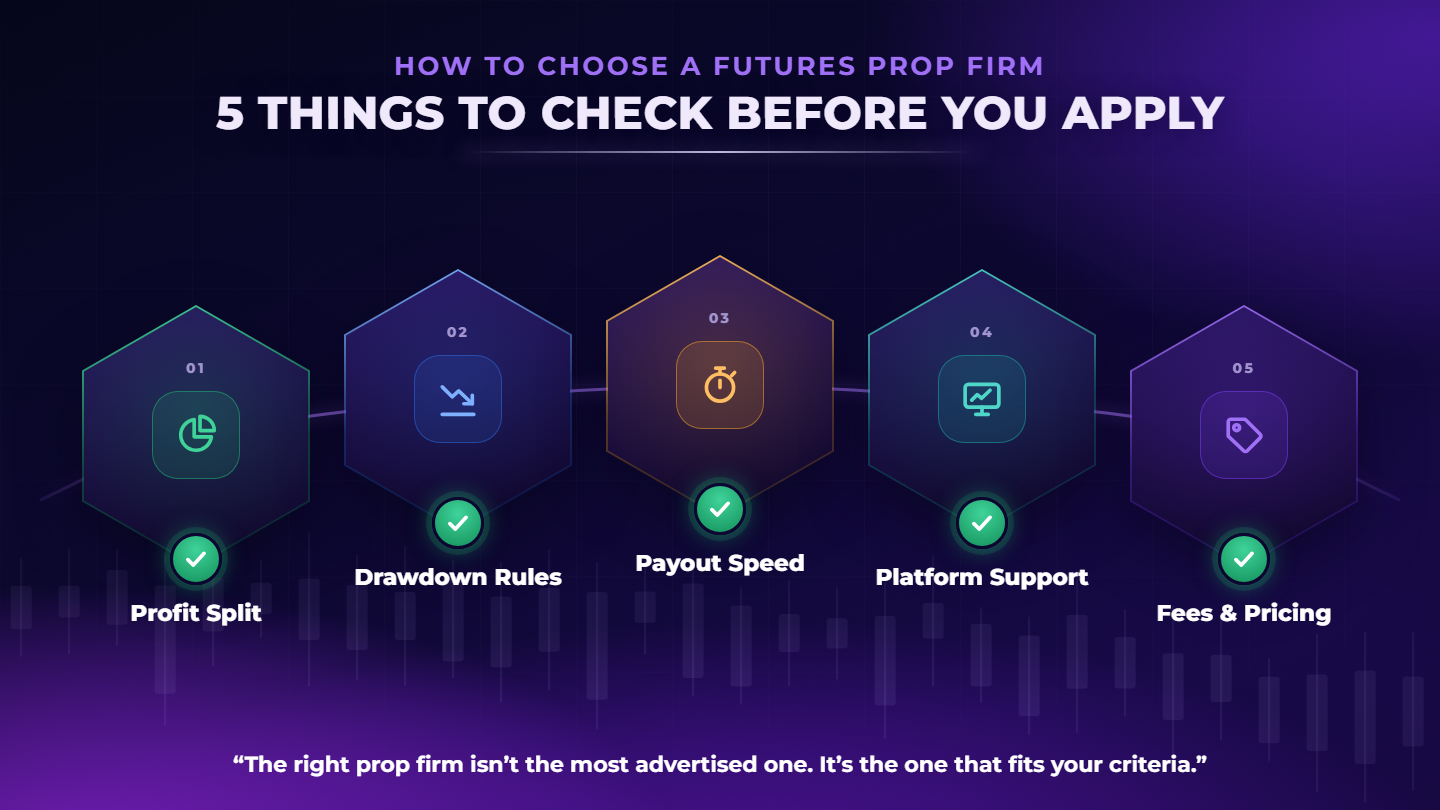
Finding the right prop firm starts with knowing whether scaling is even part of the offer. Many of the popular prop firms and top prop firms list their rules publicly, but there is no universal best prop firm, because the best prop firm for you depends on how you trade. Prop firms offer very different structures, so it helps to compare the same questions across every program:
- Does the firm offer a scaling program at all, and are the terms written down?
- Does the firm publish its scaling structures clearly, including targets, review periods, and account levels?
- What happens to the drawdown and daily loss rules after each increase.
- What trader feedback says about whether the plan is honoured in practice.
- Whether the plan suits how you actually trade, not just your ambitions.
A futures prop firm and a CFD-focused firm may handle all of this differently, and firms that offer scaling plans rarely structure them in the same way. Reading the rules for funded trading accounts in full, before you pay for anything, is the simplest protection you have.
Different proprietary trading firms also give traders different routes to more capital. Some focus on helping traders to grow through a published ladder. Others let traders grow funded accounts by adding new ones. Whichever model a firm offers, the goal for you is the same: to increase your funded account size over time in a way that fits your own risk tolerance and budget.
How 4PropTrader Approaches Growing Your Capital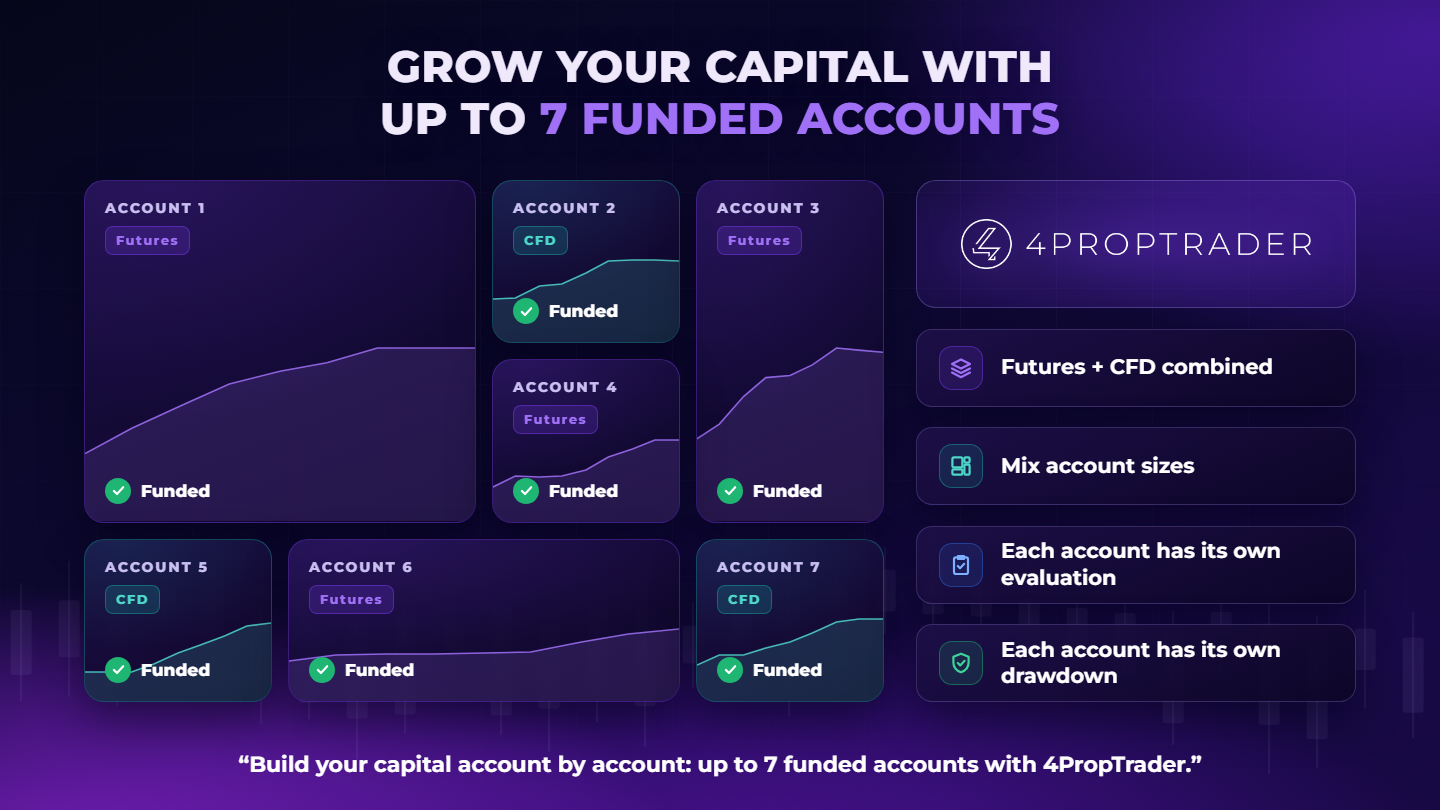
4PropTrader does not run a milestone-based scaling plan. Instead, a trader can hold up to 7 funded accounts at the same time, combined across Futures and CFD, and each additional account needs its own evaluation. A trader can mix account sizes, and each account runs its own drawdown and payout rules independently.
In practice, that means growth comes from adding accounts rather than from unlocking upgrades. For example, a trader might run one larger account for their main strategy and a smaller account to test a different trading style, adding further accounts over time up to the maximum of 7. Because each account follows its own rules, the setup is easy to plan around.
The trade-off compared with a scaling ladder is straightforward: each additional account involves its own evaluation, but there is no waiting on a performance milestone to unlock more capital. Traders can grow their exposure when they are ready, and they choose the size of each new account themselves.
Frequently Asked Questions
What is a scaling plan?
It is a set of published rules that lets a trader move to a larger account after meeting performance requirements, such as a profit target, a minimum number of trading days, and staying inside the drawdown limits.
Does every prop firm offer scaling?
No. Some firms offer scaling, some offer none, and some only offer it on certain accounts. 4PropTrader does not run a scaling ladder; traders instead hold up to 7 accounts at once, each with its own evaluation.
How long does it take to qualify for scaling?
It depends entirely on the program and on how quickly a trader reaches each target while staying within the rules. Reviews are usually tied to a minimum number of trading days or a fixed review period, so qualifying is rarely instant.
Is scaling better than buying a new challenge?
For someone already performing well, scaling can avoid paying challenge fees again and restarting from zero. For someone who wants more accounts quickly, a new challenge may be the more direct route. The better option depends on the program and your goals.
Can a bigger account increase risk?
Yes. A larger account multiplies the dollar value of both gains and losses, so risk management matters even more after an increase. Keeping position sizes and rules consistent is the safest way to grow.
Does 4PropTrader have a scaling plan?
No. At 4PropTrader, a trader can hold up to 7 funded accounts, combined across Futures and CFD, with mixed account sizes allowed. Each account needs its own evaluation and runs its own drawdown and payout rules.
Final Thoughts
Scaling is a way to connect bigger capital to proven performance. The best ones are transparent, flexible, and realistic about drawdown, and they reward the trader who protects the account long enough to reach each step. Before you commit to any program, check what its scaling structure actually requires, and calculate the numbers yourself rather than relying on the headline figure.
At 4PropTrader, growth works through multiple accounts rather than a scaling ladder: up to 7, mixed sizes, Futures and CFD combined, each qualified separately. Scaling is one part of the funded journey. To understand how withdrawals work, read Article 27, How Do Prop Firm Payouts Work? Withdrawal Rules, Speed & Requirements Explained, and for the rule that shapes how profits are earned, read Article 28, What Is the Consistency Rule in Prop Trading? How It Works and Why It Matters.
Disclaimer: This article is provided for informational purposes only and does not constitute investment advice. Trading involves substantial risk of loss, and results will vary based on individual performance. Calculation examples are illustrative and are not 4PropTrader figures. Scaling terms, account rules, and other conditions vary by provider and are subject to change — always confirm current terms directly with your prop firm before trading.
Grow your capital with your performance — apply for a funded Futures or CFD account with 4PropTrader and scale step by step.