Quick Summary
A profitable futures trading strategy is not built on signals, hype, or aggressive speculation. Successful futures traders understand that consistency comes from structured execution, disciplined risk management, and a clear trading plan — not emotional decisions or oversized positions.
In today’s fast-moving futures market, where price movement, volatility, and real-time data shape every trade, traders must follow defined trading rules to protect capital and avoid violations. Whether you trade futures for intraday opportunities or hold a futures position longer, success depends on managing exposure, understanding margin requirement levels, and maintaining control over risk.
This guide presents effective futures trading strategies designed specifically for funded accounts and evaluation environments. You will learn how to start trading futures with structure, identify high-probability trading opportunities, and build a repeatable system that improves long-term trading performance.
If your goal is to trade the futures professionally, pass evaluations, and remain funded, the strategies outlined here provide the structure, discipline, and edge needed to succeed.
Introduction
The futures market offers exceptional liquidity, transparency, and nearly around-the-clock trading hours — but it also demands precision, discipline, and informed trading decisions.
Many new traders enter the market eager to trade futures, attracted by leverage, fast price movement, and the wide range of futures products available, from S&P 500 futures and crude oil futures to bitcoin futures. Yet without a structured approach, these same advantages can quickly expose a futures account to excessive volatility, poor execution, and unnecessary risk.
In funded trading environments, aggressive day trade habits, oversized futures positions, and emotional reactions to price swings rarely succeed. While such behavior may produce occasional wins, it often leads to rule violations, inconsistent trading performance, and even a costly margin call.
Prop firms are not evaluating how aggressively you buy or sell. They are evaluating whether you can:
- follow strict trading rules
- apply disciplined risk management
- adapt to changing market conditions
- protect capital while managing a futures contract responsibly
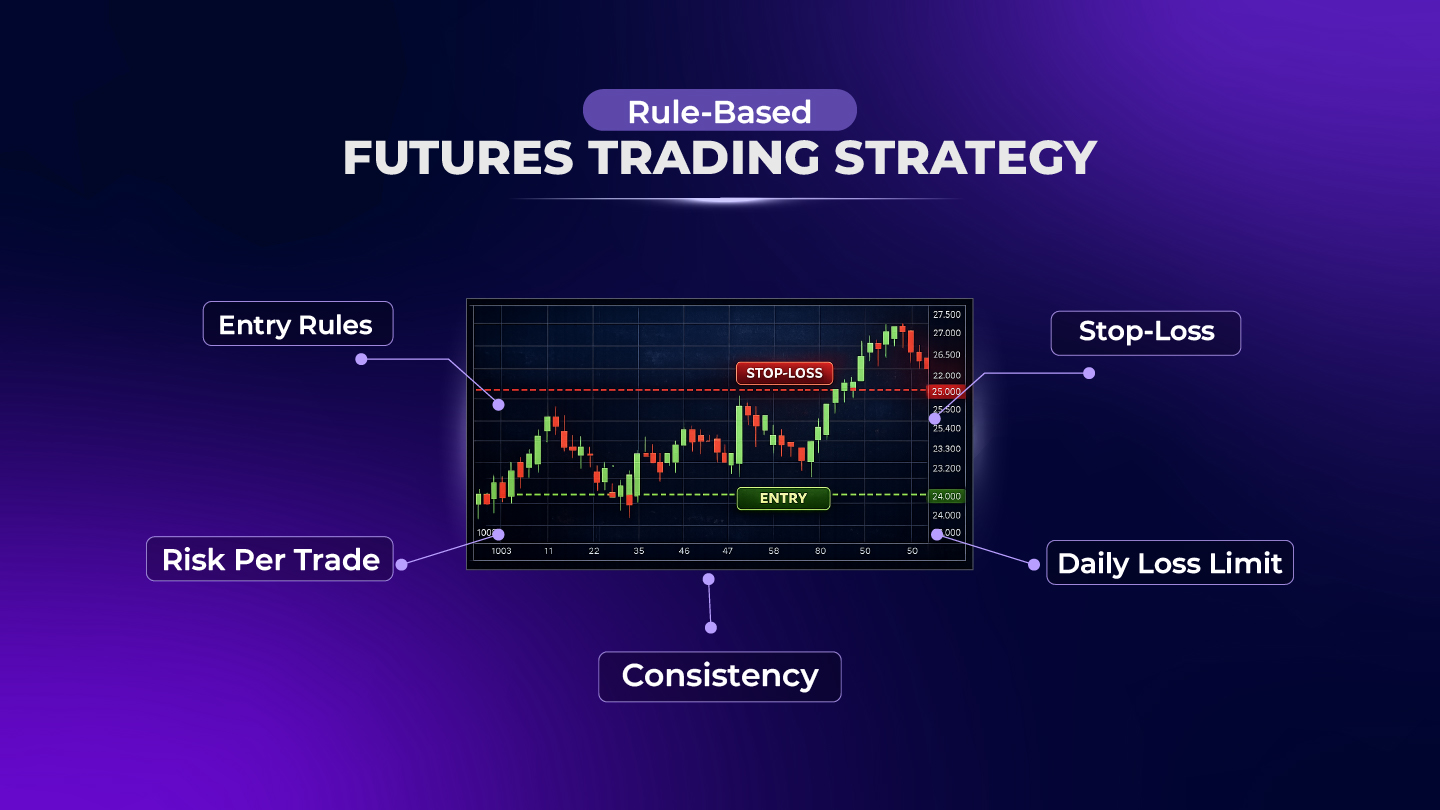
This is why a professional futures trading strategy must be rule-based, structured, and repeatable.
Whether your trading style focuses on short-term directional trades, pullback trading, or structured breakout trading, success begins with a clear futures trading plan.
This guide will help you develop a trading framework grounded in discipline, structure, and real-time execution — so you can navigate the futures trade environment with confidence and consistency.
Why Rule-Based Strategies Matter in Funded Futures Trading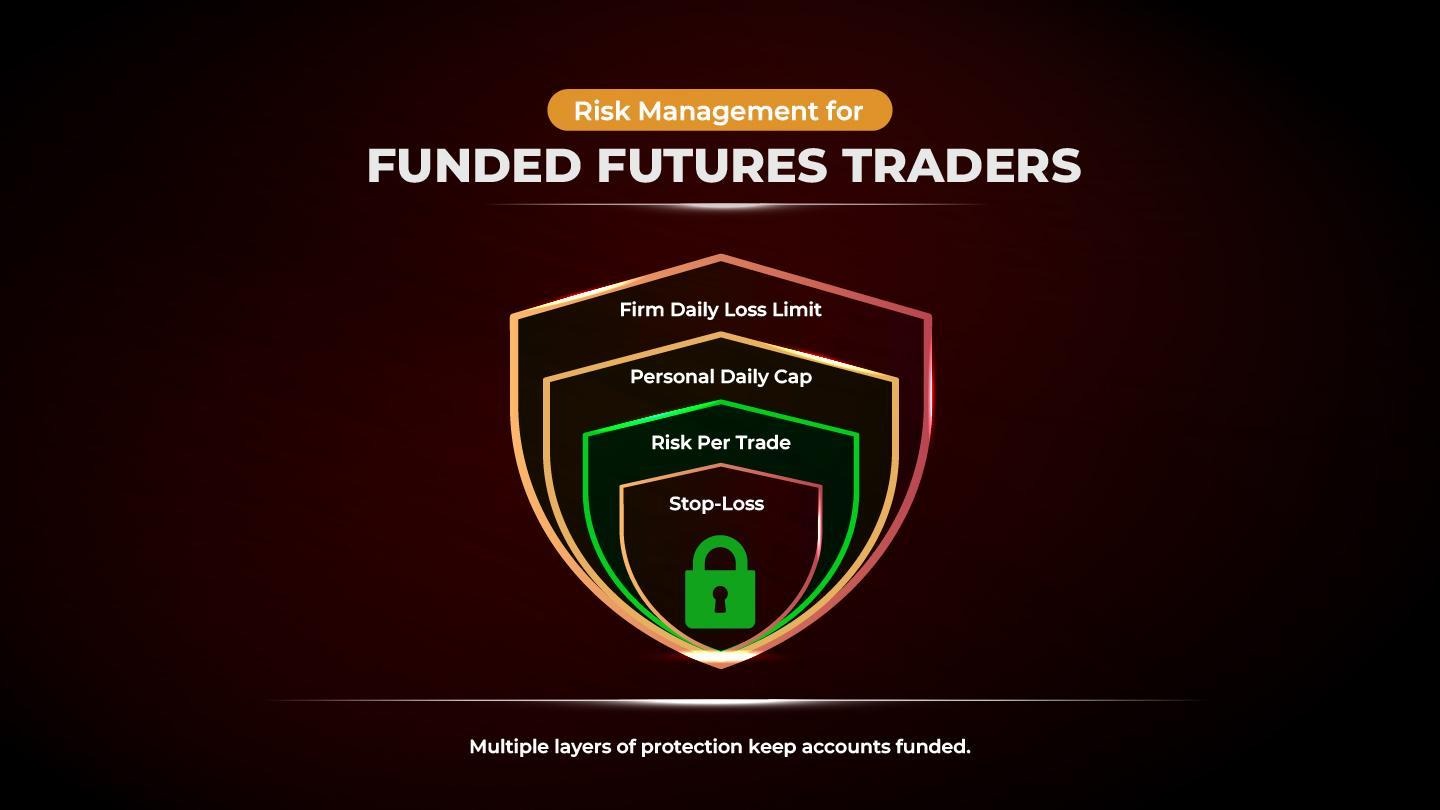
Every futures trade carries defined risk, leverage, and exposure. Because each futures contract is standardized and subject to specific margin requirement levels, even small errors in execution can quickly escalate into significant losses. In funded environments, where strict drawdown limits apply, this makes discipline and structure essential.
When you trade futures under prop firm rules, you must manage more than just market direction. You must control:
- daily loss limits
- trailing drawdown thresholds
- minimum trading day requirements
- consistency of position sizing
- restrictions during high-impact news events
Unlike stock trading, where flexibility is greater, futures trading involves strict compliance and precise execution. A discretionary approach driven by emotion or impulse often leads to violations, inconsistent results, and avoidable margin call risk.
Rule-based trading strategies remove uncertainty and help traders adapt to changing market conditions. Instead of reacting emotionally to sudden price swings or increased volatility, traders follow predefined trading rules that guide entry and exit decisions.
Structured execution helps eliminate:
- guesswork during fast price movement
- emotional impulse after wins or losses
- inconsistency in position sizing
- overtrading during slow sessions
- poor decisions caused by real-time pressure
This is especially important in the highly liquid CME futures environment, where rapid execution and real-time data can tempt traders to abandon discipline.
A rule-based futures strategy ensures that every futures position — whether you go long or take a short position — aligns with a defined risk tolerance and a structured trading plan.
Without structure, traders react.
With structure, traders execute.
And in funded trading, execution — not emotion — is what keeps accounts active and profitable.
Core Principles of a Funded-Account Futures Trading Strategy
Before applying any futures strategy, successful futures traders establish a structured framework that guides every futures trade. In funded environments, where drawdown limits and margin requirement thresholds are strictly enforced, discipline and preparation are essential.
A professional futures trading plan ensures that each futures position aligns with defined risk tolerance, adapts to evolving market conditions, and supports consistent trading performance. Whether you trade the futures intraday or hold positions across sessions, these principles create the foundation for long-term success.
Below are the core rules that support effective futures trading strategies.
1. Fixed Risk Per Trade
Risk must remain consistent regardless of confidence, recent wins, or market excitement.
Most professional futures traders risk:
- 0.25% – 0.75% per trade
This approach prevents a single loss from damaging the account and protects against sudden price swings and unexpected volatility.
Proper risk sizing also reduces the likelihood of a margin call and ensures your futures account remains within firm limits.
Consistency in risk is one of the most important elements of risk management.
2. Predefined Stop-Loss and Take-Profit Levels
Every futures contract entered should include clearly defined stop orders and profit targets.
Your plan must determine:
- where the trade becomes invalid
- where to secure profits
- how to manage entry and exit execution
Stops should be placed based on price action, key support level zones, or established support and resistance levels — never on emotion.
Avoid moving stops during a trade. Doing so increases risk and weakens your trading rules.
3. Limited Daily Exposure
Overtrading increases emotional fatigue and reduces decision quality.
Professional futures traders often limit activity to:
- 1–3 trades per session
- high-quality trading opportunities only
This protects mental clarity and improves execution during fast price movement.
More trades do not equal more profit — they often increase mistakes.
4. Clear Entry Criteria
A repeatable futures trading strategy requires objective entry conditions.
Your rules should define:
- current market conditions (trend, range, breakout)
- confirmation signals from technical indicators or moving average structure
- ideal trading hours for execution
- contract selection and futures margin considerations
If the setup cannot be clearly written, it should not be traded.
Clear rules support disciplined trading decisions and help traders avoid impulsive reactions to real-time market noise.
When these principles guide your actions, every futures position — whether you go long, going short, or managing long and short exposure — becomes part of a structured process rather than an emotional reaction.
Consistency is not built on predictions.
It is built on disciplined execution of a proven futures trading strategy.
Rule-Based Futures Trading Strategies for Funded Accounts
Strategy 1: Trend Continuation Strategy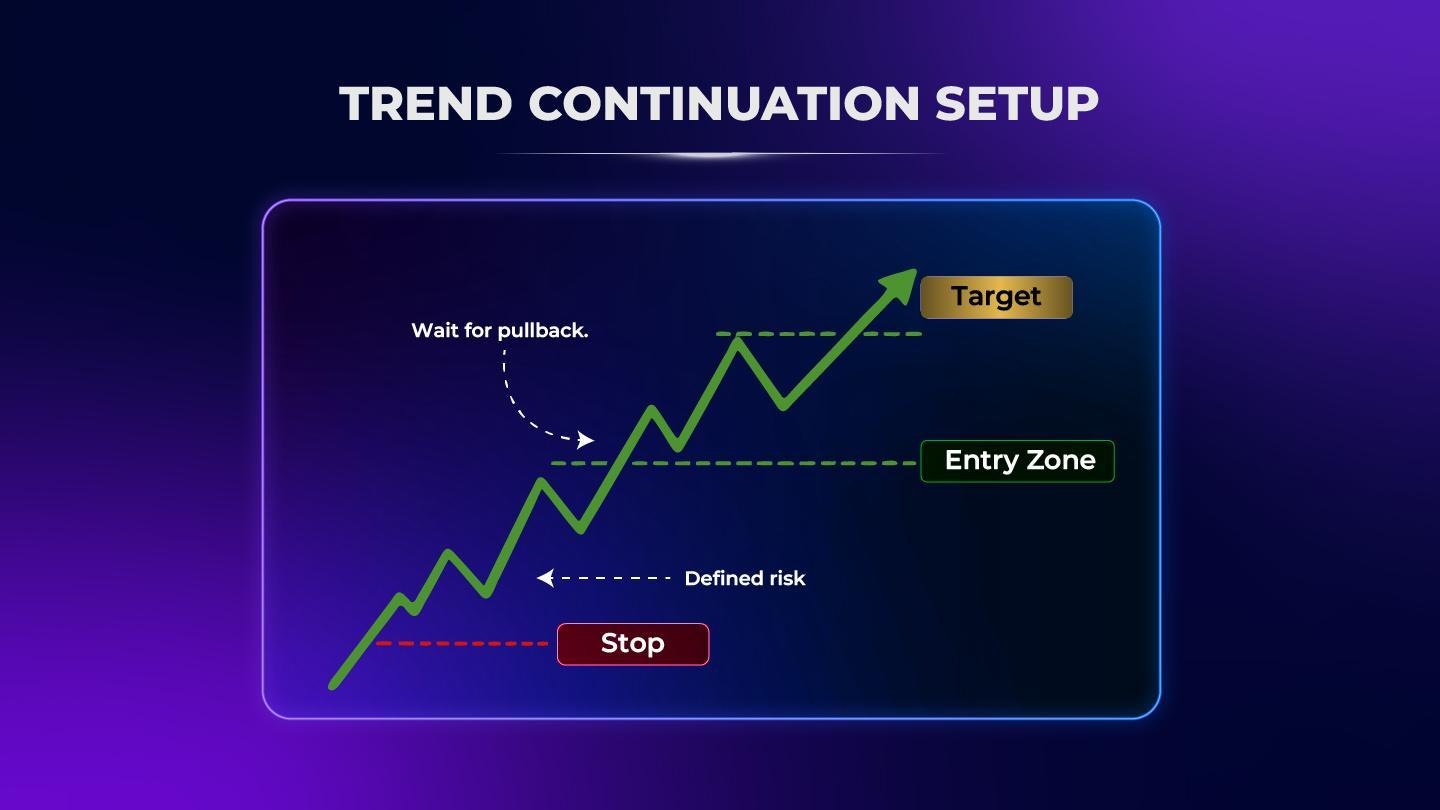
Trend continuation is one of the most reliable approaches for traders looking to trade futures with structure and discipline. Rather than predicting reversals, this approach focuses on following established momentum in the futures market, allowing traders to align with dominant price movement and sustained directional flow.
Because trends often develop in highly liquid CME futures such as S&P 500 futures and crude oil futures, this strategy provides consistent trading opportunities while maintaining controlled risk.
Best For:
- Index contracts like S&P 500 futures and Nasdaq futures
- Highly liquid cme products
- Traders who prefer structured directional trades
- Funded traders seeking consistency over frequency
This strategy is considered one of the best futures approaches for funded environments due to its clarity and repeatability.
Market Condition
This strategy works best when clear directional momentum exists.
Look for:
- Higher highs and higher lows in an uptrend
- Lower highs and lower lows in a downtrend
- strong price action confirming trend structure
- supportive moving average alignment
- sustained momentum in real-time market flow
Trending environments reduce uncertainty and improve decision-making.
Entry Rules
- Identify a strong directional trend on the 1H or 4H timeframe.
- Wait for a pullback toward a key support level or support and resistance levels.
- Confirm momentum resuming in the trend direction.
- Enter once a confirmation candle closes and momentum returns.
This form of pullback trading allows traders to take a position with favorable risk-to-reward.
Stop-Loss Placement
- Below the recent swing low in an uptrend
- Above the recent swing high in a downtrend
Stops should be based on structure and the price of a futures contract, not arbitrary distances.
Using properly placed stop orders helps manage risk and protects the futures account from sudden volatility spikes.
Profit Target
- Aim for 2:1 or 3:1 reward-to-risk
- Trail stops when momentum strengthens
- Scale out near key resistance or support levels
As the trend continues, traders may take a long position in uptrends or manage a short futures position when the trend is bearish.
Why This Strategy Works for Funded Traders
Trend continuation aligns with the realities of funded trading because it:
- encourages patience and discipline
- reduces overtrading
- aligns with institutional momentum
- adapts well to real-time execution
- supports structured risk management
- minimizes emotional decision-making
Instead of chasing breakouts, traders wait for controlled retracements and take a position when momentum resumes.
This method helps traders stay aligned with dominant market flow while maintaining a strategy in place — a critical factor for consistent trading performance.
Pro Tip: Avoid Counter-Trend Trades
Counter-trend trades often appear attractive but introduce unnecessary risk.
Trend continuation improves probability by aligning with institutional order flow rather than fighting it.Trend continuation strategies demonstrate that successful futures trading involves patience, structure, and disciplined execution — not constant activity.
Strategy 2: Opening Range Breakout (ORB)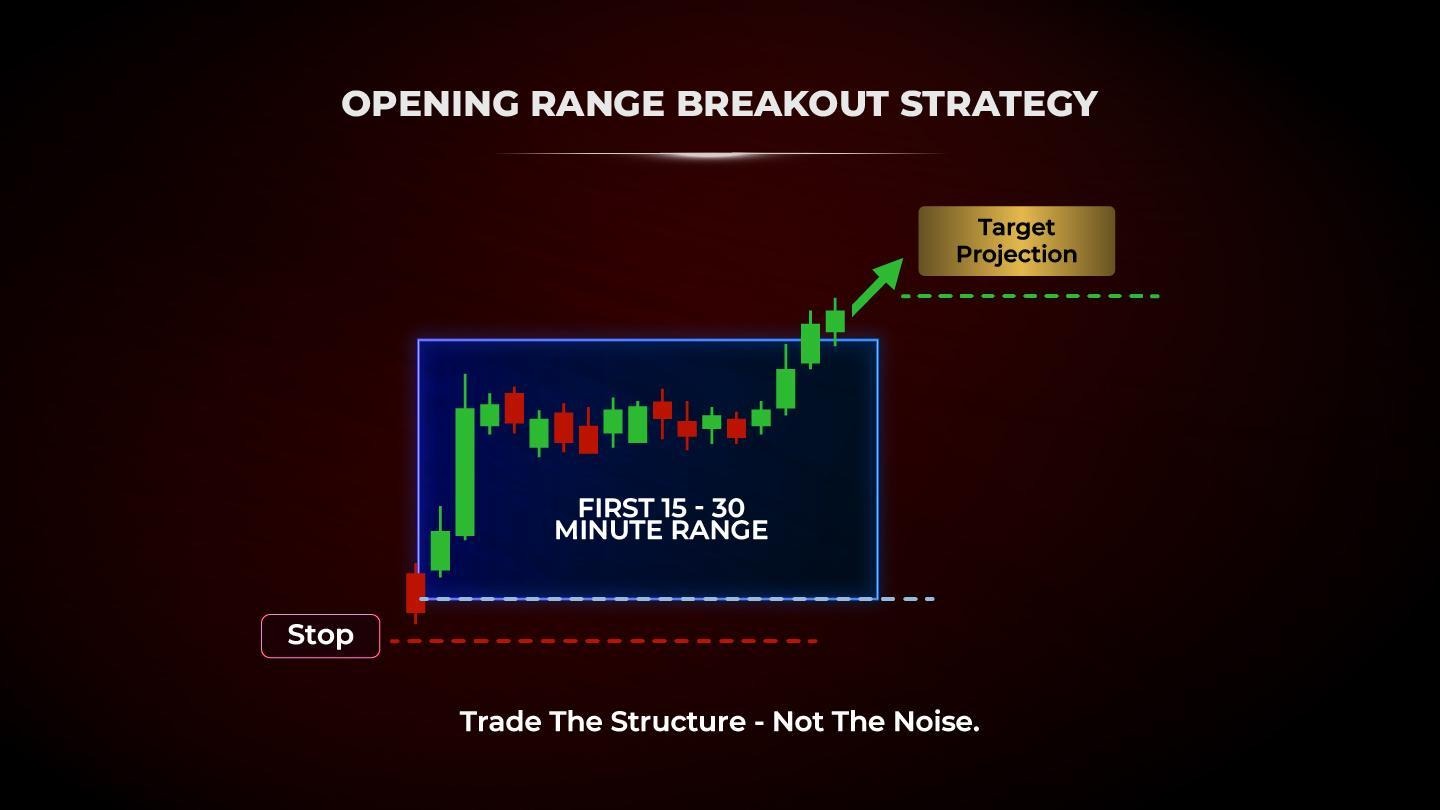
Best For:
The Opening Range Breakout (ORB) is a structured intraday approach used by professional futures traders to capture early-session momentum. This strategy focuses on the initial price movement that occurs shortly after the market opens, when liquidity surges and institutional participation drives decisive moves in the futures market.
Because this window often sets the tone for the trading day, ORB provides clear structure, objective rules, and high-probability trading opportunities — making it ideal for funded traders who require discipline and consistency.
Best For:
- Intraday traders who day trade futures
- Highly liquid CME futures such as S&P 500 futures and Nasdaq contracts
- Traders seeking structured momentum entries
- Traders using modern trading platforms with real-time execution
This approach is especially useful for traders who want to start trading with clear rules and defined time windows.
Market Condition
ORB works best during the first 15–30 minutes after the session opens, when:
- institutional order flow increases
- volatility expands rapidly
- decisive price action develops
- the market establishes early directional bias
This period often determines the session’s dominant momentum.
Entry Rules
- Identify the high and low of the opening range.
- Wait for the price to break above or below the range.
- Confirm breakout strength using volume or momentum indicators.
- Enter in the breakout direction once momentum is confirmed.
This form of breakout trading allows traders to take a position as momentum begins rather than chasing later moves.
Stop-Loss Placement
- Place stops on the opposite side of the opening range.
- Avoid widening stops beyond the structure.
This ensures risk remains controlled relative to the price of a futures contract and protects against false breakouts.
Profit Target
- Aim for 1.5x–2x the opening range size.
- Trail stops if momentum accelerates.
- Scale out near key resistance or support zones.
If momentum fails, traders can buy back the futures or exit quickly to protect capital.
Why ORB Works for Funded Traders
The Opening Range Breakout strategy aligns well with funded trading requirements because it:
- provides a defined trade window
- limits overtrading
- supports disciplined risk management
- encourages structured decision-making
- adapts well to fast real-time market execution
- reduces emotional decision-making
Because opportunities are time-bound, traders avoid impulsive trades later in the session.
Pro Tip: Avoid Low-Volume Breakouts
Breakouts during low liquidity periods often fail. Confirm participation before entering.
False breakouts can trigger unnecessary losses and damage trading performance.
The ORB strategy demonstrates that successful futures trading involves precision timing, disciplined execution, and adherence to rules — not constant activity throughout the session.
Strategy 3: Mean Reversion in Ranging Markets
Not every session in the futures market trends. Many trading days are defined by consolidation, balanced order flow, and limited directional conviction. During these periods, momentum strategies often struggle — but a mean reversion strategy can provide structured opportunities.
Mean reversion focuses on identifying when the futures price moves too far from equilibrium and is likely to return toward its average. This approach allows traders to take a position near extremes and capitalize on predictable rebalancing behavior.
For funded traders, this strategy offers controlled risk, smaller stops, and repeatable setups — ideal for maintaining stable trading performance.
Best For
- Slow or sideways market sessions
- Range-bound market conditions
- Traders comfortable trading both long and short
- Traders seeking consistency during low volatility environments
This strategy is especially useful prior to trading futures products during uncertain sessions when momentum is absent.
Market Condition
Mean reversion works best when the market is clearly ranging.
Look for:
- horizontal support and resistance levels
- repeated rejection at range extremes
- stable price action without directional momentum
- reduced volatility and balanced order flow
Ranging conditions often appear after major moves or ahead of significant news releases.
Entry Rules
- Identify the established range boundaries.
- Wait for price to approach the upper or lower extreme.
- Confirm rejection using candlestick behavior or technical indicators.
- Enter once price shows evidence of reversing back toward equilibrium.
Traders may take a long position near support or initiate a short futures trade near resistance.
Stop-Loss Placement
- Place stops slightly outside the range boundary.
- Avoid placing stops inside the range where noise can trigger exits.
Stops should reflect the structure and the asset’s price behavior to ensure risk remains controlled.
Profit Target
- Target the mid-range equilibrium level.
- Extend targets toward the opposite boundary when momentum is weak.
Traders may also buy back the futures or exit partial positions near the midpoint to secure profits.
Why Mean Reversion Works for Funded Traders
Range-bound strategies offer several advantages in funded environments:
- smaller stop distances reduce drawdown risk
- frequent setups during consolidations
- clear structure improves execution discipline
- reduced exposure to sudden volatility spikes
- supports consistent risk management
This approach helps traders avoid forcing directional trades when the market lacks momentum.
Pro Tip: Avoid Mean Reversion During Strong Trends
Attempting to fade strong trends can lead to repeated losses.
Before entering, confirm that the market is truly ranging rather than consolidating before a breakout.
Mean reversion reminds traders that successful futures and options participants adapt to conditions. Trends provide momentum opportunities, while ranges offer equilibrium-based setups.
Understanding both environments strengthens trading knowledge and supports long-term consistency throughout your trading journey.
Risk Management Framework for Futures Trading Strategy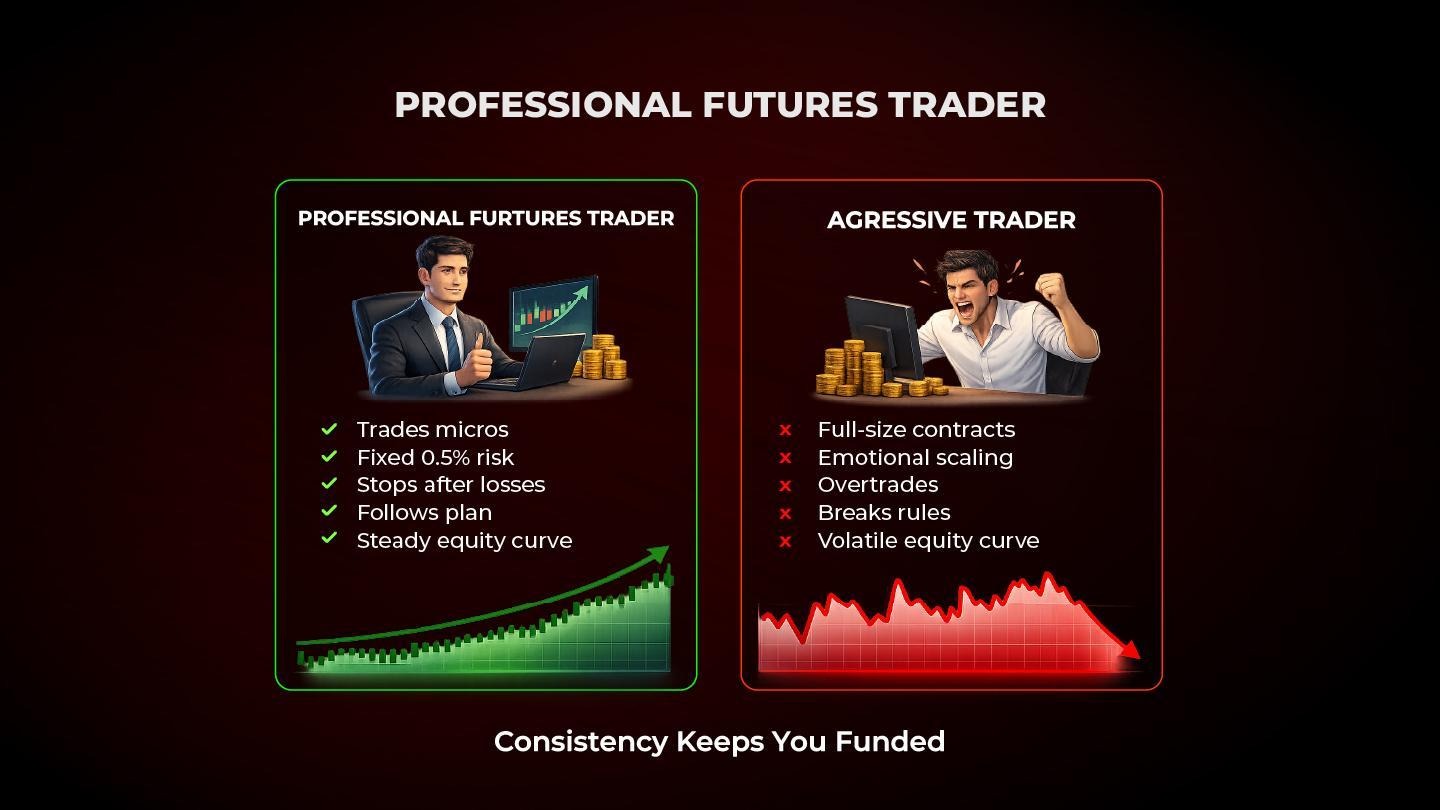
Even the most effective setups fail without disciplined risk management. In funded environments, protecting capital is more important than maximizing profit. A single oversized loss can violate limits and end an evaluation.
Successful traders understand that trading involves controlling exposure, adapting to volatility, and preparing for unexpected market moves.
1. Contract Selection & Exposure Control
Micro contracts (such as MES or MNQ) are often ideal because they:
- reduce emotional pressure
- allow precise position sizing
- lower the impact of sudden futures price swings
Larger contracts increase drawdown risk and accelerate losses when the asset’s price moves quickly.
Understanding how a futures contract could impact account equity is essential prior to execution.
2. Daily Loss Limits & Capital Protection
If a firm allows a 4% daily loss, many professionals cap risk at 2% or less.
This buffer helps:
- protect evaluation progress
- reduce emotional decision-making
- maintain consistency
Professional traders think defensively first — profits follow discipline.
3. Use Hedging & Risk Offsetting When Appropriate
Advanced traders may use strategies to hedge exposure during volatile conditions.
Examples include:
- reducing directional risk
- using correlated instruments
- applying pairs trading concepts
More experienced traders may explore spread trading, calendar spread, or other spread strategies to manage risk while maintaining market exposure.
These methods are common in professional futures and futures options trading environments.
4. Avoid High-Impact News & Sudden Volatility
Major economic releases can cause extreme price spikes.
Avoid entering trades immediately before:
- CPI releases
- FOMC announcements
- Nonfarm payrolls
During these periods, even a well-placed stop may fail due to rapid volatility.
5. Advanced Risk Tools for Experienced Traders
As traders gain experience, they may incorporate:
- options on futures to manage directional exposure
- structured spreads to reduce volatility risk
- diversified positions across new futures markets
These advanced tools are not required to succeed, but they illustrate how professional strategies can help manage risk beyond simple stop placement.
Strong risk control separates disciplined professionals from impulsive traders. The goal is not to avoid losses — it is to ensure no single loss threatens the account.
Well-structured risk control creates consistency, and consistency sustains long-term success.
Position Sizing for Funded Futures Accounts
Proper position sizing is one of the most important factors in protecting a funded account. Even the best setups can fail if trade size is too large relative to risk limits.
Because each futures contract has a fixed tick value, traders must size positions based on risk — not confidence.
Understand Contract Value
Different contracts carry different tick values:
- ES ≈ $12.50 per tick
- NQ ≈ $5 per tick (micro contracts significantly lower)
Choosing the appropriate contract helps control exposure and prevents losses from escalating when the futures price moves quickly.
How to Calculate Position Size
Position size should always be determined using:
- stop-loss distance
- maximum percentage risk per trade
- remaining drawdown room
- account size and firm limits
This ensures your position aligns with risk management rules and protects long-term trading performance.
Why Micro Contracts Improve Consistency
Micro contracts allow traders to:
- fine-tune risk exposure
- maintain consistency during volatility
- reduce emotional pressure
- stay compliant with drawdown limits
They are especially useful for traders still refining execution or adjusting to funded account rules.
Avoid Sizing Based on Confidence
Confidence is not a risk metric.
Even high-probability setups can fail due to unexpected price movement or sudden volatility. Oversizing positions increases the chance of breaching limits and damaging evaluation progress.
Professional traders think in probabilities, not certainty.
Position Sizing Example
If your maximum risk per trade is $100 and your stop distance equals 10 ticks:
- Risk per tick: $10
- Maximum size: 1 micro contract
This approach keeps risk consistent and prevents emotional decision-making.
Strong position sizing ensures survival. Survival creates consistency. And consistency is what keeps funded accounts active.
Psychological Discipline in Futures Trading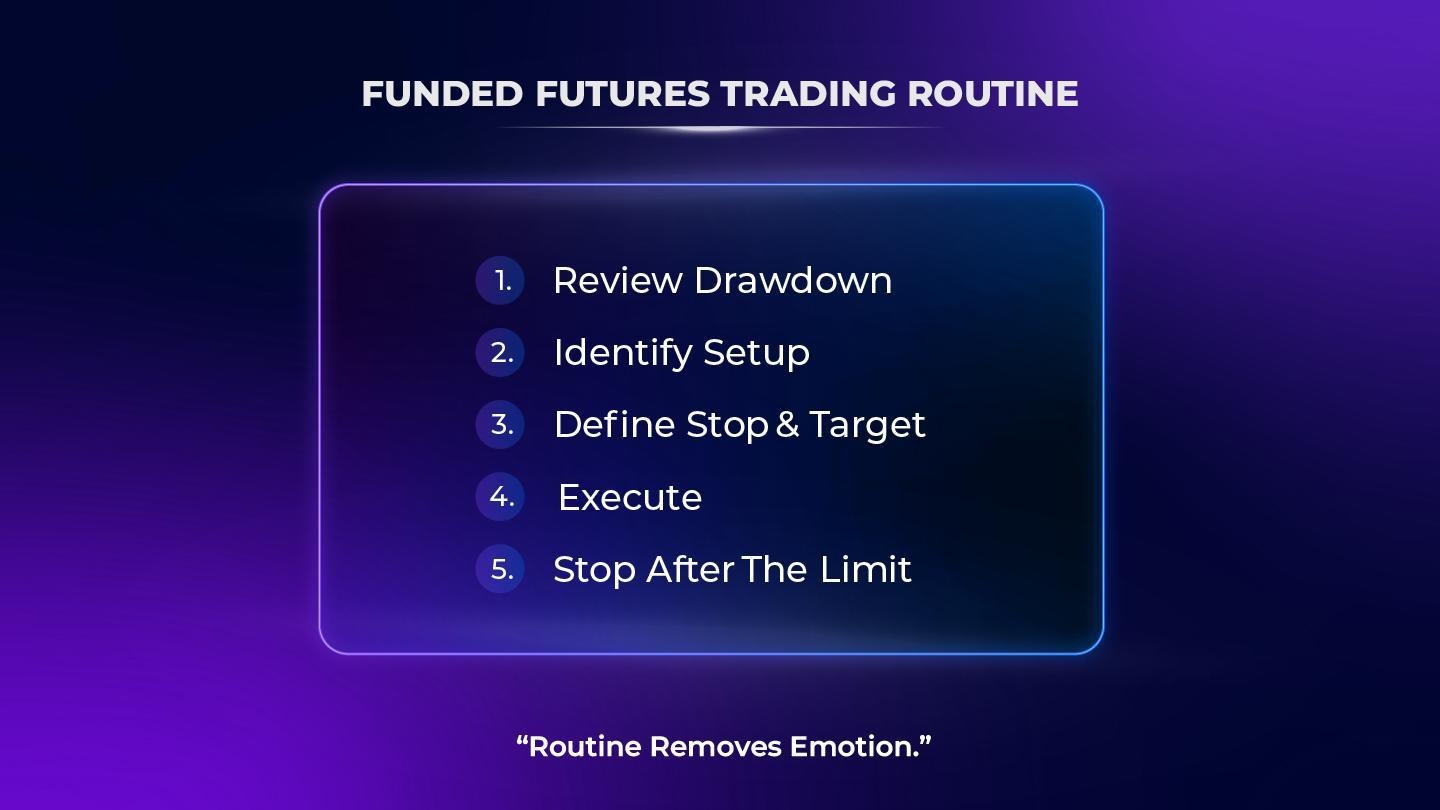
Futures markets move quickly, and emotional decisions can happen just as fast. While technical skills are essential, long-term success depends on discipline, emotional control, and the ability to follow rules under pressure.
Many traders who learn how to trade futures focus heavily on charts and indicators but underestimate the psychological demands of real-time execution. Unlike trading stocks, where price movement may be slower, futures markets require rapid decision-making and emotional stability.
Discipline is what separates consistent traders from impulsive ones.
Why Psychology Matters
Strong emotional control helps traders:
- follow their trading plan under pressure
- avoid revenge trading after losses
- maintain consistency after wins
- stay patient during slow sessions
Structured strategies can help reduce emotional stress by removing guesswork and providing clear execution rules.
Key Psychological Rules
- Do not increase position size after a win.
- Do not double down after a loss.
- Do not chase missed moves.
- Accept flat days without forcing trades.
Flat days protect accounts. Forced trades damage consistency.
Avoid Emotional Decision Cycles
Emotional trading often follows a predictable pattern:
- Loss triggers frustration.
- Frustration leads to impulsive trades.
- Impusive trades increase losses.
- Confidence drops and discipline weakens.
Maintaining discipline breaks this cycle.
Build Psychological Consistency
These practices help traders maintain control:
- step away after consecutive losses
- reduce size during emotional stress
- trade only predefined setups
- focus on process, not profit
These strategies to help maintain emotional stability are essential for traders interested in trading professionally and sustaining long-term performance.
Think Like a Professional
Professional traders do not aim to win every trade. They aim to execute consistently.
They understand:
- losses are part of probability
- discipline protects capital
- patience improves performance
- consistency builds long-term success
Psychological discipline turns a strategy into a repeatable process.
In futures trading, your edge is not only your system — it is your ability to follow it.
Sample Weekly Framework for Funded Futures Traders
Monday: Trade light, observe volatility.
Tuesday–Wednesday: Full structured execution.
Thursday: Reduce risk if in drawdown.
Friday: Conservative trading; avoid late volatility.
Consistency across days matters more than big days.
Common Mistakes in Futures Trading for Funded Accounts
1. Over-Leveraging
Large contract exposure increases emotional pressure and rule violations.
2. Trading Every Session
Not every day offers an opportunity.
3. Ignoring Drawdown Tracking
Trailing drawdown requires constant awareness.
4. Abandoning the Plan Mid-Session
Changing strategy mid-day usually leads to inconsistency.
5. Scaling Up Too Quickly
Growth should be gradual, not aggressive.
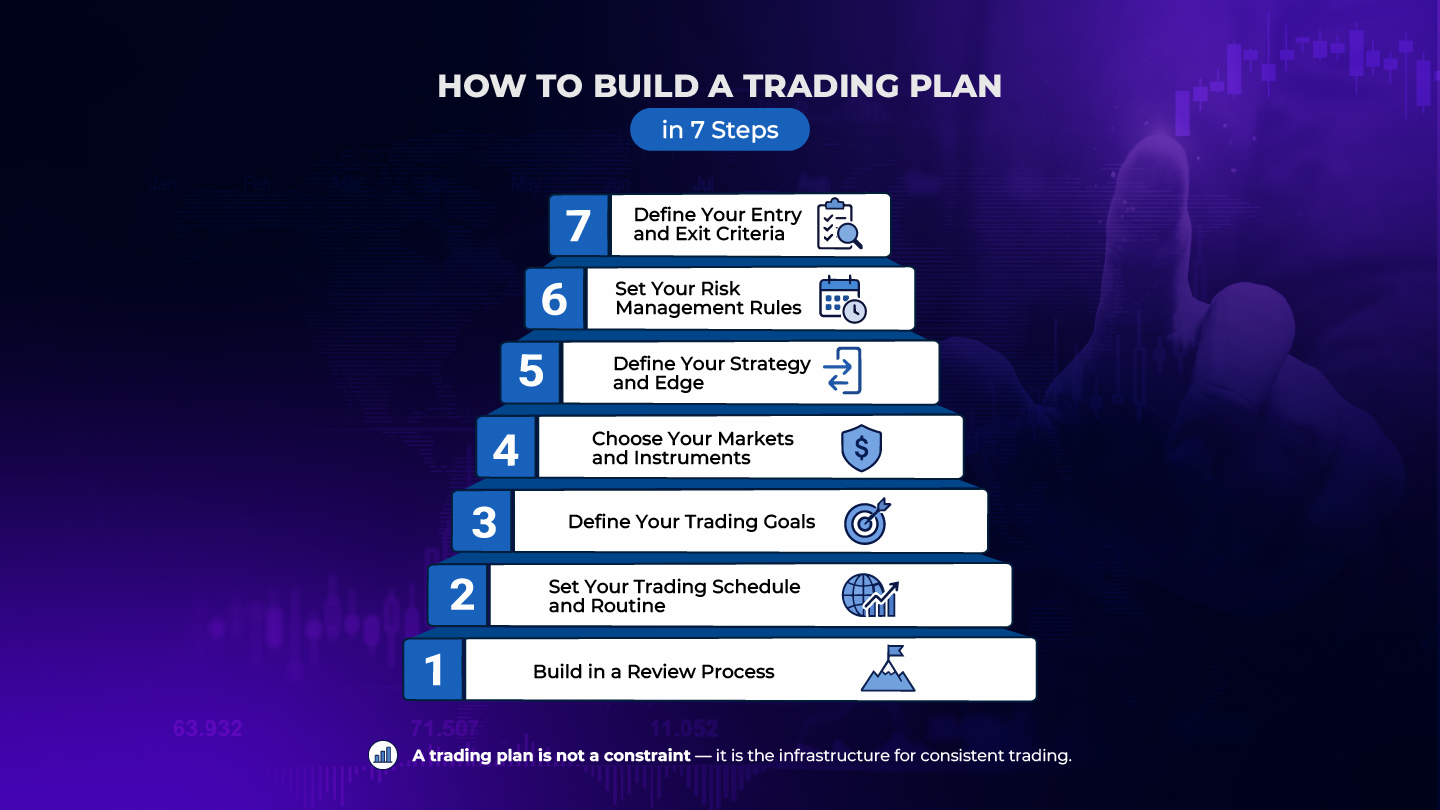
How to Build Your Personal Futures Trading Strategy
- Choose one primary setup.
- Define exact entry and exit rules.
- Backtest it over 50–100 trades.
- Forward test in simulation.
- Apply to evaluation slowly.
Complexity kills consistency. Simplicity wins.
Frequently Asked Questions (FAQs)
What is the best futures trading strategy for funded accounts?
There is no universal best strategy. The best futures trading strategy is one that is rule-based, risk-controlled, and consistently executed.
Should I trade multiple futures markets during a challenge?
It’s usually better to focus on one or two markets to avoid overexposure and confusion.
Are breakout strategies good for funded trading?
Yes, if executed with strict risk control and proper confirmation.
How much should I risk per futures trade?
Most funded traders risk between 0.25% and 0.75% per trade.
Can aggressive strategies pass prop firm challenges?
Occasionally, but they rarely sustain funded accounts long term.
Final Thoughts
A professional futures trading strategy is not flashy. It doesn’t rely on signals, hype, or oversized positions. It relies on structure.
Funded trading rewards:
- discipline
- patience
- risk management
- consistency
It punishes:
- emotion
- aggression
- inconsistency
If you want to pass evaluations and remain funded, build a rule-based system, trade micros when possible, control risk tightly, and focus on steady execution.
Apply structured, rule-based futures trading strategies in a professional environment — start your funded Futures account with 4PropTrader and trade under clear, transparent rules.