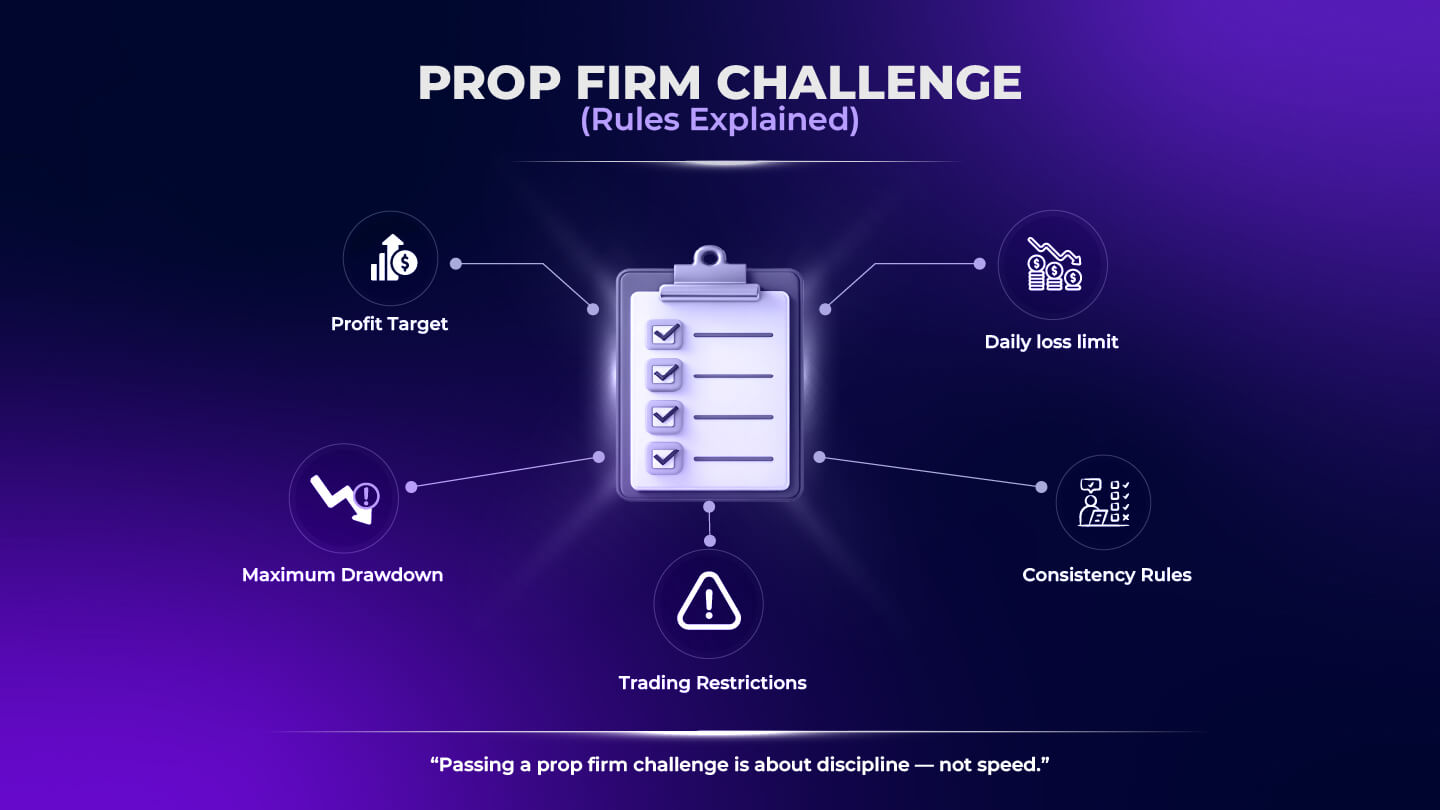
Quick Summary
A prop firm challenge is a structured evaluation designed to test whether traders can follow prop firm rules, manage risk, and trade with discipline over a defined period. In the world of prop trading, most traders fail prop firm challenges not because their strategy is poor, but because they misunderstand the rules, breach a daily loss limit, or fail to protect their account during drawdowns. This guide explains what is a prop firm, what is a prop firm challenge, and how to pass the prop firm challenge by breaking down trading rules, common mistakes to avoid, and practical how to steps to manage risk properly. By learning how a prop firm challenge works and sticking to the framework during the challenge, traders who want to earn access to a funded account can trade like a professional and dramatically improve their chances of passing a prop firm challenge.
Introduction
Passing a challenge at a prop trading company is not about luck or short bursts of performance. In the world of prop trading, success comes from understanding how prop firms operate and why rules and structure matter as much as profitability. Proprietary trading firms use evaluations to identify traders who can perform within a controlled risk framework, not those trying to make fast money.
For traders who want to pass a prop firm challenge, the real objective is to demonstrate discipline, patience, and the ability to trade responsibly over a sustained period. Challenges are built to meet the firm’s expectations around consistency, capital protection, and professional behavior of trading, not emotional decision-making.
This guide is written for traders looking to pass a structured evaluation by understanding the firm, respecting trading rules, and learning how to pass the challenge and move closer to achieve a funded account. By breaking down rules of evaluations and explaining how the prop firm challenge works in practice, you’ll gain clarity on what it truly takes to pass the process and trade like a professional.
What Is a Prop Firm Challenge?
What is a prop firm challenge, exactly? A prop firm challenge is a structured evaluation designed to assess whether traders can operate responsibly on the firm while managing risk, following strict parameters, and maintaining consistency of your performance. In simple terms, a prop firm challenge can determine whether a trader is ready to trade firm capital with a professional mindset.
A typical evaluation requires traders to achieve a predefined profit objective within a fixed timeframe, while respecting loss thresholds and operational constraints. A typical prop firm challenge will also require traders to demonstrate control during the challenge, rather than relying on a single oversized trade to recover losses or inflate results.
Unlike personal trading, trading is evaluated against firm-defined benchmarks, and every decision impacts your account standing. The challenge is a process that measures how traders behave over a series of sessions, not how aggressively they trade in a short burst. For those aiming to pass the evaluation, understanding how prop firms structure assessments is critical.
Ultimately, a prop firm challenge is a gateway to working with them for a few steps closer to a professional trading environment, where discipline, consistency, and risk control matter more than speed.
Why Prop Firm Challenge Rules Exist
Prop firm challenge rules are not arbitrary obstacles. They are designed to protect capital, shape professional behavior, and ensure traders can operate responsibly on a firm’s infrastructure. Understanding why these rules and controls exist makes it far easier to stick to them.
These rules exist for a few critical reasons:
- To manage risk exposure across most prop trading environments.
Firms place limits up to defined thresholds to ensure losses stay controlled and predictable.
- To pass responsibility tests, not just profit tests
The challenge is to evaluate decision-making over a series of trades, not outcomes from a single lucky position.
- To protect capital of prop trading operations
By enforcing rules of engagement, firms reduce the likelihood of reckless behavior that can harm the firm.
- To filter traders to professional standards
Most prop firms use evaluations to identify traders who can operate within a framework, not those trying to recover losses through emotional trades.
- To prepare you to trade firm capital long-term
These trading rules mirror real-world expectations once you gain access to capital in a live environment.
In short, prop firms have strict guidelines because a firm challenge is a structured process meant to prepare traders for sustained performance, not short-term wins. When you understand the purpose behind the rules, it becomes much easier to pass the evaluation and trade with confidence.
Core Prop Firm Challenge Rules Explained
At its core, a prop firm challenge is a structured evaluation that traders must pass to demonstrate discipline, consistency, and risk control. These challenges exist to ensure traders can operate responsibly before gaining access to capital. Each rule within the challenge and funding framework is designed to test how well you manage risk to your account over time.
Below is a breakdown of the most important rules traders encounter of the challenge, and what each one is meant to prove.
1. Profit Target
The profit target is the minimum return you must achieve during the challenge period.
Typical range:
- 8%–10% of account balance
The profit target defines how much you need to achieve before you pass the evaluation. This rule exists to ensure traders can generate returns over a controlled period, not through reckless behavior.
Common mistake:
Trying to force profits instead of allowing a trade setup to play out naturally.
How to pass:
Focus on steady execution. Hitting the target is less important than showing you can trade responsibly and account for risk.
2. Daily Loss Limit
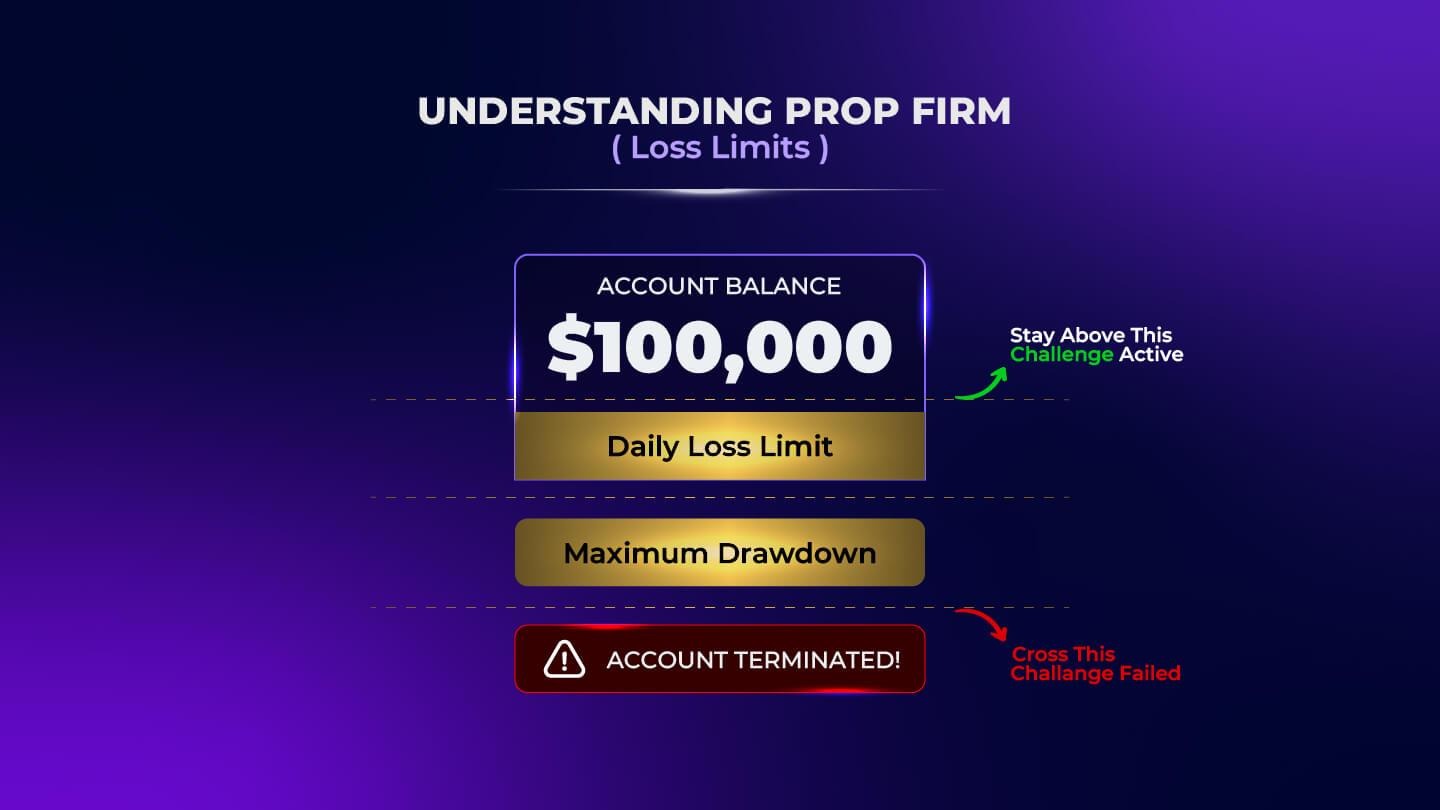
A daily loss limit caps how much you are allowed to lose in a single session. This rule protects your account from emotional spirals and impulsive decisions.
Typical range:
- 2%–5% of account balance
Some firms include:
- closed trades only
- or closed + open (floating) losses
Common mistake:
Continuing to trade after reaching the limit because you want to recover losses.
How to pass:
Set a personal daily loss limit below the firm’s rule and stop trading once it’s hit.
3. Maximum Drawdown (Overall Loss Limit)
This rule defines the maximum loss up to a threshold your account can sustain during the challenge with your chosen prop firm. It is one of the most important filters that traders must pass to prove long-term viability.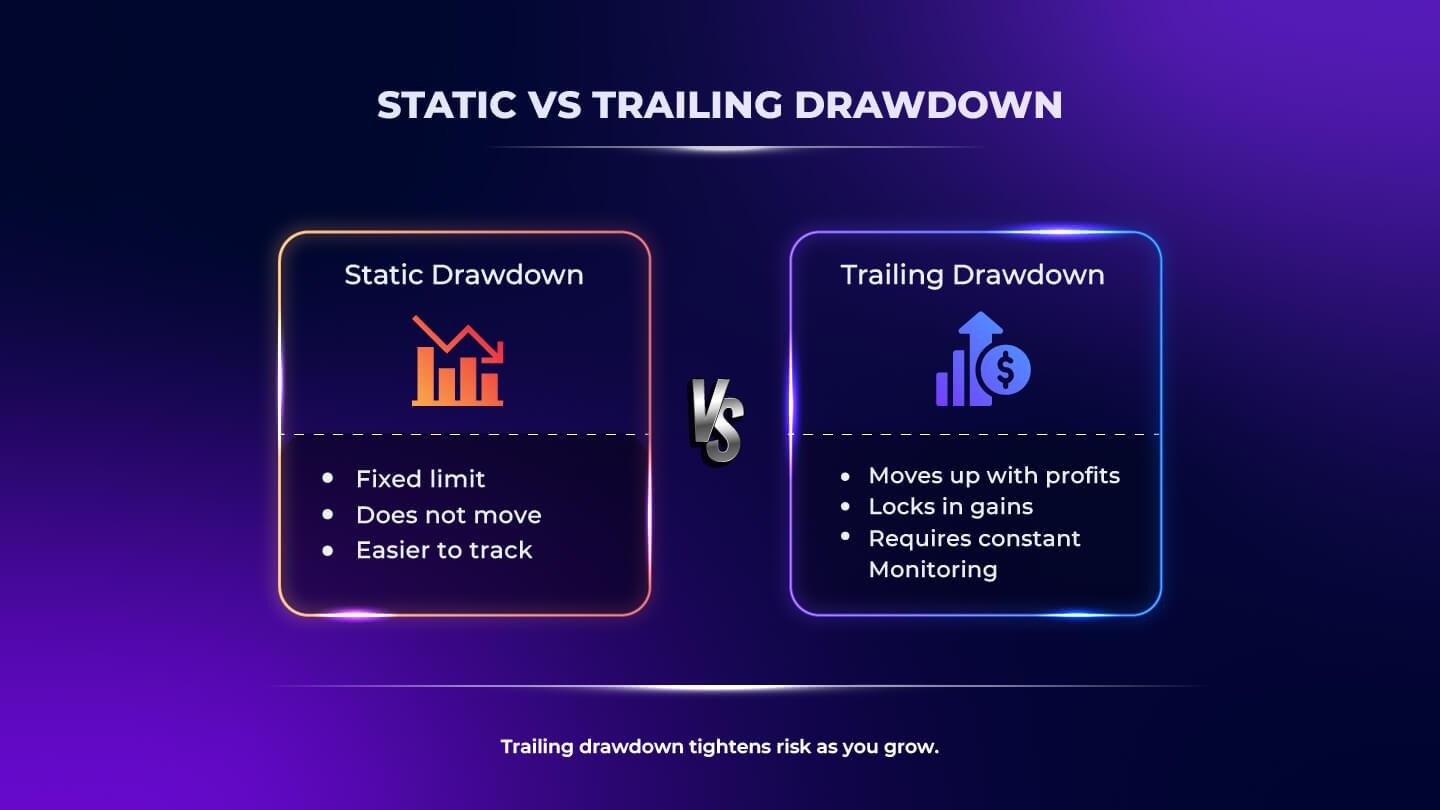
There are two common types:
a) Static Drawdown
- Fixed amount below starting balance
- Example: $100,000 account → $95,000 minimum
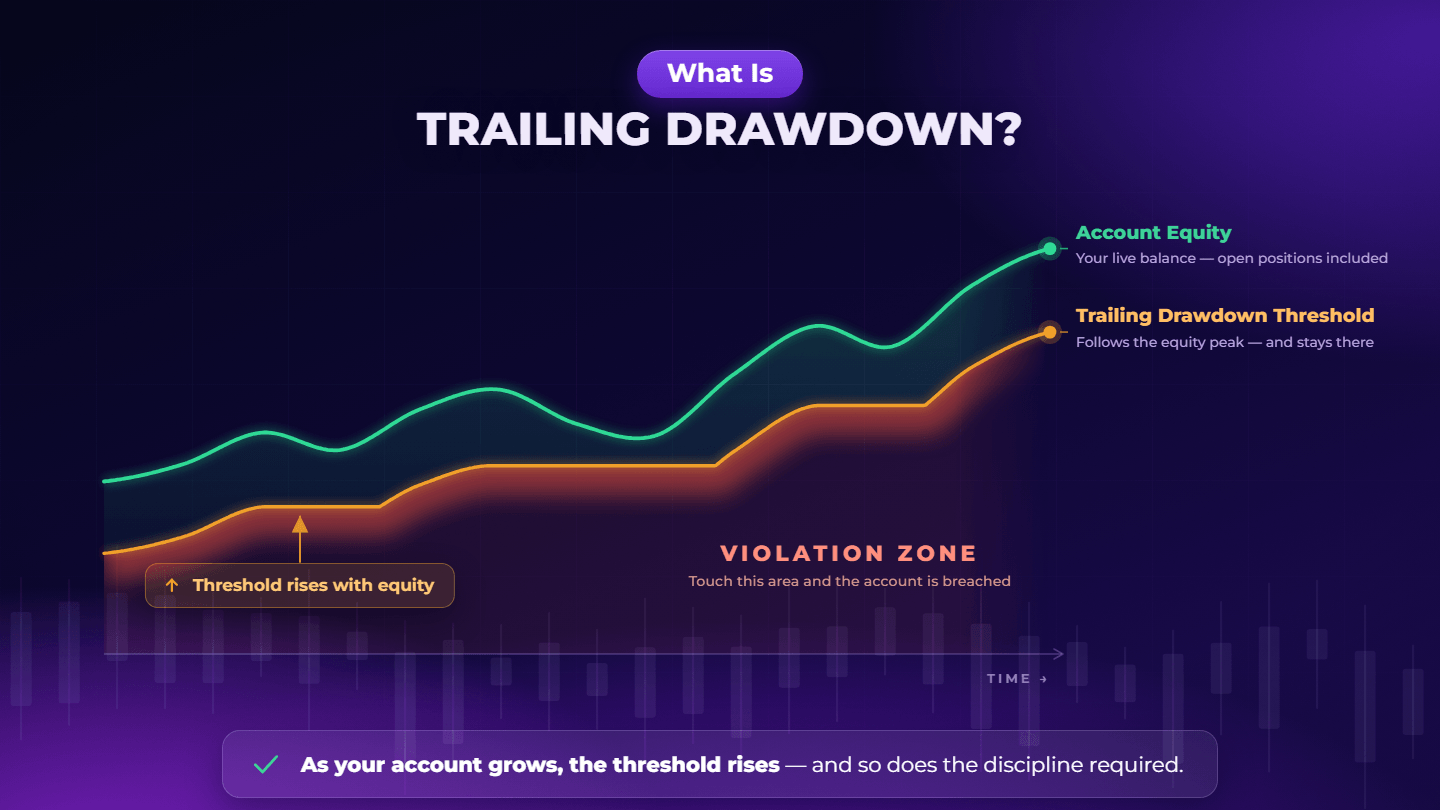
b) Trailing Drawdown
- Moves up as your balance grows
- Locks in profits but tightens risk
Common mistake:
Not adjusting position size as the drawdown trails upward.
How to pass:
Track your current drawdown threshold daily and reduce risk as your balance increases.
4. End-of-Day Drawdown (If Applicable)
Some evaluations require your balance to remain above a set level at session close. This ensures traders can manage risk not just intraday, but across sessions.
Common mistake:
Holding positions late because time to exit feels inconvenient.
How to pass:
Flatten positions well before the cutoff time and keep a safety buffer.
5. Minimum Trading Days
This rule exists to prevent luck-based success. Traders to qualify must show consistency over time, not just a few strong sessions.
Typical requirement:
- 5–10 trading days
Common mistake:
Rushing results instead of allowing performance to develop naturally.
How to pass:
Let the evaluation play out. Consistency matters more than speed when passing a prop evaluation.
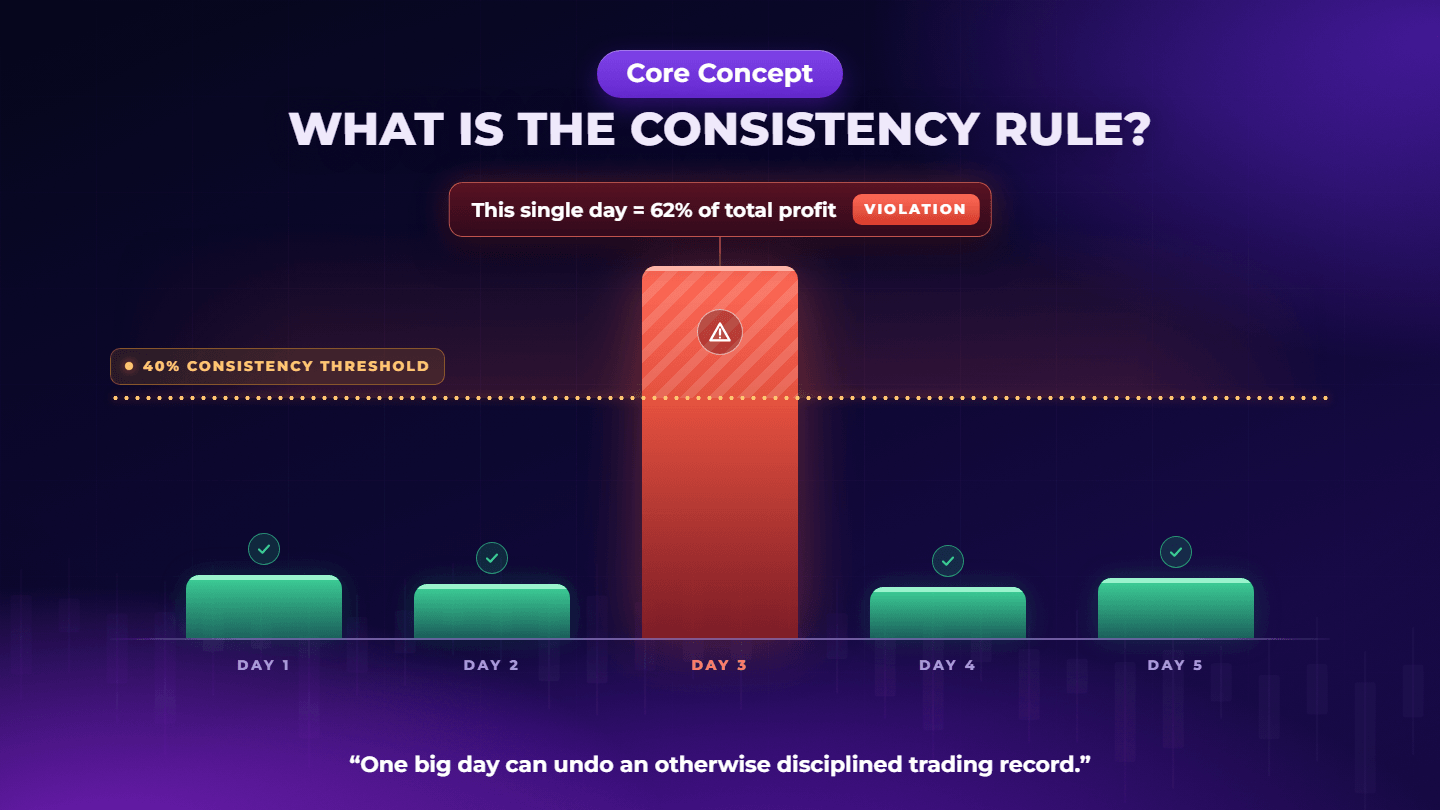
6. Consistency Rules (If Applied)
Consistency rules ensure profits are not generated from one outsized day. They reinforce that the challenge is a test of repeatable execution.
Purpose:
To prevent “all-in” trading behavior.
Common mistake:
One aggressive day skewing results.
How to pass:
Aim for balanced performance throughout the challenge and avoid extreme risk.
7. Position Size & Risk Limits
Even when not explicitly stated, position sizing is monitored closely. Firms want to see traders can stick to predefined risk limits.
Red flags include:
- risking too much per trade
- sudden size increases
- inconsistent exposure
Common mistake:
Increasing size after a win because you pass the previous day’s goal.
How to pass:
Keep risk per trade fixed (usually 0.5%–1%) throughout the challenge.
8. Trading Time Restrictions
Many firms restrict trading during specific periods depending on volatility or liquidity. These rules vary depending on the firm and the markets offered.
Many firms restrict trading during:
- major economic news
- low-liquidity sessions
- weekends or rollover periods
Common mistake:
Holding positions through restricted times unknowingly.
How to pass:
Know your firm’s schedule and flatten positions ahead of restricted windows.
9. Weekend & Overnight Holding Rules
Some firms prohibit holding trades beyond certain cutoffs to control exposure.
Some firms:
- prohibit holding trades overnight
- or disallow weekend exposure
Common mistake:
Forgetting open positions heading into market close.
How to pass:
To pass a prop firm challenge, set platform reminders and manually verify positions before cutoff.
10. Use of EAs, Bots, and Copy Trading
Automation rules differ widely. You are not allowed to assume automation is permitted without confirmation.
Some firms:
- allow EAs
- restrict them
- or ban them entirely
Common mistake:
Using an EA without written confirmation.
How to pass:
Only trade manually unless the firm explicitly allows automation.
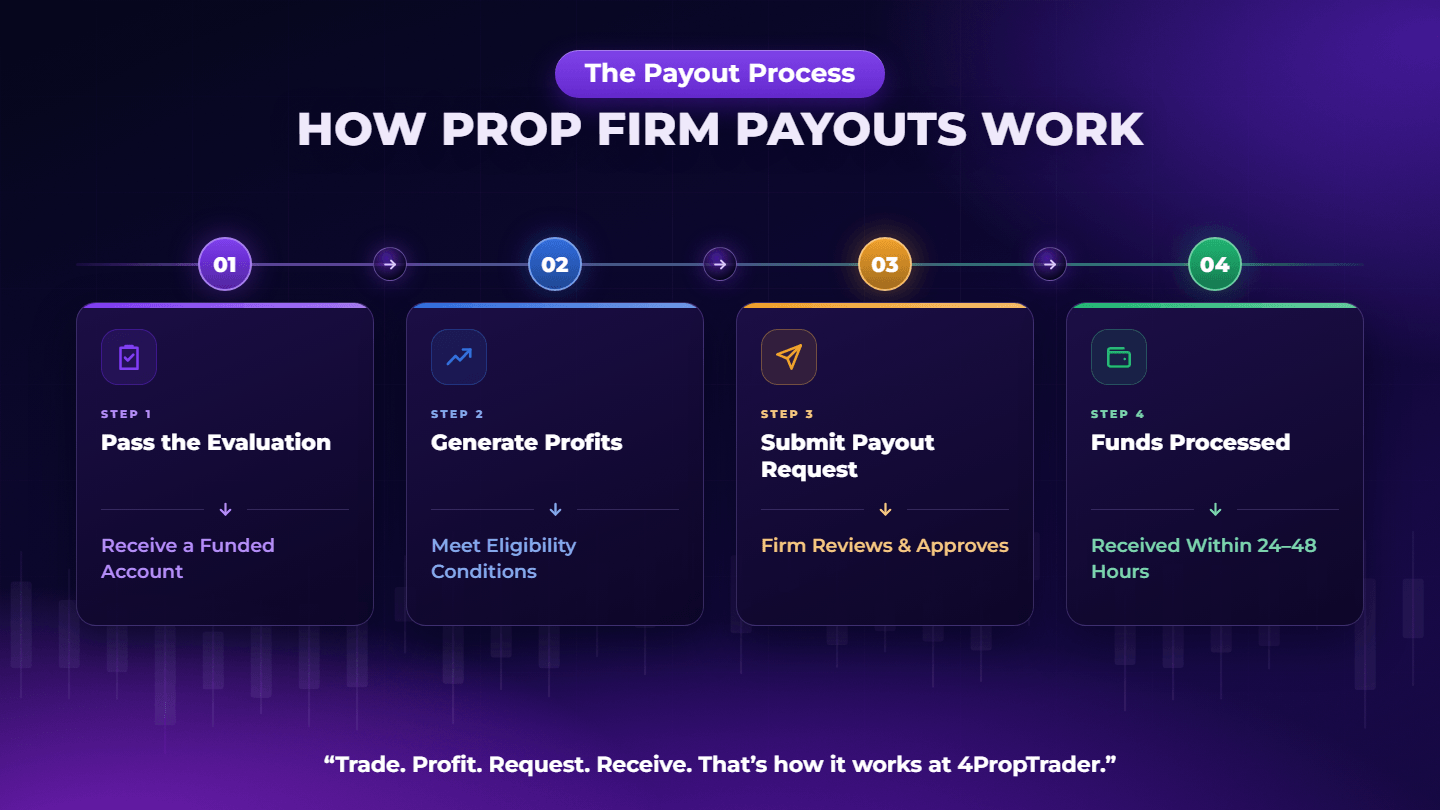
If you pass the evaluation, you move one step closer to a funded account. Passing these rules shows the firm that traders can operate professionally. Ultimately, the goal is not just to pass a test, but to demonstrate you’re ready to manage capital responsibly.
Common Mistakes That Cause Challenge Failure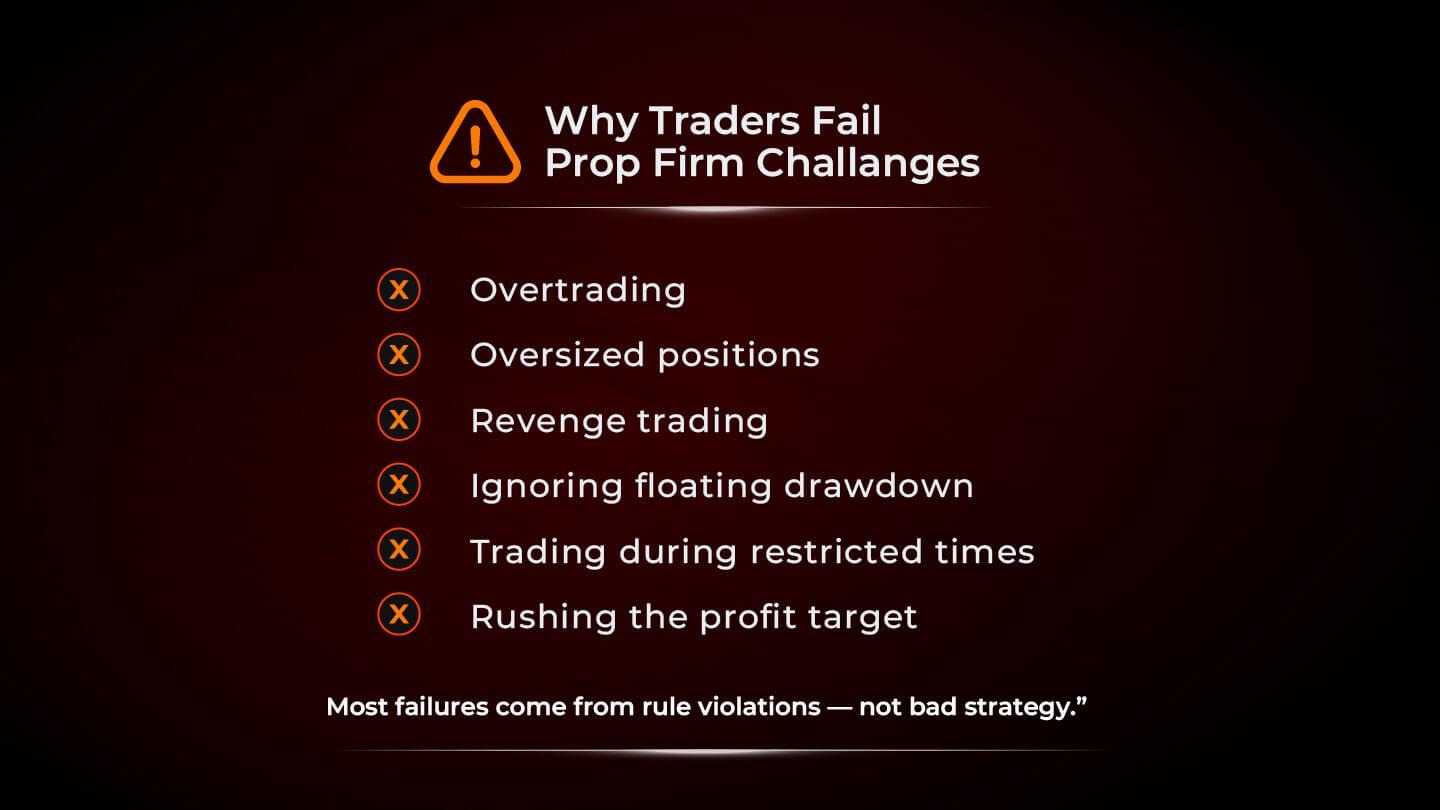
Even traders with solid strategies fail evaluations because they repeat the same behavioral errors. These mistakes have nothing to do with intelligence or market knowledge — they come from impatience, poor preparation, and misunderstanding what it actually takes to pass a prop firm evaluation.
Below are the most common reasons traders fail the challenge and fall short when trying to pass the process.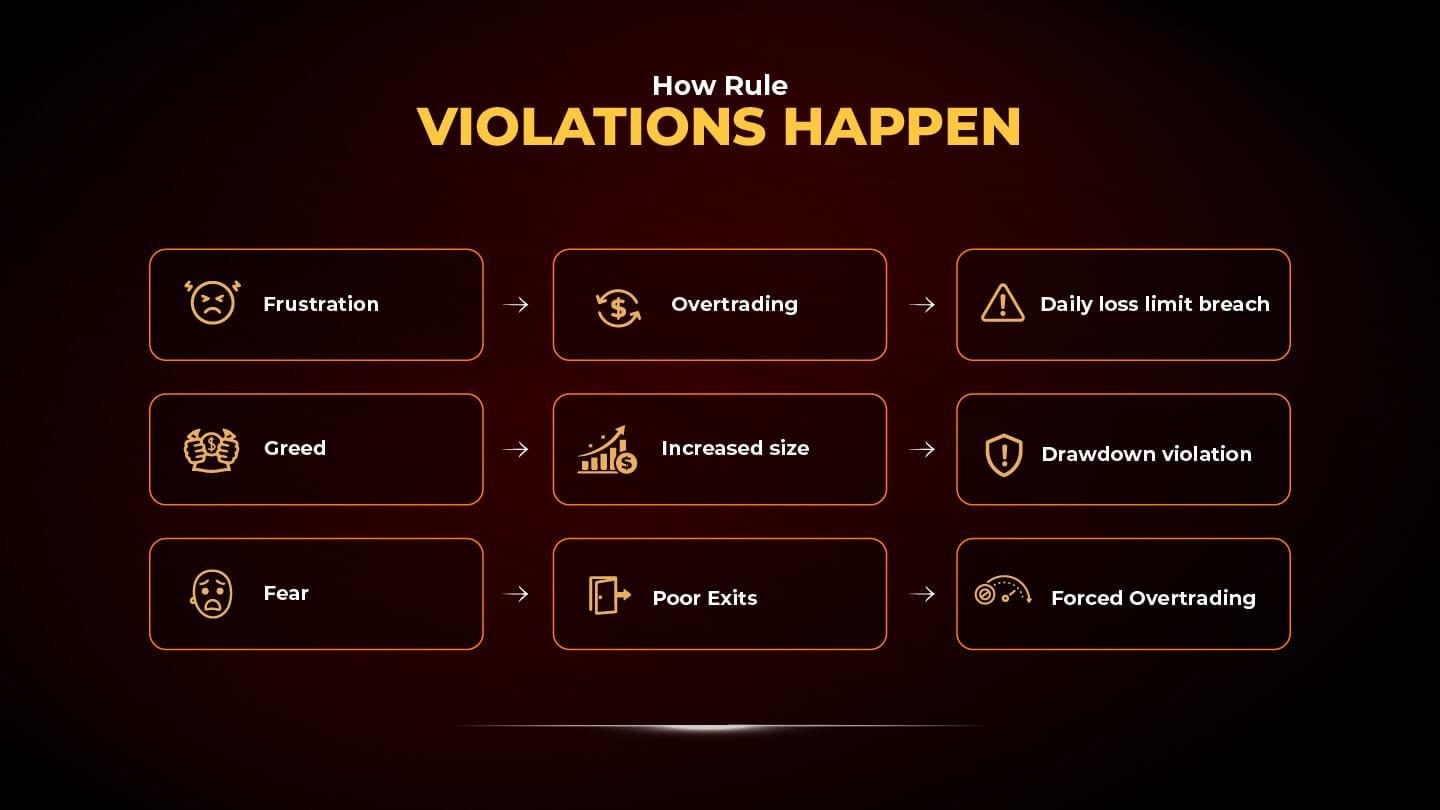
1. Overtrading
Overtrading is one of the fastest ways to fail. Taking too many trades increases emotional fatigue and raises the probability of rule violations.
Why it fails:
Traders assume more activity improves results, but firms want to see restraint and control up to a predefined risk level.
Reality:
To pass the challenge, fewer high-quality trades almost always outperform constant activity.
2. Revenge Trading
After a loss, many traders feel pressure to make it back immediately.
Why it fails:
Revenge trading breaks structure and often escalates losses beyond recovery.
Reality:
Evaluations exist to see whether traders must pass to prove they can remain calm under pressure — not react emotionally.
3. Ignoring Floating Drawdown
Some traders only focus on closed losses, ignoring open risk.
Why it fails:
Floating losses still count, and ignoring them can quietly push accounts past failure thresholds.
Reality:
You must manage exposure carefully if you want to pass a prop firm evaluation without surprises and transition to the funded account phase
4. Rushing the Challenge
Trying to finish quickly is a common mistake, especially for newer traders.
Why it fails:
Speed leads to sloppy execution and unnecessary risk.
5. Not Reading the Rulebook Carefully
Some traders trade recklessly because they assume failure has no real consequence.
Why it fails:
Firms are evaluating behavior, not just results.
Reality:
If you pass, it’s because you traded with the same seriousness you would apply to real capital.
6. Poor Firm Selection
Not all evaluations are created equal.
Why it fails:
Traders jump into challenges without understanding the structure or expectations.
Reality:
Choosing the right prop firm significantly improves your ability to pass the challenge without unnecessary friction.
Avoiding these mistakes dramatically improves your odds of passing the challenge and moving to the funded stage. Remember, the objective isn’t just passing the prop firm test — it’s demonstrating that you’re ready to manage capital responsibly and allowing you to move forward.
How to Structure Your Trading to Pass the Challenge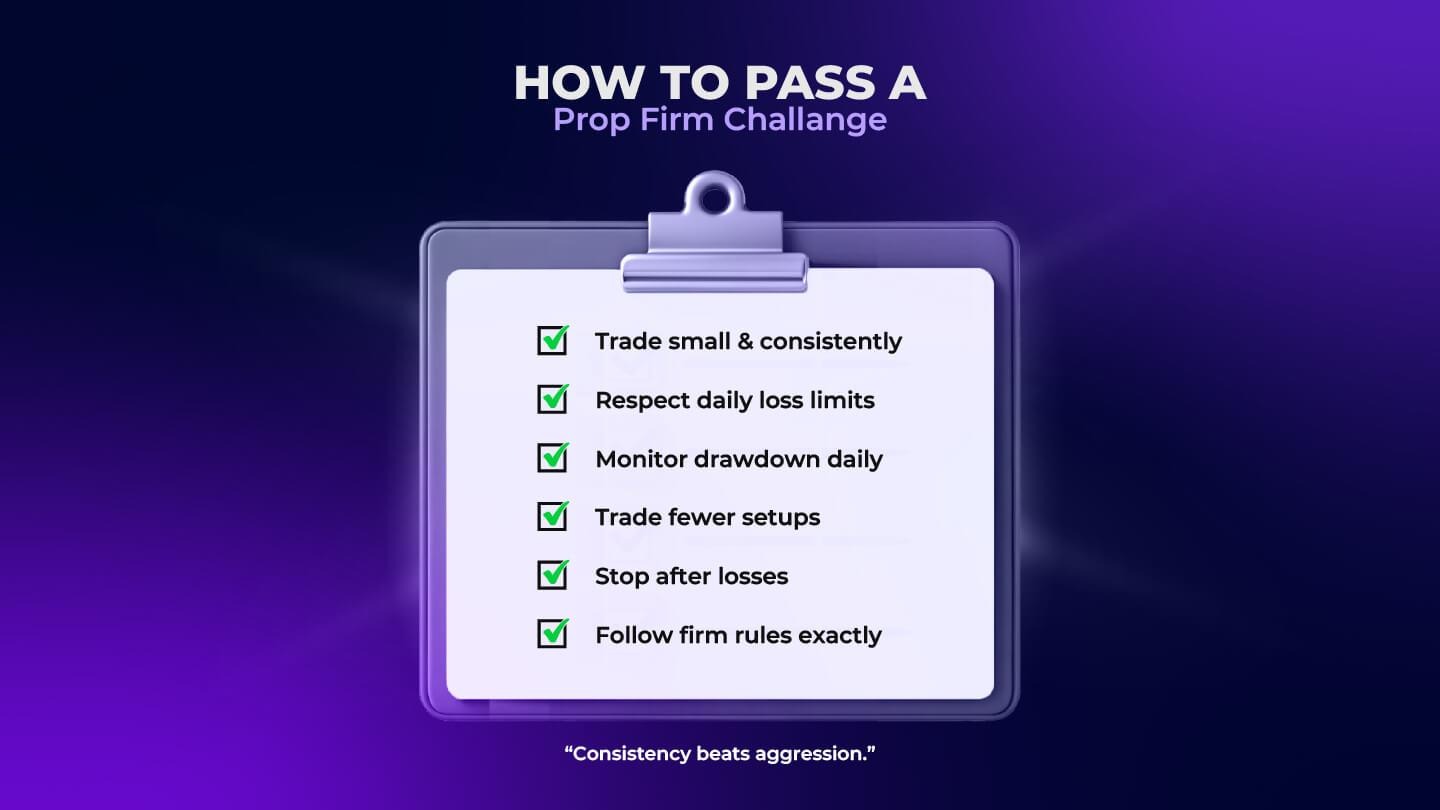
Passing a prop challenge is less about aggressive execution and more about proving you can trade within a professional framework. A firm challenge is an evaluation of discipline, risk control, and consistency — not just raw profitability. To improve your chances of success, your entire approach must be built around protecting the trading account while demonstrating control over the firm’s capital.
Below is a structured approach designed to help traders meet the common requirements to pass and move closer to get funded status.
1. Trade With a Strict Risk Framework
Every challenge account operates under strict rules, and prop firms require traders to respect defined loss limits at all times. This means applying strict risk parameters on every position and avoiding poor risk management decisions that can invalidate the account.
Risking small amounts per trade allows you to survive normal drawdowns and demonstrates your ability to manage risk, which is exactly what prop firms want to see from a potential funded trader.
2. Follow One Clear Trading Plan
Random execution is one of the fastest ways to fail. Prop firms want traders who can stick to your trading plan regardless of recent wins or losses. Your trading plan should define entry criteria, position sizing, risk limits, and exit logic before you place a single trade.
This level of structure shows disciplined trading, strong trading skills, and the ability to trade capital without risking emotional decision-making.
3. Limit Daily Exposure and Drawdown
Most prop trading firms enforce a daily drawdown limit, and breaching it is one of the most common failure points. Managing exposure carefully ensures you can continue participating in a prop firm evaluation without violating every rule outlined in the firm’s trading rules.
Professional traders treat drawdown protection as non-negotiable, especially when trading without financial risk to their own capital.
4. Trade Fewer, Higher-Quality Setups
High-frequency trading is rarely rewarded in paid prop firm challenges. Instead, firms often favor traders who wait for clean, high-probability setups aligned with proven trading strategies.
This approach improves trading performance, reduces emotional fatigue, and aligns with how known as prop firms evaluate long-term potential.
5. Respect the Evaluation Environment
Remember that most challenges are run on a demo account designed to simulate real market conditions. While you’re not trading live funds yet, the goal is to show you can handle real trading responsibilities.
Whether the account size is small or large, the expectations remain the same. The objective is to prove consistency, not to rush toward the minimum profit target.
6. Avoid Rule-Based Traps
Many traders fail by overlooking restrictions such as news trading limitations or execution timing rules. These are part of the core rules that firms require traders to follow.
Ignoring them — even unintentionally — can end a challenge instantly, regardless of profitability or progress toward a payout.
7. Treat the Challenge Like a Funded Account
The mindset shift is critical. Trade as if you are already a funded trader managing institutional capital. This means no emotional overtrading, no revenge positions, and no shortcuts.
Traders who approach evaluations this way stand out to prop trading firms and significantly improve their odds of passing both free and paid prop firm challenges.
8. Prepare for Retakes Without Emotion
Failing once does not mean failure overall. Many traders retake the challenge after refining their process. The difference between repeated failure and eventual success is whether lessons are applied.
Understanding requirements to pass a prop, adapting to how firms may structure rules, and choosing the right prop firm challenge all play a role in long-term success.
Ultimately, passing a challenge is about proving you can trade responsibly, follow structure, and protect capital — exactly what prop firms want before granting access to a funded account.
Psychological Pressure During Prop Firm Challenges
The biggest obstacle in prop trading challenges is rarely technical skill — it’s psychological pressure. From the moment traders enter an evaluation, emotions intensify because the outcome determines whether they gain access to capital or lose the challenge fee they paid to participate.
Unlike personal trading, challenges often place traders in unfamiliar mental territory. You are trading under observation, following rules you must respect at all times, knowing that one mistake can end the evaluation instantly.
Why Pressure Feels Higher in Prop Challenges
Most paid challenges are structured to test behavior under stress. Firms require traders to perform consistently, not emotionally, and this expectation creates internal tension. Traders often feel torn between being patient and the urge to accelerate results.
This pressure increases because firms offer a clear reward: access to capital and the potential to earn payouts trading without risking personal funds. However, the awareness that financial risk still exists — through failure or resets — keeps emotions elevated throughout the process.
Fear of Loss vs. Fear of Missing Out
One of the most common psychological traps is fear-based decision-making. Traders hesitate to take valid setups because they don’t want to violate rules, while others overtrade because they feel they’re running out of time.
This emotional conflict is especially common in prop trading competitions, where traders subconsciously compare their performance to others instead of focusing on execution. Successful traders understand that traders have the opportunity to trade firm capital only after proving discipline — not speed.
Free vs Paid Challenges: Mental Trade-Offs
The mindset differs between evaluations. While firms offer free challenges as a low-risk entry point, traders often take them less seriously. On the other hand, paid challenges introduce emotional attachment because real money is involved.
Understanding the pros and cons of free evaluations versus the cons of free and paid challenges is essential. Free challenges reduce pressure but can encourage careless behavior, while paid challenges sharpen focus but amplify stress.
A Simple Daily Routine for Challenge Success
- Review drawdown and loss limits
- Identify one or two high-quality setups
- Trade only during optimal hours
- Stop trading after reaching your daily goal or loss
- Journal trades and emotions
Consistency beats intensity.
Frequently Asked Questions (FAQs)
What is the most important prop firm challenge rule?
Maximum drawdown. Most traders fail by breaching it—often unintentionally.
Can I pass a challenge without hitting the profit target quickly?
Yes. Slow, consistent gains are preferred and safer.
Why do prop firms have so many rules?
To protect capital and identify disciplined traders—not gamblers.
Can I retry a challenge if I fail?
Yes, but repeated failures usually indicate psychological or risk management issues.
Is strategy or discipline more important?
Discipline. A mediocre strategy with strong rule compliance outperforms a great strategy with poor discipline.
Final Thoughts
Passing a prop firm challenge is not about being aggressive—it’s about being professional.
The traders who succeed understand prop firm challenge rules, respect drawdowns, manage risk conservatively, and stay emotionally disciplined. Those who fail usually break rules under pressure, not because they lack skill.
If you want to pass your evaluation, understand the rules, avoid violations, and pass your evaluation with confidence — start your Futures or CFD prop firm challenge with 4PropTrader and trade under transparent, fair rules.