Quick Summary
Position sizing is the process of determining exactly how many units, lots, or contracts to trade on any given position — based on your account size, your defined risk per trade, and the distance of your stop-loss. It is not a guess. It is not based on confidence. It is a precise calculation that every serious trader must apply before entering any trade.
Sizing in trading is one of the most critical yet overlooked disciplines. Getting it right is the foundation of long-term survival. Without proper position sizing, even a solid trading strategy can fail. With it, you give your plan the structure it needs to survive drawdowns, protect your total capital, and remain consistent — whether you are trading forex, futures, stocks, or CFDs on a prop firm account.
Introduction
Most traders understand they should use a stop-loss. Fewer understand how to properly determine how large their position should be before they place a trade. This is one of the most common and costly gaps in a trader's skill set.
Position sizing is the process of answering a critical question every trader must ask:
"How much of my account am I willing to risk on this trade — and how do I size accordingly?"
Without a clear answer, traders are essentially guessing. They choose a trade size based on how confident they feel, how well their last trade went, or simply out of habit. This inconsistency is one of the leading causes of account blowouts — including in prop firm challenges.
This article focuses specifically on position sizing as a standalone technique: what it is, why position sizing matters, the formula, and real examples you can apply immediately. Learn how position sizing can improve your trading — and why it is vital to your long-term results.
What Is Position Sizing in Trading?
Position sizing refers to the process of determining how many units you buy or sell in a trade. It is how you decide how much of your account to put at risk on any single trade. Position sizing is the process that bridges the gap between your trading strategy and your risk management — it is what ensures your risk stays controlled regardless of market conditions.
Position sizing is vital because it directly determines how much you stand to lose if the market moves against you. Without it, two traders using the same strategy and the same stop-loss level can experience completely different outcomes — simply because one sized their trade correctly and the other did not.
In practical terms, position size in trading applies to:
- How many lots you trade in forex trading
- How many contracts you trade in futures
- How many shares or number of shares you trade in stocks
- How many units you trade in CFDs
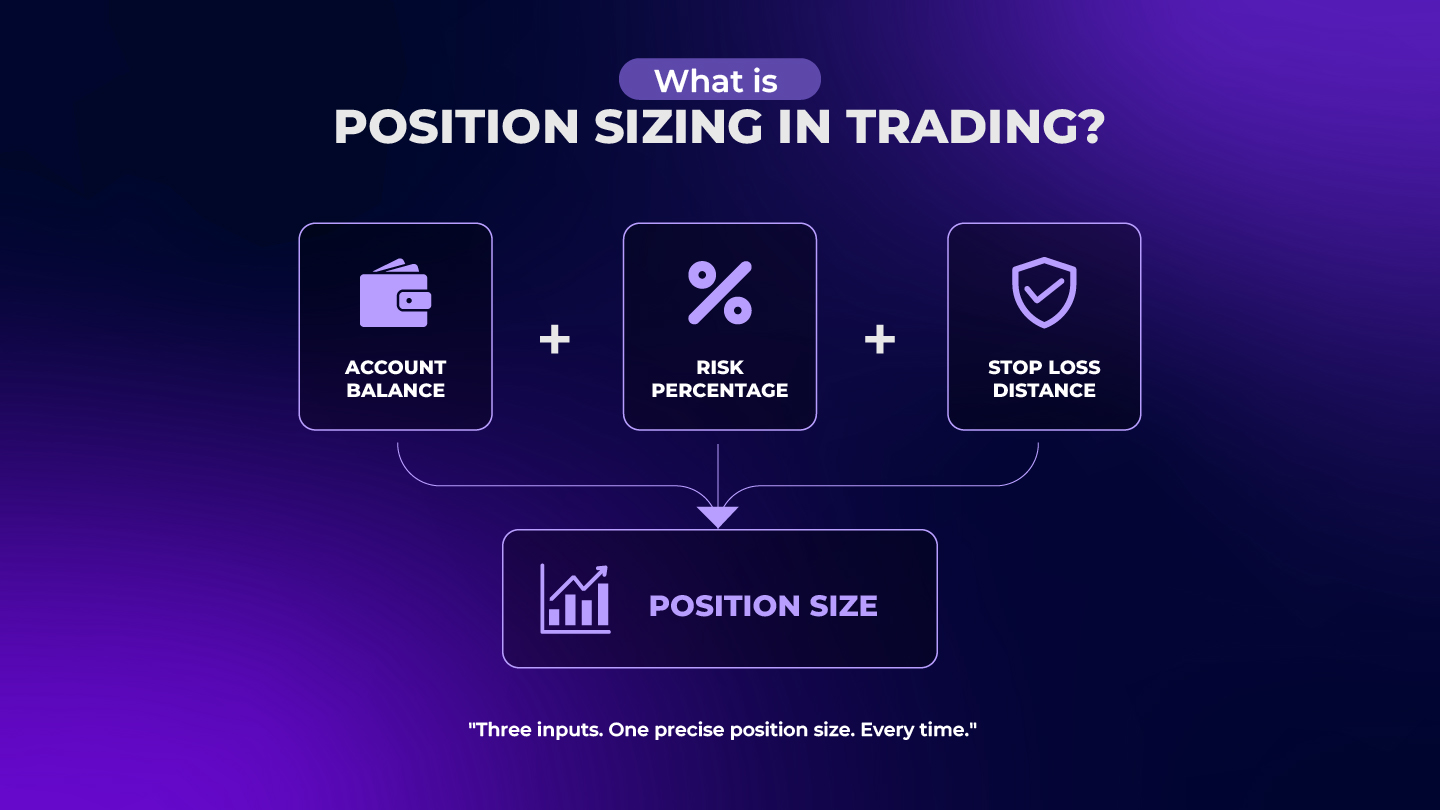
Position sizing involves three core inputs:
- Your account size (total capital available)
- Your risk percentage — the fixed percentage of your account you are willing to lose per trade
- Your stop-loss distance — the gap between your entry price and your stop-loss level
These three elements combine into a single formula that tells you exactly what your position size should always be — regardless of how the trade feels or how volatile the market is moving.
Why Position Sizing Matters
Effective position sizing is the foundation of sustainable trading. Here is why position sizing is important and why every trader must treat it as non-negotiable:
- It helps you manage risk on every single trade — not just in theory, but in practice
- It ensures one bad trade never destroys your account
- It allows you to control risk regardless of changing market conditions
- It removes emotion from trade execution by replacing guesswork with calculation
- It lets you optimize your risk and reward over time with consistency
Good position sizing is what separates traders who survive long-term from those who blow up after a single volatile session. Without it, even the best entry price and the tightest stop-loss cannot protect you from oversized losses.
Position sizing lets you trade based on rules rather than feelings — and that is precisely what prop firms and professional trading environments demand.
The Core Position Sizing Formula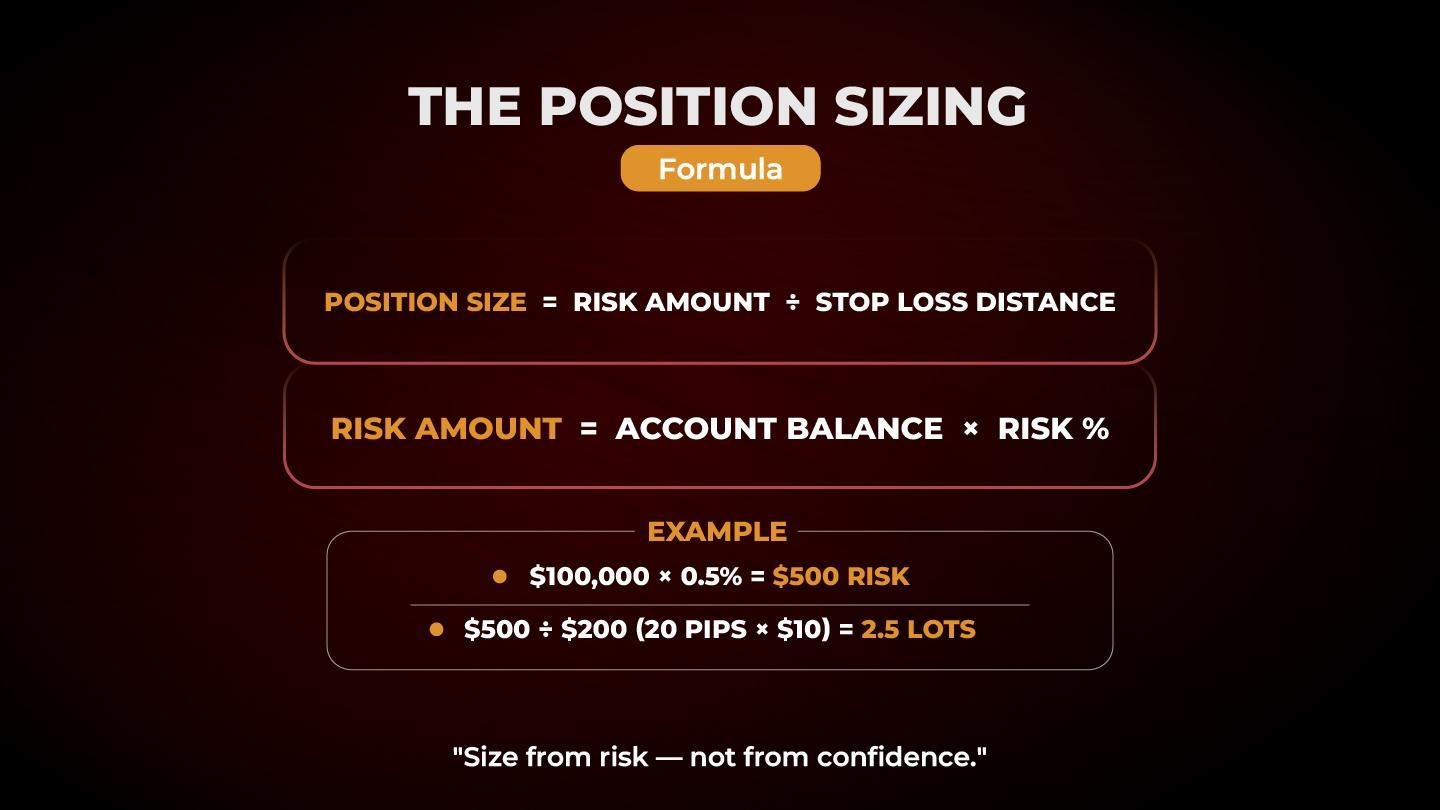
The universal formula used to calculate position size is straightforward. Proper position sizing always starts here:
Position Size = Risk Amount ÷ Stop Loss Distance
Where:
Risk Amount = Account Size × Risk Percentage
Stop Loss Distance = Entry Price − Stop-Loss Level
To calculate your position size, you divide the risk per trade by the risk per share, pip, or point — depending on the instrument. This is the process of determining the exact trade size based on your predefined rules.
Position size should always be calculated this way — before entering any trade. Never size based on a feeling or on how confident you are about a setup. Use a calculator if needed. Many trading platforms include built-in position size calculators to make this faster.
The right position size is not the biggest position you can take — it is the one that keeps your risk exactly where you have defined it.
Position Sizing Examples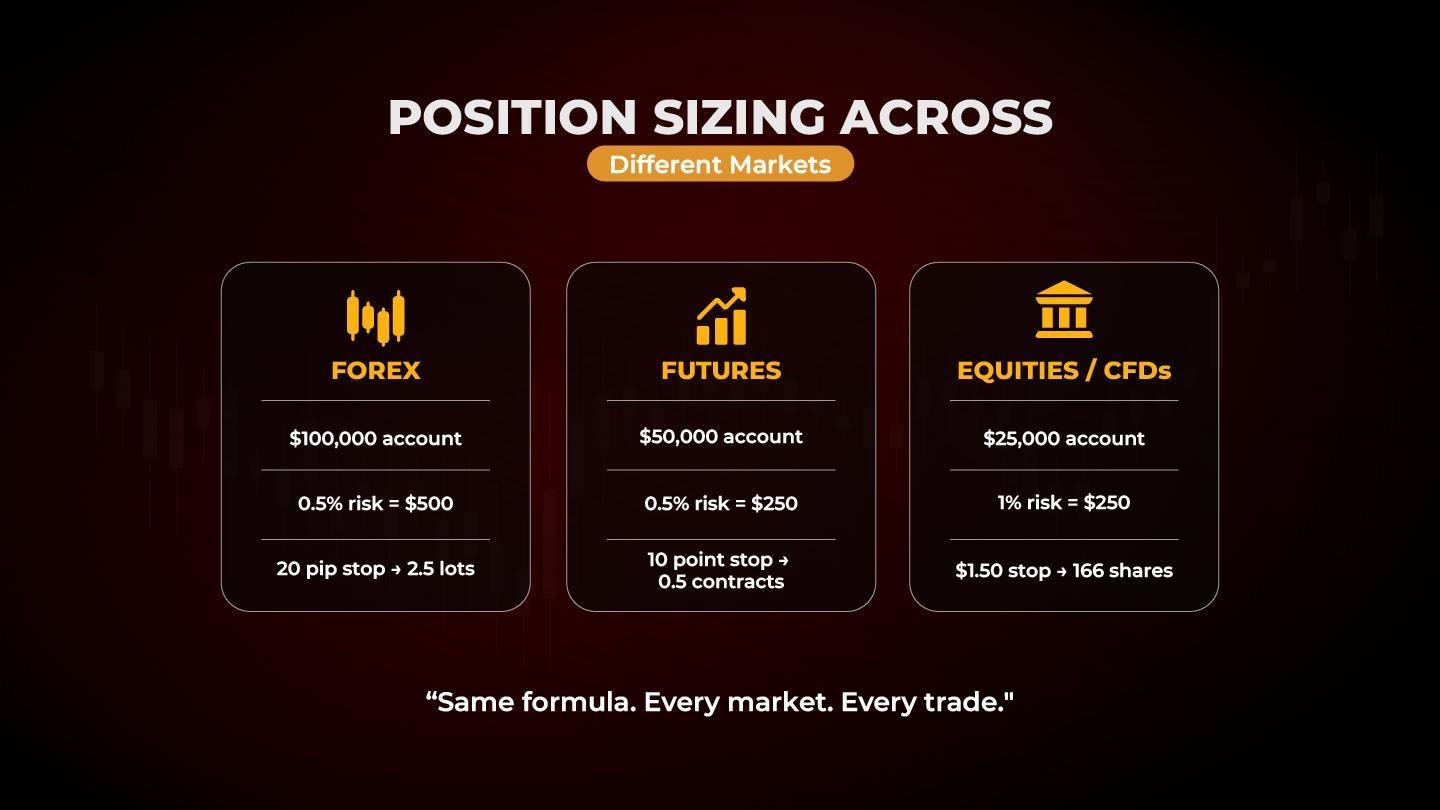
The basics of position sizing become clearest through real numbers. Below are three worked examples across different markets. The same formula applies in every case — only the variables change.
Example 1: Forex Trading
Let's calculate position size for a forex trade on a prop firm challenge account:
- Account size: $100,000
- Risk per trade: 0.5% (risk the same percentage on every trade)
- Stop-loss: 20 pips from entry price
- Pip value (standard lot size): $10 per pip
Step 1: Risk Amount = $100,000 × 0.5% = $500
Step 2: Divide the risk per trade by the risk per pip:
$500 ÷ (20 pips × $10) = $500 ÷ $200 = 2.5 lots
Result: You trade 2.5 standard lots. If the trade hits your stop-loss level, you lose exactly $500 — no more, no less. Your trading account survives, your plan stays intact, and you move on to the next setup. This is effective position sizing in action.
Example 2: Stock Trading
Now let's apply the same logic to a stock trade. Position sizing in stock trading is based on risk per share:
- Account size: $25,000
- Risk per trade: 1%
- Entry price: $50.00 per share
- Stop-loss level: $48.50 (distance = $1.50 risk per share)
Step 1: Risk Amount = $25,000 × 1% = $250
Step 2: Position Size = $250 ÷ $1.50 = 166 shares
You buy 166 shares. If the stock drops to your stop-loss, you exit with a loss of approximately $249 — exactly within your defined limit. You controlled risk precisely, and one bad trade did not impact your overall plan.
Example 3: Futures Trading
Futures position sizing follows the same process. Here we calculate position size based on account size and stop-loss distance in points:
- Account size: $50,000
- Risk per trade: 0.5%
- Stop-loss: 10 points from entry price
- Point value: $50 per contract
Step 1: Risk Amount = $50,000 × 0.5% = $250
Step 2: Trade size = $250 ÷ (10 × $50) = $250 ÷ $500 = 0.5 contracts
In this case, you would round down to 0 or wait for a tighter stop-loss setup that allows at least 1 contract within your risk limit. This is position sizing working as intended — it prevents you from taking a trade that is oversized for your current level and account size.
Common Position Sizing Strategies
There are several common position sizing strategies traders use depending on their style, risk tolerance, and trading account size. Understanding these helps you identify the right approach for your situation.
1. Fixed Percentage Risk
This is the most widely used method and the one recommended for prop firm challenges. You risk the same percentage of your account on every trade — typically between 0.25% and 1%. This fixed percentage approach means your trade size based on account balance adjusts naturally as your account grows or shrinks, making it a self-correcting system.
Good position sizing starts with a fixed percentage rule. It is simple, consistent, and easy to apply across changing market conditions.
2. Volatility-Based Sizing
This strategy adjusts position size based on the current volatility of the instrument. In more volatile markets, position size is reduced. In calmer conditions, it may be slightly increased. This approach is useful for traders who want to optimize their exposure relative to market conditions, but it requires more experience to implement correctly.
An adjusts-position-size-based-on-volatility approach can be powerful, but for most challenge traders, the fixed percentage method is more reliable and easier to manage.
3. Fixed Dollar Risk
Rather than using a percentage, some traders decide how much in dollar terms they are willing to lose per trade — for example, $200 per trade regardless of account size. This method is less adaptive than percentage-based sizing but can work well when combined with a clearly defined stop-loss level and consistent trade size.
Using a Position Size Calculator
Many traders, particularly in day trading and forex trading, use a position size calculator to speed up their pre-trade routine. These tools are built into most trading platforms or are freely available online.
To use a calculator, you input:
- Your account size
- Your risk percentage per trade
- Your entry price
- Your stop-loss level
The calculator then returns your optimal position size instantly. Position size calculators are particularly useful for traders managing multiple instruments or those who want to eliminate manual errors from their pre-trade process.
Whether you calculate manually or use a tool, the principle is the same: calculate your position size before entering any trade — every trade, without exception.
Why Position Sizing Is Critical for Prop Firm Challenges
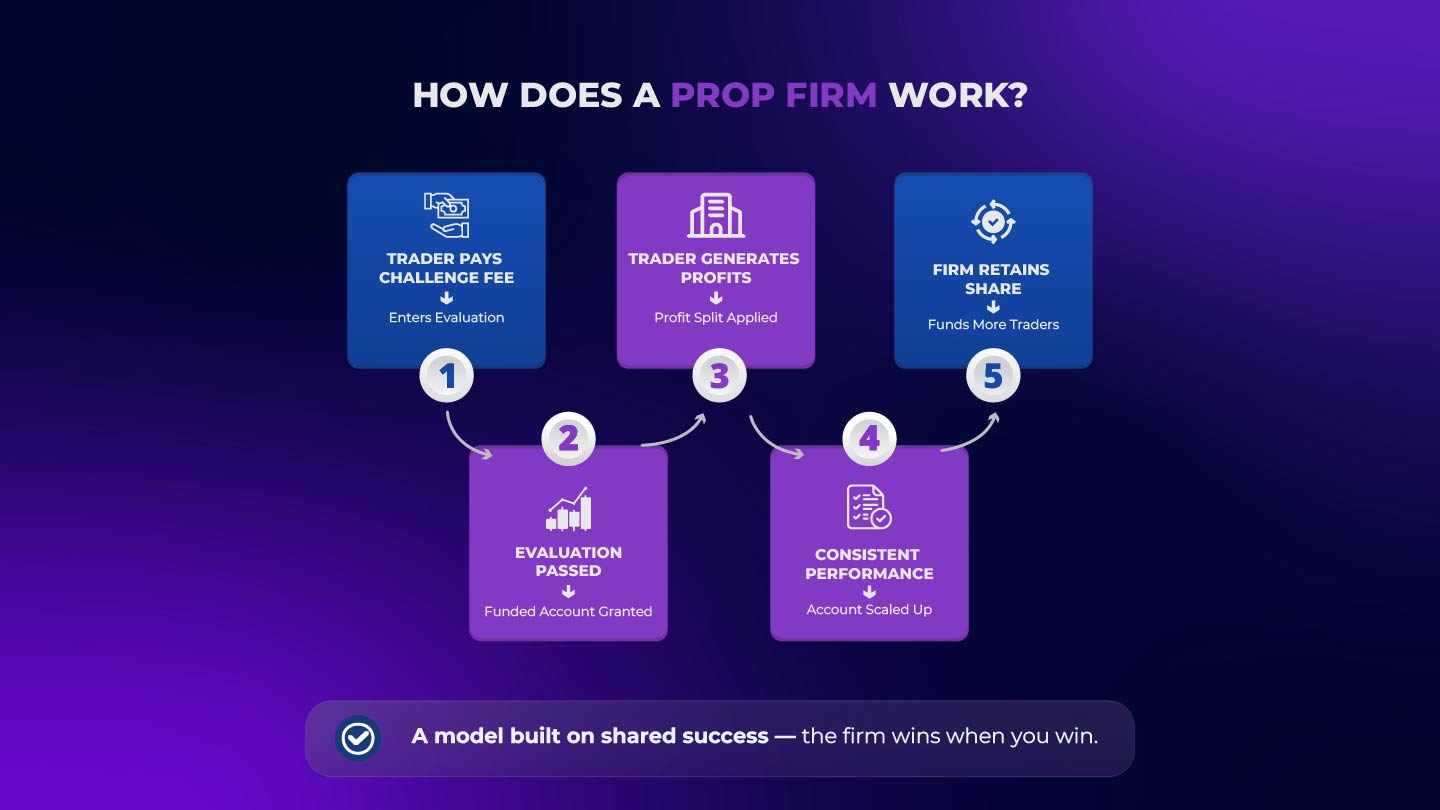
Prop firm evaluations are structured around two key limits: a maximum daily loss and a maximum overall drawdown. Violating either results in immediate disqualification. Proper position sizing is the single most effective way to ensure you never breach those limits by accident.
Here is why position sizing is important, specifically in a prop firm context:
- Prevents account blowouts: A single oversized trade on a volatile instrument can wipe out days of progress in one move
- Keeps losses predictable: When you know exactly what risk you take per trade, you can calculate how many losses you can absorb before hitting daily or overall limits
- Supports consistency: Consistent position sizing creates consistent results — which is exactly what evaluators are looking for
- Removes trading biases: When your size is pre-calculated, there is no temptation to adjust mid-trade based on fear, greed, or overconfidence
- Controls capital on any one trade: No single trade should ever be large enough to threaten your overall challenge progress
For example, if your prop firm has a 4% maximum drawdown limit and you risk 0.5% per trade, you can absorb up to 8 consecutive losses before reaching the limit. That buffer gives you room to trade without anxiety — and without reckless decisions. Position sizing is the foundation that makes this possible.
Choosing the Right Risk Percentage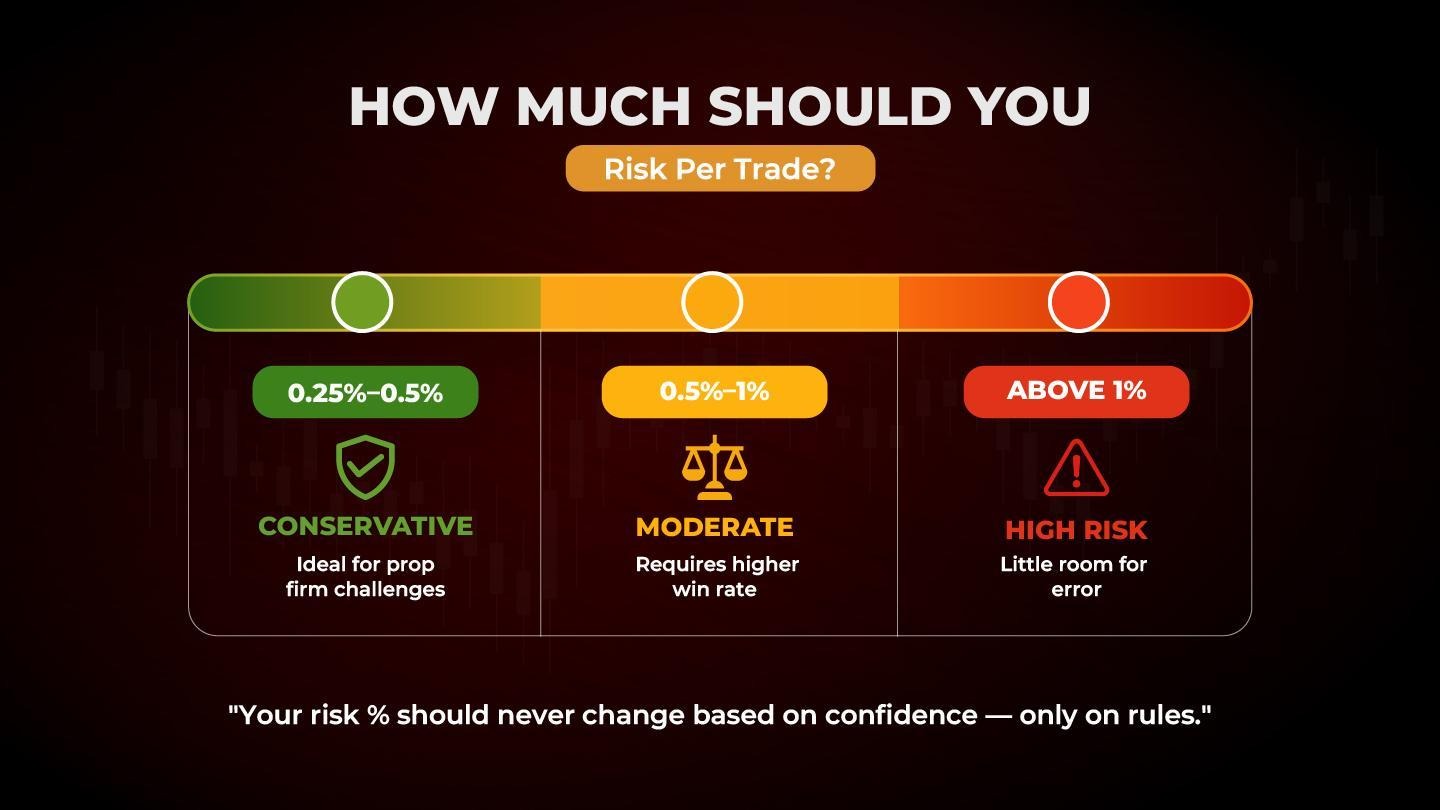
The risk percentage you select is a personal decision, but it should be grounded in the structure of your prop firm rules and your own trading history. Your risk tolerance is a real factor — but it must be balanced against the mathematical realities of drawdown limits.
General guidelines for determining the risk per trade:
- 0.25%–0.5%:
- Conservative — Ideal for most prop firm challenges. Gives you a large buffer and keeps losses manageable even during a losing streak.
- 0.5%–1%:
- Moderate — Still responsible, but requires a higher win rate to remain profitable over time.
- Above 1%:
- Higher risk — Can work for experienced traders with a proven edge, but leaves little room for error in a challenging environment.
The key principle: your risk percentage should never change based on how confident you feel about a particular setup. Confidence is not a calculation. Determining the risk per trade should always be formula-driven — never emotion-driven.
When traders risk the same percentage on every trade, their results become measurable, predictable, and improvable. This consistency is what separates professional traders from those chasing volatile, unpredictable outcomes.
Position Sizing in Day Trading
Day trading presents unique challenges when it comes to position sizing. In day trading, positions open and close within the same session — which means traders face multiple decisions about trade size based on fast-moving conditions.
Position sizing in day trading is important for several specific reasons:
- You may take more trades per session, meaning cumulative risk adds up quickly if each trade is oversized
- Market conditions can shift rapidly, making it tempting to adjust size based on momentum — a dangerous habit
- Intraday volatility means stop-loss distances can vary significantly from one trade to the next, making the formula even more important
For day traders, the rule is simple: calculate position size before the session begins for planned setups, and never take a trade without knowing your exact risk on a single trade. The trade will automatically close at your stop-loss — but only if you have sized it correctly in the first place.
Small your trade size when in doubt. In day trading, surviving to trade tomorrow is always more important than maximising returns today.
Common Position Sizing Mistakes to Avoid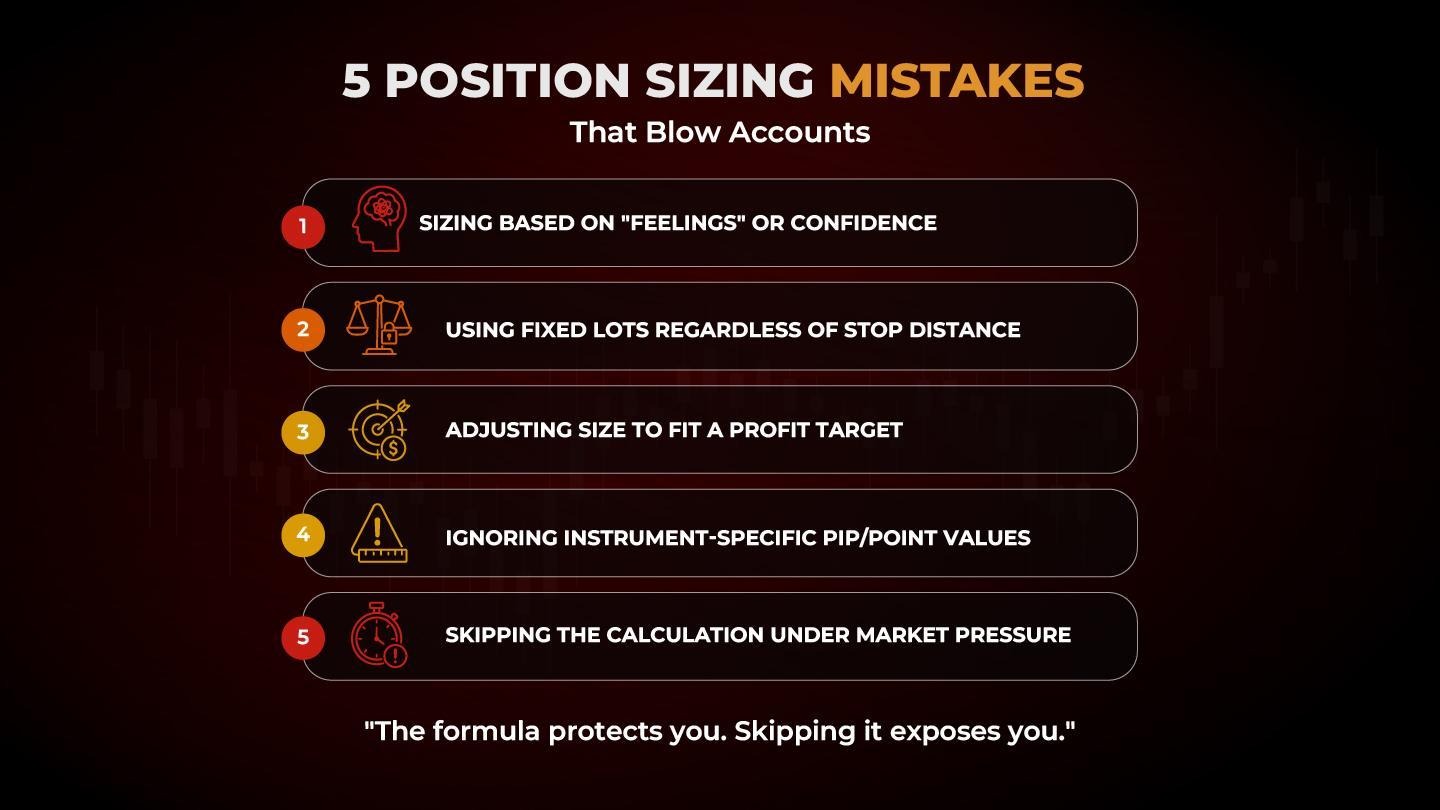
Understanding the basics of position sizing is not enough if you fall into these common traps. Here are the most frequent mistakes traders make:
1. Sizing Based on Feel Rather Than Formula
Many traders increase their position size after a winning streak because they feel confident, or reduce it in a panic after losses. Both reactions introduce trading biases that break the formula and create inconsistency. Traders risk compounding their problems by abandoning their system at exactly the wrong moment.
2. Ignoring the Stop-Loss Level When Sizing
Some traders use a fixed lot size regardless of where their stop-loss is placed. This means a tight stop creates a small risk, while a wide stop creates a massive one — all from the same position size. The formula exists to solve this problem. Trade size based on stop distance — always.
3. Adjusting Size to "Make It Work."
A classic mistake is finding a setup with a wide stop and then adjusting position size to fit a profit target rather than a risk limit. Always size your positions from risk first — not from potential returns. The right position is one that respects your risk rules, not one that chases a specific outcome.
4. Not Accounting for Instrument-Specific Variables
Pip values, point values, and lot sizes differ across instruments. A 20-pip stop on EUR/USD carries a very different dollar risk than a 20-pip stop on GBP/JPY. Always verify the pip or point value of the specific instrument before you calculate position size. Position size based on inaccurate values will produce inaccurate results.
5. Skipping the Calculation Under Pressure
When the market is moving, and you want to enter quickly, it is tempting to skip the sizing calculation and go with a round number. This is precisely when the formula matters most. Make position sizing part of your pre-trade routine — non-negotiable. Use a position size calculator if speed is an issue.
6. Not Adapting to Changing Market Conditions
While your risk percentage should remain fixed, you should be aware that changing market conditions can affect stop-loss distances, which in turn affects your trade size. A wider stop in a volatile market means a smaller position. A tighter stop in a calm market may allow a slightly larger one. The formula adjusts position size based on these inputs automatically — trust it.
Making Position Sizing Part of Your Trading Plan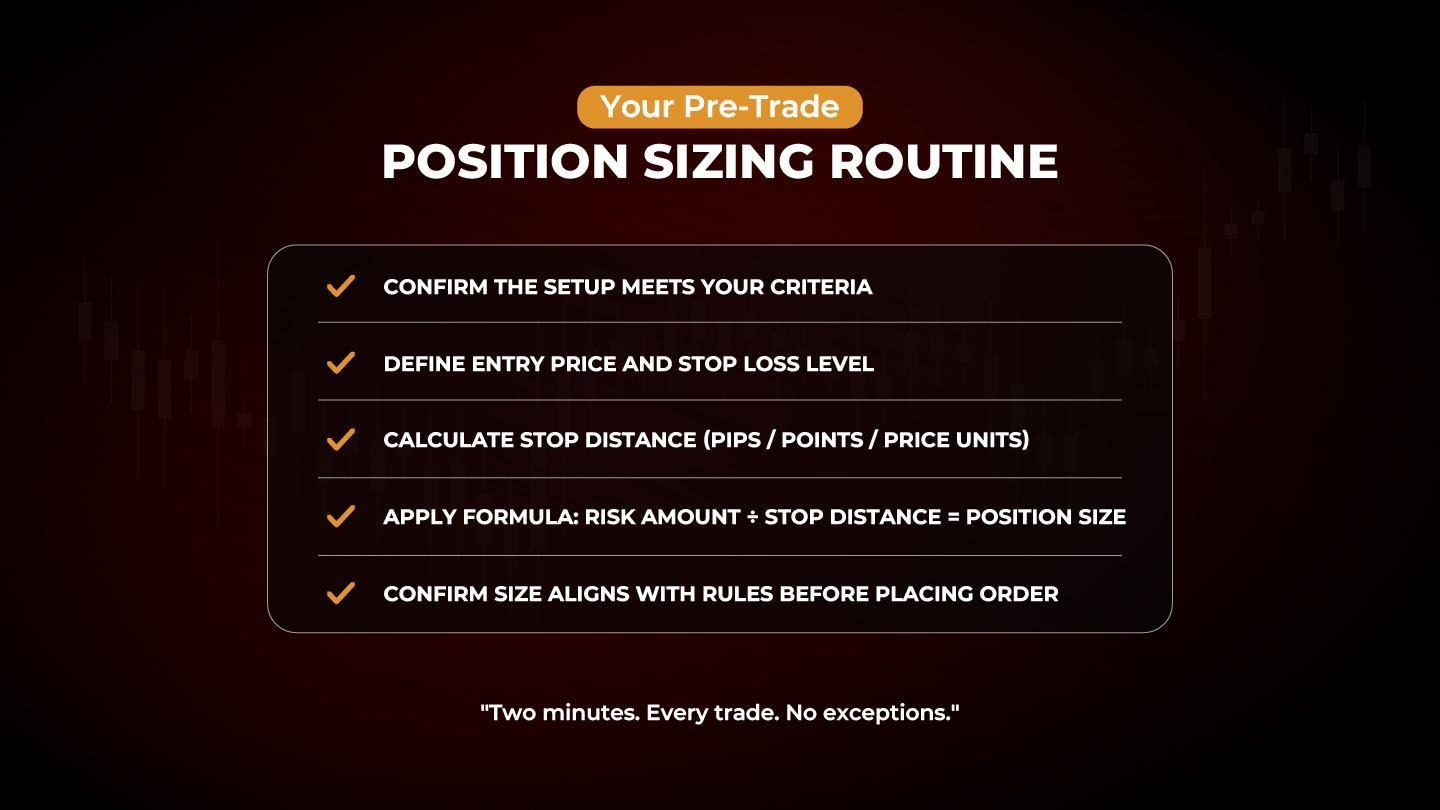
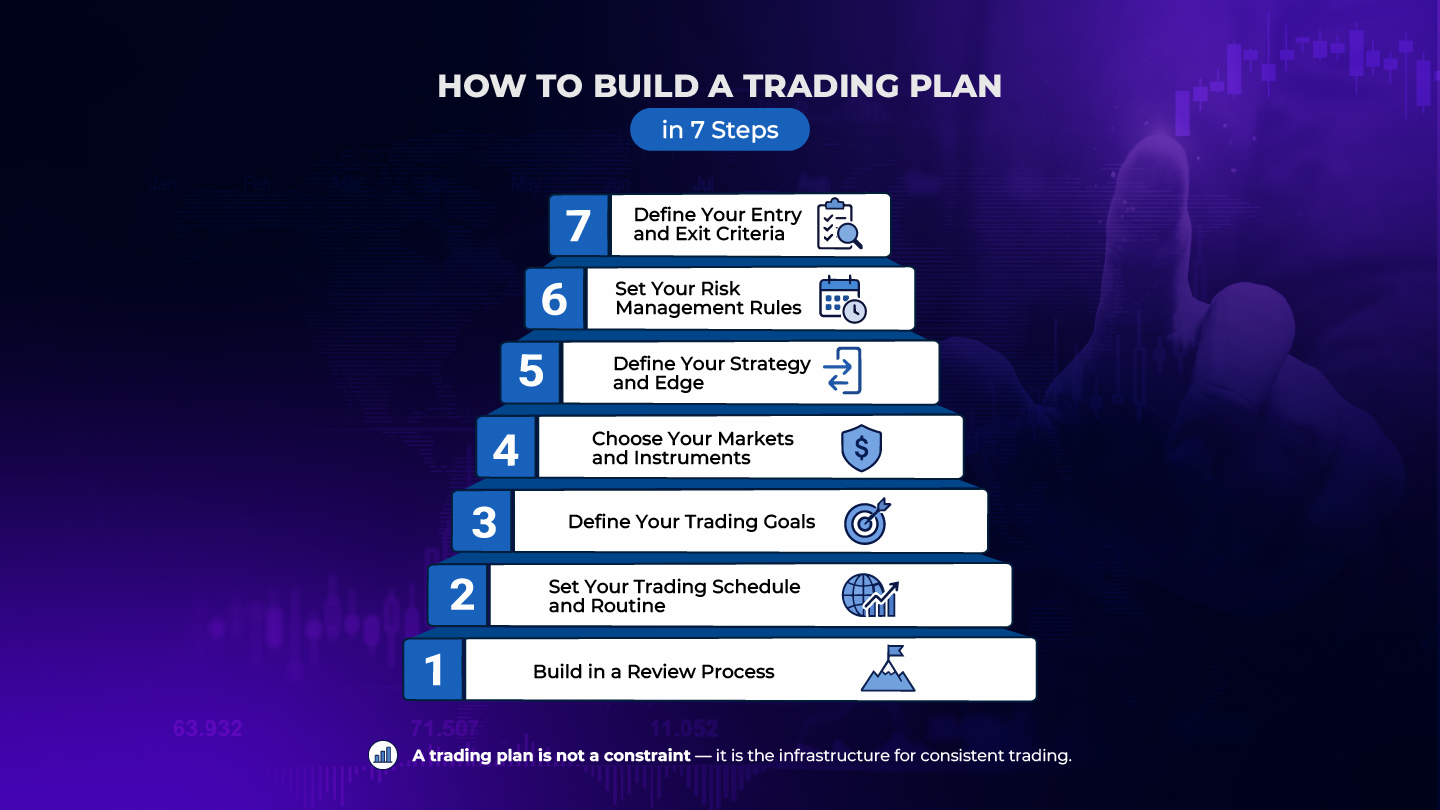
Position sizing is the foundation of any serious trading plan. It should not be an afterthought — it should be built into your pre-trade checklist and executed before every single entry, without exception.
A simple pre-trade routine to size your positions correctly:
- Identify the setup and confirm it meets your trading strategy criteria
- Define your entry price and stop-loss level
- Calculate the stop-loss distance in pips, points, or price units
- Apply the formula: Risk Amount ÷ Stop Distance = Position Size
- Use a calculator or a trading platform tool to verify the result
- Confirm the position size aligns with your risk rules before placing the order
This process takes less than two minutes. Over time, it becomes automatic. Effective position sizing becomes second nature — and it is one of the clearest separators between traders who survive long-term and those who do not.
Behind position sizing is a simple truth: it is not about predicting the market. It is about controlling what you can control — and the amount you risk on a single trade is always within your control.
Position Sizing and Long-Term Consistency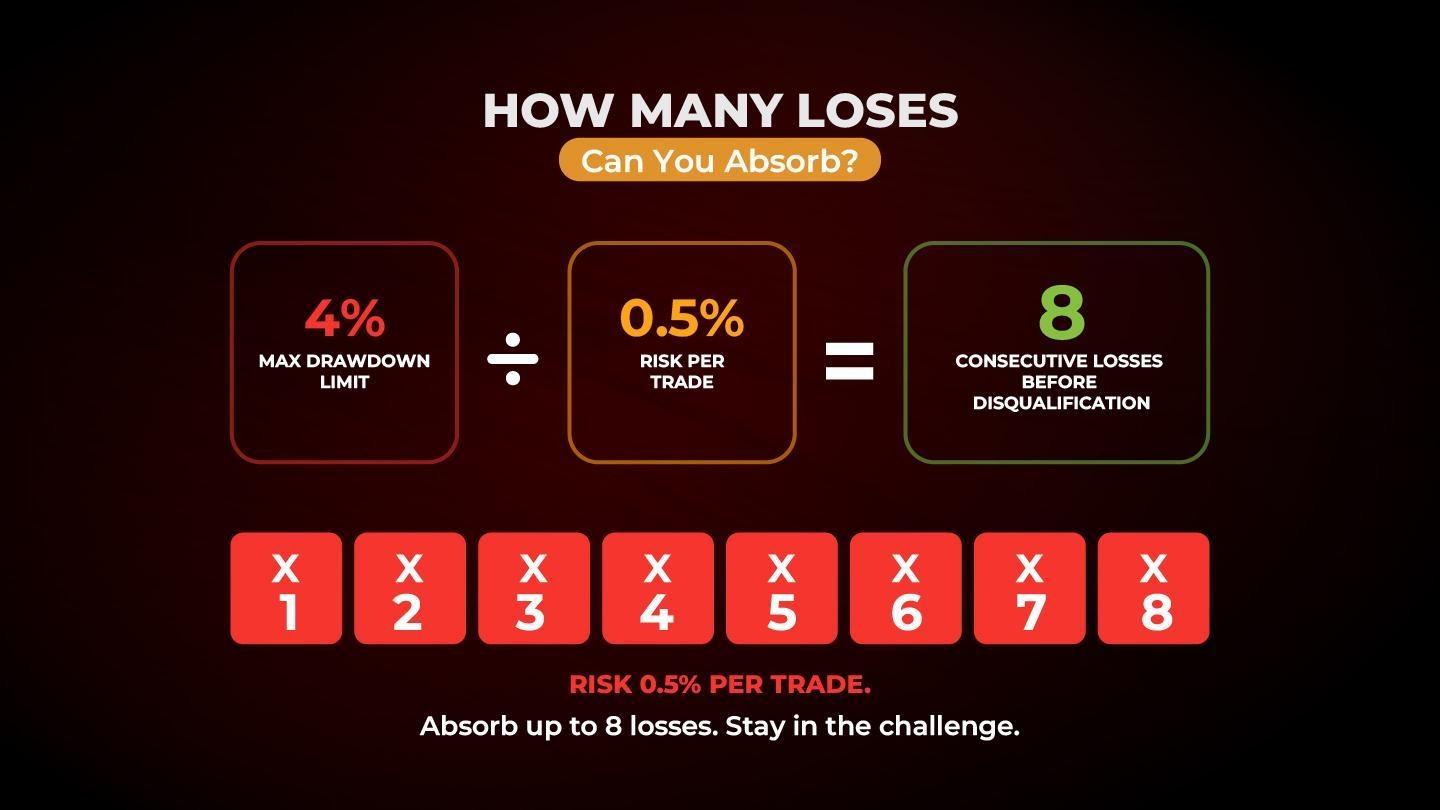
One of the most overlooked benefits of disciplined position sizing is its effect on psychological consistency. When your risk per trade is fixed and pre-calculated, each loss feels the same — manageable, expected, and part of the process. There are no catastrophic outliers. There are no trades that wipe out a week of progress.
This predictability has a direct impact on your decision-making. Traders who size correctly:
- Are less likely to revenge trade after a loss
- Are less likely to hold losers too long to avoid a calculated loss
- Are more likely to follow their trading strategy without emotional interference
- Are better positioned to optimize potential returns steadily over time
- Can evaluate their performance accurately because their trade risk is consistent across all setups
Position sizing helps you think clearly. When you know that the worst case on any single trade is a small, pre-defined percentage of your account, fear loses its grip. You execute. You follow the plan. You move on.
Consistency in position sizing creates consistency in results. And consistency in results is exactly what prop firms are evaluating — and what separates long-term profitable traders from the rest.
Frequently Asked Questions
What is position sizing in trading?
Position sizing is the process of determining how many units, shares, lots, or contracts to trade on a single position. It is calculated using your account size, risk percentage, and stop-loss distance — and it ensures that the amount you risk on a single trade is always controlled and predefined.
Why is position sizing important?
Position sizing is important because it is the primary tool you have to manage risk on every trade. Without it, one bad trade can wipe out significant capital. With proper position sizing, losses are predictable and manageable — and your account survives to trade another day.
What is the best position size for a prop firm challenge?
There is no single answer, but 0.25%–0.5% risk per trade is widely considered appropriate for most challenge structures. It gives you enough buffer to absorb losing streaks without breaching drawdown limits. Good position sizing at this level keeps you in the challenge even through difficult market conditions.
Should I use the same position size on every trade?
Not necessarily the same lot size — but always the same risk percentage. Because stop-loss distances vary by setup, your actual trade size based on stop distance will adjust accordingly. The risk amount stays fixed. This is how you risk the same percentage on every trade without using a rigid lot size.
Can I use a position size calculator?
Absolutely. Position size calculators are useful for traders at all levels. Most trading platforms include one, or you can find free calculators online. They speed up the pre-trade process and eliminate manual calculation errors. Whether you use a calculator or calculate manually, always determine your position size before entering any trade.
Does position sizing guarantee I won't lose?
No. Position sizing does not prevent losses — it controls them. You will still have losing trades. What effective position sizing ensures is that no single loss or series of losses destroys your account or your challenge. It is about survival and consistency, not elimination of risk.
Can I increase my position size as my account grows?
Yes — and this is one of the advantages of percentage-based sizing. As your account balance increases, the same risk percentage produces a larger dollar amount, which naturally scales your position size upward. This is how proper position sizing lets you grow without changing your risk framework.
Final Thoughts
Position sizing is the foundation of consistent, professional trading. It is not a complex concept — but it is one that many traders consistently overlook or apply inconsistently.
The formula is simple:
Position Size = Risk Amount ÷ Stop Loss Distance
Risk Amount = Account Size × Risk Percentage
The discipline is in applying it every single time — before entering any trade, without shortcuts, and without adjustments based on confidence or market pressure.
Position sizing is vital. It is what allows you to manage risk, control your exposure, survive losing streaks, and compound your gains over time. Whether you are in day trading, forex trading, or trading stocks and futures, the process of determining how much of your account to risk on a single trade is always the same.
Size your positions correctly. Protect your capital. Stay in the game.
Apply disciplined position sizing in a professional trading environment — join 4PropTrader’s funded trader program and manage real capital with structured risk rules.